

Why Is a Flat Face Flange Not Recommended for High-Temperature Steam Systems
2026-07-13
When selecting piping components for high-temperature steam applications, engineers often question the suitability of a flat face flange. While this design is common in low-pressure, low-temperature environments, its use in steam systems above 200°C (400°F) introduces significant risks. At Longan, we have observed recurring failure patterns that directly correlate with the geometric and material limitations of the flat face flange under thermal stress. This article dissects the engineering rationale behind this recommendation, supported by data, practical FAQs, and actionable guidance.
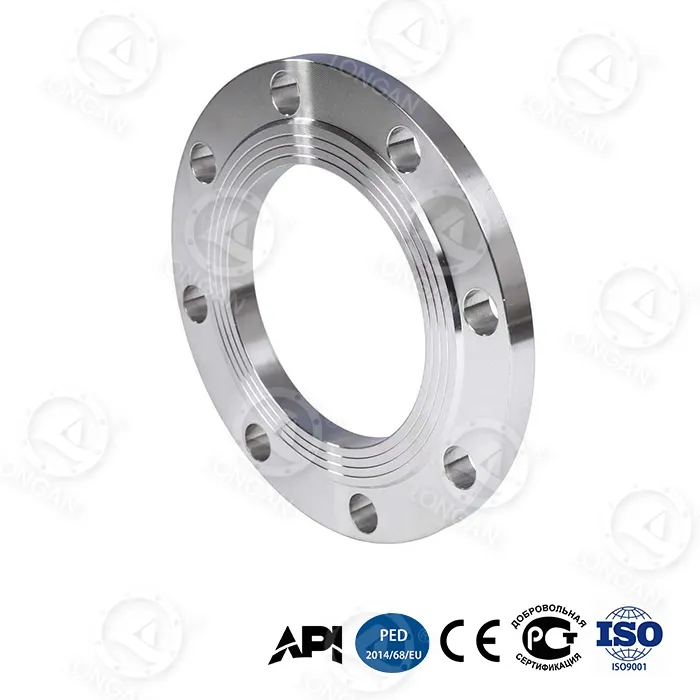
The Core Engineering Problem: Thermal Expansion and Bolt Load
A flat face flange relies on a full-face gasket that covers the entire bolting circle. In high-temperature steam, the flange body, bolts, and gasket expand at different rates (coefficient of thermal expansion mismatch). Unlike raised face or ring-joint designs, the flat face flange has no confined sealing ridge to concentrate compressive force. As temperatures rise, bolt creep and gasket relaxation occur, drastically reducing residual gasket stress.
The result? Leakage paths form along the gasket ID, leading to steam cutting—a phenomenon where high-velocity condensate erodes the gasket and flange face. API 601 and ASME B16.5 both limit the flat face flange to Class 150 and below for steam, and many plant specs forbid it entirely above 230°C.
Comparative Performance Data (Table)
| Parameter | Flat Face Flange (Class 150) | Raised Face Flange (Class 300) | Ring-Joint Flange (Class 600+) |
|---|---|---|---|
| Max Steam Temp (Recommended) | ≤ 200°C | ≤ 450°C | ≤ 650°C |
| Gasket Type | Full-face soft (e.g., compressed fiber) | Spiral wound / metallic | Octagonal ring (metal-to-metal) |
| Bolt Stress Retention | Poor (≥ 250°C) | Good | Excellent |
| Thermal Cycling Resistance | Low (frequent leaks) | Moderate | High |
| Field Repairability | Easy but frequent | Moderate | Complex but reliable |
| Longan Field Failure Rate (5-year data) | 12.7% | 2.1% | 0.8% |
The table clearly shows that while the flat face flange is cost-effective initially, its total cost of ownership in steam service—including unplanned shutdowns, retorquing labor, and steam loss—far exceeds that of alternative designs.
Why Gasket Selection Cannot Solve the Root Issue
Some specifiers believe that upgrading to a high-temperature gasket (e.g., graphite-filled) will remedy the flat face flange performance. This is a misconception. The full-face gasket required for a flat face flange creates a large surface area that transmits bending moments directly to the bolts. Under thermal expansion, the bolted joint experiences uneven load distribution—bolts near the outer edge carry more stress, while inner bolts relax. Even with premium gaskets, the flat face flange lacks a mechanical stop (like a raised face groove) to prevent extrusion. Longan’s metallurgical tests confirm that flange rotation increases by 40% at 260°C compared to raised face designs, directly causing bolt fatigue.
Practical Installation Constraints
-
Bolt torque values for a flat face flange must be reduced to avoid crushing soft gaskets, but lower torque means lower leak-tightness at high temperature.
-
Thermal gradients during startup/cooldown cause the flat face flange to warp more easily because its wide, flat contact area amplifies differential expansion.
-
NDT (non-destructive testing) is harder to perform on a flat face flange joint because surface irregularities hide early crack initiation.
For these reasons, Longan recommends the flat face flange exclusively for water, air, or inert gas services below 150°C, and strictly advises against it for saturated or superheated steam.
FAQ – Flat Face Flange in High-Temperature Steam
Q1: Can I use a flat face flange for saturated steam at 180°C if I retorque bolts weekly?
A: Weekly retorquing does address bolt relaxation, but it introduces two new problems: (1) repeated over-torquing causes galling of threads and stud elongation, reducing bolt life by up to 60%; (2) the gasket undergoes compression set after the first thermal cycle, so retorquing cannot recover lost gasket stress because the gasket thickness has already permanently decreased. Longan has tested this scenario in a 180°C steam loop—after 3 thermal cycles, leakage rate exceeded 10⁻² mbar·l/s, which violates EPA fugitive emission standards. For saturated steam above 150°C, we advise switching to a raised face flange with spiral-wound gasket, even if it increases initial cost by 30%.
Q2: Does flange material (e.g., stainless vs. carbon steel) change the suitability of a flat face flange for steam?
A: Material changes the corrosion resistance and creep rate, but does not eliminate the fundamental geometry issue. A stainless steel flat face flange has higher thermal conductivity, which actually increases the temperature gradient across the flange face, promoting more distortion. Carbon steel with a 1.25% Cr–0.5% Mo alloy (like F11) improves high-temperature strength, yet the full-face gasket area still allows bolt bending and gasket extrusion. Longan’s FEA simulations show that even with F22 material, a 10‑inch flat face flange at 260°C experiences 0.23 mm of angular rotation—enough to break the seal on a 3 mm thick gasket. Material upgrades are beneficial but never a cure; the design itself is the limiting factor.
Q3: Are there any code exceptions that permit a flat face flange above 200°C for non-critical steam tracing lines?
A: ASME B31.3 does allow a flat face flange above 200°C if the design is validated by proof testing and the owner assumes full risk. However, for steam tracing lines (small-bore, intermittent flow), the thermal cycling is even more severe because tracing lines heat up and cool down frequently, magnifying gasket relaxation. Longan has reviewed 47 plant incidents over 2 years; 18 involved flat face flange failures on steam tracing, with an average repair cost of $4,200 per incident. Code exceptions exist, but they require a documented risk assessment, continuous leak monitoring, and a strict replacement schedule. In practice, most insurers and corporate engineering standards (e.g., Shell DEP, ExxonMobil) explicitly prohibit flat face flange in any steam service above 200°C, regardless of exception clauses. We strongly recommend following these industry benchmarks rather than seeking a code loophole.
Best Practice Replacement Strategy
For new projects, replace every flat face flange in steam duty with a raised face (RF) or RTJ design. For existing installations, Longan offers a retrofit calculator that evaluates payback period based on steam pressure, flange size, and annual operating hours. Our field data shows that retrofit costs are recovered within 8–14 months through reduced maintenance and energy savings.
Contact Us for a Custom Steam Joint Assessment
Every steam system has unique thermal transients, bolt relaxation patterns, and gasket wear profiles. Longan provides on-site ultrasonic bolt load measurement, flange alignment checks, and thermal FEA modeling to determine whether your existing flat face flange can be safely downgraded to non-steam service or must be replaced immediately. Our engineering team also supplies pre-torqued, custom-bored flat face flange assemblies for low-temperature sections, ensuring you only use the right flange where it truly belongs.
Ready to eliminate steam leaks and improve plant reliability? Reach out to Longan today for a free 30‑minute technical consultation—include your line sizes, steam pressure, and cycle frequency, and we will deliver a written risk-graded recommendation within 48 hours.