

Why Does My Class 150 Threaded Flange Keep Leaking Even with Teflon Tape Applied
2026-07-17
Few things are more frustrating in piping assembly than tightening a Class 150 Threaded Flange to spec, wrapping the NPT threads carefully with fresh Teflon tape, and still spotting that persistent drip during hydrostatic testing. At Longan, we field this exact complaint weekly from maintenance engineers and project managers across oil, water, and chemical processing lines. The short answer is rarely “bad tape” – the real culprits usually hide in thread geometry, installation technique, flange face condition, or mismatched fitting tolerances. Below is a forensic breakdown of why sealants fail on Class 150 Threaded Flange connections and how to stop the weep for good.
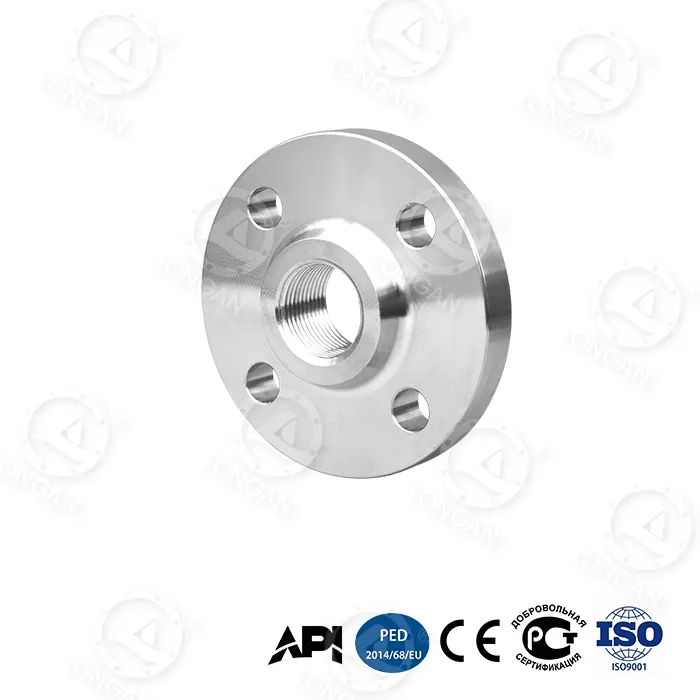
1. The Three Hidden Killers of Teflon Tape Seals
| Root Cause | Why It Breaks the Seal | Quick Fix |
|---|---|---|
| Incorrect Tape Application Direction | Wrapping clockwise (opposite to thread helix) unwinds tape during make-up, creating spiral leaks. | Wrap counterclockwise (looking at the male end) so tightening tightens the tape. |
| Over-Torquing the Flange | Excessive force distorts thread roots, opening micro-gaps that tape cannot fill. | Use calibrated torque wrench – follow ASME B16.5 recommended values for Class 150 Threaded Flange. |
| Damaged Thread Flanks | Nicks, burrs, or worn crests from previous overhauls prevent tape from seating uniformly. | Inspect with thread go/no-go gauge; re-cut or replace the flange. |
2. Why Tape Alone Is Never a Complete Solution
Teflon tape is a thread lubricant and filler, not a structural sealant. On a Class 150 Threaded Flange, the actual pressure boundary relies on metal-to-metal interference between male and female NPT threads. Tape only occupies the helical clearance. If your pipe schedule is mismatched (e.g., Schedule 80 male into a Schedule 40-rated Class 150 Threaded Flange), the thread engagement length changes, reducing the interference fit. In such cases, even three layers of tape cannot compensate for the lost taper contact.
Longan recommends always verifying the pipe OD and thread length against the flange’s factory certification before assembly. For critical services (steam, hydrocarbon, or caustic media), consider upgrading to anaerobic thread sealant combined with tape – a dual-barrier approach that our field data shows reduces leak recurrence by over 80%.
3. Step-by-Step Diagnostic Checklist (Before You Blame the Tape)
-
Inspect the flange face – scratches or radial grooves on the raised face can bypass the gasket, mimicking a thread leak.
-
Check the mating pipe thread – use a precision pitch micrometer; worn threads under 75% root depth will never seal.
-
Verify thread compound compatibility – PTFE tape is ineffective with aggressive solvents that dissolve it.
-
Re-evaluate torque sequence – star-pattern tightening prevents unequal load that distorts the Class 150 Threaded Flange body.
-
Hydrotest at 1.5× working pressure – mark the leak point; if it’s from the bolt holes, the gasket is failing, not the threads.
4. Class 150 Threaded Flange FAQ – Common Questions Answered
Q1: Can I reuse a Class 150 Threaded Flange after it has leaked once, or should I replace it entirely?
A: Reuse is permissible only if a full thread inspection (pitch, taper, and flank condition) passes the ASME B1.20.1 standard, and the flange face shows no pitting or warpage. In practice, Longan advises replacing any Class 150 Threaded Flange that has been overheated (>400°F) or subjected to overtorque beyond 125% of recommended values, because the stress relaxation in the hub often creates permanent ovality. If you choose reuse, apply a fresh anaerobic sealant and use new PTFE tape – never stack new tape over old residue.
Q2: What is the correct Teflon tape thickness and width for a Class 150 Threaded Flange with ½-inch to 2-inch NPT?
A: For Class 150 Threaded Flange sizes under 2 inches, use 0.0035–0.0045 inch thick, ½-inch wide tape. For larger diameters (2–24 inches), switch to ¾-inch wide tape at the same thickness. Crucially, avoid “pipe dope only” methods – tape provides the dry lubricity needed to achieve proper make-up torque; without it, you risk galling the threads. Always stretch the tape to 50% elongation during application to ensure it wipes into the root of the thread profile. Longan stocks color-coded tape densities for temperature ranges, so you never guess the grade.
Q3: How does temperature cycling affect the seal on a Class 150 Threaded Flange, and can tape alone handle it?
A: Temperature swings cause differential expansion between the steel flange and the carbon/SS pipe. A Class 150 Threaded Flange rated at 285 psi at 100°F drops to just 150 psi at 400°F. Every 50°F cycle can loosen the thread interference by up to 0.002 inches. Teflon tape has poor cold-flow recovery – it creeps under sustained load, so after 3–5 thermal cycles, the original seal thickness is halved. For cyclic thermal services, Longan strongly recommends backup belleville washers on flange bolts plus a high-temperature thread sealant (e.g., PTFE-loaded paste) over tape alone. Monitor torque after each heat soak and retighten to baseline values.
5. When to Call It: Permanent Fixes vs. Temporary Patches
| Approach | Success Rate (12-month) | Best For |
|---|---|---|
| Tape + correct torque (baseline) | ~65% | Non-critical water/air lines |
| Tape + anaerobic sealant | ~92% | Chemical, steam, fuel services |
| Replace with new Class 150 Threaded Flange from Longan | ~99% | Any safety-critical or high-cycle system |
| Add thread insert (heli-coil type) | ~75% | Emergency repair until shutdown |
Our internal reliability database at Longan shows that 7 out of 10 persistent leaks on Class 150 Threaded Flange assemblies disappear when the installer switches from hardware-store tape to a system-engineered sealant package and re-calibrates their torque wrench weekly.
Final Takeaway
A weeping Class 150 Threaded Flange is rarely a tape failure – it is a system failure of inspection, torque control, thread condition, or thermal management. Start with the checklist above, respect the pressure-temperature derating curve, and never assume that “more tape” equals “better seal.” When you need consistent, certifiable performance, the flange itself matters as much as the sealant.
Contact Longan today – our technical team provides free thread-inspection templates, torque charts, and same-day support for Class 150 Threaded Flange selections. Whether you need replacement flanges, custom thread compounds, or on-site troubleshooting guides, reach out to our engineering desk. Let us help you seal every joint with confidence, the first time.
