

Why Are Copper Semi Hollow Rivets a Reliable Fastening Solution for Precision Assembly?
2026-11-20
Article Summary
Copper semi hollow rivets are widely considered for fastening applications that require reliable mechanical connections, electrical conductivity, thermal performance, and convenient installation. Their partially hollow shank reduces the amount of material that must be deformed during riveting, making them easier to set than comparable solid rivets while maintaining a permanent joint.
For manufacturers and industrial buyers, selecting the right rivet involves more than choosing a diameter and length. Copper grade, head style, shank dimensions, hollow depth, material compatibility, installation equipment, and working environment all influence the final connection quality. This guide explores why copper semi hollow rivets are valuable, how they work, where they are used, and how to select and install them correctly. It also explains common fastening problems and the factors buyers should evaluate when working with a professional rivet manufacturer such as Nuote Metals Technology Co.,Ltd.
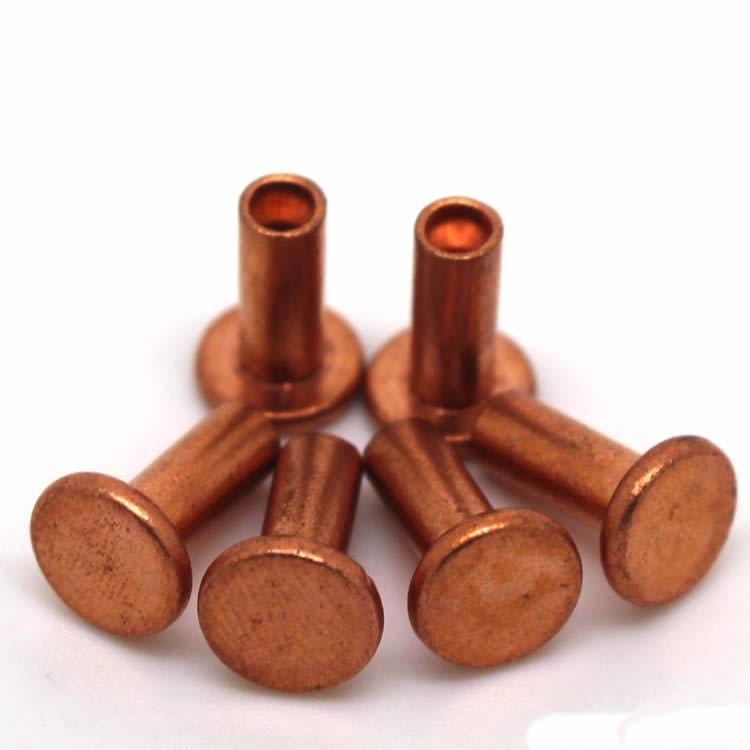
1. What Are Copper Semi Hollow Rivets?
Copper semi hollow rivets are permanent mechanical fasteners manufactured with a solid head and a partially hollow shank. The hollow section is usually formed at the tail end of the rivet, leaving part of the shank solid to provide structural support.
During installation, the rivet is inserted through aligned holes in the materials being joined. A suitable punch and anvil then apply controlled pressure to the hollow end, causing it to expand or roll outward. This deformation creates a secondary head that locks the connected components together.
Compared with solid rivets, the partially hollow construction requires less material deformation during setting. This can reduce installation force, simplify tooling requirements, and improve production efficiency in applications where large quantities of fasteners are used.
Copper adds another important dimension to this design. Unlike ordinary steel fasteners, copper rivets offer excellent electrical and thermal conductivity, along with good corrosion resistance in many environments.
How Are They Different from Fully Hollow Rivets?
A semi hollow rivet contains a partial cavity at the tail, whereas a fully tubular rivet has a hollow shank extending through most or all of its length. The semi hollow design retains more material in the shank, making it suitable for applications that need a balance between fastening strength and relatively low installation force.
The appropriate design depends on the thickness of the materials, required joint strength, available installation equipment, and expected service conditions.
2. Why Is Copper a Suitable Material for Semi Hollow Rivets?
The choice of fastener material affects much more than appearance. It determines electrical performance, heat transfer, corrosion behavior, mechanical characteristics, and compatibility with the materials being joined.
Copper is particularly useful in applications where a fastener must perform additional functions beyond simply holding components together.
2.1 Excellent Electrical Conductivity
Copper is one of the most conductive commonly used engineering metals. High-purity copper such as C11000 electrolytic tough pitch copper has a nominal electrical conductivity of approximately 100% IACS under standard reference conditions.
This property makes copper semi hollow rivets useful for selected electrical assemblies, including terminals, grounding connections, electrical contacts, and conductive components.
In applications where the rivet participates in the electrical current path, joint design remains essential. Contact pressure, surface condition, oxidation, current loading, and temperature rise must all be evaluated to ensure safe electrical performance.
2.2 High Thermal Conductivity
Copper also transfers heat efficiently. Its thermal conductivity is approximately 401 W/m·K for high-conductivity copper under commonly referenced conditions.
This makes copper fasteners useful in certain heat transfer assemblies, including heat sink structures and thermal management components. A copper rivet can provide mechanical attachment while also contributing to the thermal path between connected parts.
2.3 Good Corrosion Resistance
Copper naturally develops a surface oxide or patina when exposed to environmental conditions. This layer can provide some protection against further corrosion in suitable environments.
Unlike ordinary carbon steel, copper does not develop conventional iron rust. This makes it a useful material for outdoor hardware, selected marine components, roofing assemblies, and other applications where atmospheric exposure is expected.
However, copper is not immune to corrosion. Chemical exposure, chloride concentration, acidic conditions, and contact with dissimilar metals can affect its service life.
2.4 Natural Antimicrobial Properties
Copper surfaces have demonstrated antimicrobial activity under specific laboratory conditions. This property can be relevant in selected high-touch hardware and equipment designs.
However, antimicrobial performance depends on copper composition, surface condition, contact time, and environmental conditions. A copper rivet should not automatically be treated as a substitute for validated hygiene or infection-control measures.
| Copper Property | Typical Reference Value | Potential Benefit |
|---|---|---|
| Electrical Conductivity | Approximately 100% IACS for C11000 | Conductive electrical connections |
| Thermal Conductivity | Approximately 401 W/m·K | Heat transfer applications |
| Corrosion Behavior | Protective surface patina can develop | Suitable outdoor applications |
| Mechanical Character | Ductile and readily deformable | Controlled riveting and forming |
| Surface Properties | Natural antimicrobial activity under specific conditions | Selected hygiene-related applications |
3. How Does the Semi Hollow Rivet Structure Work?
The semi hollow structure is designed to make the installation process more efficient without removing too much material from the shank.
The Main Structural Elements
- Rivet Head: The preformed head provides a bearing surface and helps prevent the rivet from passing through the installation hole.
- Solid Shank Section: The solid portion provides material continuity and contributes to the mechanical performance of the joint.
- Hollow Tail: The partial cavity reduces the amount of copper that must be deformed during installation.
- Rolled Secondary Head: The hollow tail expands outward during setting to secure the assembled components.
Understanding the Riveting Process
- Material preparation: The components are positioned and aligned, and suitable holes are prepared.
- Rivet insertion: The rivet is inserted through the aligned holes with its preformed head supported on one side.
- Tool positioning: The anvil supports the preformed head while the setting punch is positioned against the hollow tail.
- Controlled deformation: Axial force causes the hollow section to flare or roll outward.
- Joint formation: The expanded tail forms a secondary head that clamps the components together.
- Quality inspection: The finished joint is checked for symmetry, tightness, cracks, and dimensional consistency.
The amount of deformation must be controlled. Insufficient deformation can produce a loose connection, while excessive force may cause the copper tail to split or flatten.
4. Key Advantages of Copper Semi Hollow Rivets
For manufacturers working with electrical equipment, light metal assemblies, and precision hardware, copper semi hollow rivets provide several practical advantages.
The partial cavity reduces the material volume that must be deformed compared with a comparable solid rivet.
Copper offers excellent conductivity for suitable conductive fastening applications.
High thermal conductivity makes copper useful in selected thermal management assemblies.
The formed secondary head creates a durable mechanical connection that does not depend on screw threads.
Copper performs well in many atmospheric environments and does not develop iron rust.
The distinctive reddish metallic finish is suitable for visible hardware and decorative applications.
Improving High-Volume Production
In manufacturing environments, installation force directly affects the equipment required for riveting. Lower setting force can help reduce the load on presses and tooling, depending on the rivet size and installation conditions.
Nuote Metals highlights reduced setting force as one of the advantages of its copper semi tubular rivet designs. Its published product information describes reductions of up to 70% compared with solid rivets in specified applications. Actual results depend on rivet dimensions, copper condition, joint configuration, and the setting process.
Reducing Assembly Complexity
Unlike threaded fasteners, rivets do not require nuts or threaded holes. Once correctly installed, the joint remains mechanically secured without routine tightening.
This can be valuable for compact assemblies, high-volume production, and products exposed to vibration, provided the rivet is properly sized and the joint is designed for the expected loading conditions.
5. Common Industrial Applications
Copper semi hollow rivets are used in applications where the combination of copper's material properties and a permanent fastening structure offers practical value.
5.1 Electrical and Power Equipment
Electrical assemblies often require fasteners that can provide mechanical retention while maintaining a conductive connection. Copper semi hollow rivets can be considered for selected electrical terminals, grounding components, transformer accessories, and conductive hardware.
For current-carrying joints, engineers should evaluate the electrical resistance of the complete connection rather than relying only on the conductivity of the rivet material.
5.2 Automotive Components
Automotive manufacturing uses different rivet types for interior hardware, electrical components, braking assemblies, and lightweight mechanisms.
Copper semi hollow rivets may be suitable for selected electrical or light mechanical assemblies where their conductivity and forming characteristics are useful. Automotive applications must also account for vibration, fatigue, temperature changes, and mechanical loading.
5.3 Electronics and Electrical Appliances
Electronic products often contain compact conductive components and small mechanical assemblies. Copper semi hollow rivets can help secure selected terminals, contact elements, and internal metal parts.
Their compact dimensions and relatively low setting force can support automated assembly when the rivet geometry is matched to the production equipment.
5.4 Heat Sinks and Thermal Management
Heat sinks and thermal assemblies rely on efficient heat movement from one component to another. Copper's high thermal conductivity makes it a useful material for certain fastening and connection points within these structures.
For demanding thermal applications, the contact interface, joint pressure, material thickness, and overall thermal resistance should be considered during design.
5.5 Marine and Outdoor Hardware
Copper rivets are used in selected marine fittings, roofing components, outdoor hardware, and traditional metalwork. Their corrosion behavior and distinctive appearance can be advantageous in appropriate environments.
However, direct contact with aluminum or other dissimilar metals in the presence of moisture can cause galvanic corrosion. Material combinations should therefore be reviewed before production.
5.6 Leather Goods and Decorative Products
Copper fasteners are also used in belts, bags, footwear, saddlery, denim products, and decorative hardware. Their warm metallic color and ability to form permanent joints make them suitable for products where appearance is important.
| Industry | Typical Application | Main Benefit |
|---|---|---|
| Electrical | Terminals and grounding components | Electrical conductivity |
| Automotive | Selected electrical and interior assemblies | Permanent fastening |
| Electronics | Conductive hardware and compact assemblies | Space-efficient installation |
| Thermal Management | Heat sink connections | Thermal conductivity |
| Marine and Construction | Selected outdoor fittings and metalwork | Corrosion behavior |
| Leather Goods | Bags, belts, and decorative fittings | Appearance and secure fastening |
6. Available Head Styles and Design Options
The head style determines how the rivet sits against the assembled material and affects appearance, clearance, and load distribution.
Different applications require different head geometries. A decorative product may prioritize appearance, while an industrial assembly may need a larger bearing surface or a low-profile design.
Common Head Styles
- Round Head: A traditional domed design suitable for general fastening applications.
- Flat Head: Provides a relatively low-profile appearance where clearance is important.
- Oval Head: Offers a slightly raised, rounded appearance for visible assemblies.
- Countersunk Head: Designed for applications requiring a flush or nearly flush surface when used with a matching countersink.
- Truss Head: Features a wider bearing surface that can help distribute pressure over softer materials.
- Mushroom Head: Provides a broad, rounded profile for selected decorative and soft-material applications.
| Head Style | Design Characteristic | Typical Use |
|---|---|---|
| Round | Domed profile | General industrial fastening |
| Flat | Low-profile surface | Limited-clearance assemblies |
| Oval | Smooth rounded appearance | Decorative hardware |
| Countersunk | Angled head for flush mounting | Flat exterior surfaces |
| Truss | Wide, low-profile bearing area | Soft materials and larger bearing surfaces |
| Mushroom | Wide rounded head | Leather and fabric products |
Nuote Metals offers multiple head styles for its copper semi hollow rivet range. Buyers should confirm the available tooling and dimensional drawings for their required configuration.
7. How to Choose the Right Copper Semi Hollow Rivet
Correct rivet selection is essential for obtaining consistent installation quality and dependable joint performance. A fastener that is too short, too long, or incorrectly sized may create installation defects or fail under service conditions.
7.1 Select the Correct Copper Grade
Different copper grades have different conductivity, mechanical, and manufacturing characteristics.
- C11000 Copper: High electrical conductivity and good formability make it a common choice for electrical and general copper fastening applications.
- C10200 Copper: Oxygen-free copper is considered for applications with more demanding material purity or processing requirements.
- C12200 Copper: Phosphorus-deoxidized copper is used in selected water-related and plumbing applications.
- C14500 Copper: Tellurium copper offers improved machinability for applications involving secondary machining.
The best grade depends on the actual operating conditions, required mechanical properties, and material certification requirements. Buyers should not assume that every copper grade provides identical performance.
7.2 Determine the Shank Diameter
The shank diameter should match the joint design, material thickness, hole dimensions, and expected mechanical load.
A larger diameter may increase the available load-bearing area, but it also requires a larger hole and may increase installation force. The final choice should be based on engineering calculations and physical testing.
7.3 Calculate the Appropriate Rivet Length
Rivet length depends on the total thickness of the materials being joined and the amount of tail material required to form the secondary head.
A practical starting point for semi hollow rivet selection is:
The setting allowance depends on rivet diameter, hollow depth, wall thickness, material temper, and tooling geometry. It should be confirmed using the manufacturer's technical recommendations and sample installation tests.
For example, if two metal sheets have a combined thickness of 2.5 mm, a rivet length must be selected that provides enough tail material for proper rolling without excessive protrusion. Testing adjacent standard lengths is recommended before mass production.
7.4 Consider Hole Diameter and Tolerance
The prepared hole should provide sufficient clearance for rivet insertion while avoiding excessive movement during assembly.
Hole diameter depends on the rivet size, material properties, and manufacturing tolerance. Holes that are too small can damage the shank or interfere with insertion, while oversized holes can result in loose joints and uneven deformation.
7.5 Evaluate the Working Environment
Consider the following factors before specifying the rivet:
- Indoor or outdoor installation.
- Exposure to moisture, salt, or chemicals.
- Operating temperature and thermal cycling.
- Electrical current and contact resistance requirements.
- Mechanical shear, tensile, and vibration loads.
- Contact with dissimilar metals.
- Expected service life and maintenance conditions.
7.6 Confirm Production Requirements
For high-volume production, the rivet should be compatible with the automatic feeding system, setting machine, punch, and anvil.
Consistent dimensions and stable material properties help reduce feeding problems, tooling adjustments, and rejected assemblies.
8. Installation Methods and Best Practices
Even a correctly specified copper semi hollow rivet can produce an unreliable joint if the installation process is poorly controlled. Proper tooling, hole preparation, alignment, and setting force are essential.
Step-by-Step Installation Procedure
- Prepare the materials: Clean the joining surfaces and confirm that the components are correctly aligned.
- Prepare the holes: Drill or punch holes to the specified dimensions and remove burrs.
- Insert the rivet: Position the rivet through the aligned holes with the head on the supported side.
- Position the anvil: Use a suitable anvil to support the preformed head without damaging its surface.
- Apply controlled pressure: Use a compatible punch or riveting machine to deform the hollow tail.
- Inspect the formed head: Check that the tail has rolled evenly and that the joint is properly secured.
- Verify joint quality: Perform dimensional and mechanical checks according to the application requirements.
Manual and Automatic Riveting
Manual riveting tools may be suitable for small production volumes, repair work, or applications where flexibility is more important than cycle speed.
Pneumatic, hydraulic, or servo-controlled riveting equipment is generally more suitable for repetitive production. Automatic systems can improve consistency by controlling the setting stroke and force.
| Installation Method | Suitable Production | Main Consideration |
|---|---|---|
| Manual Riveting | Small batches and repair work | Operator consistency |
| Pneumatic Riveting | Medium-volume production | Pressure and stroke adjustment |
| Hydraulic Riveting | Controlled industrial assembly | Force control and tooling alignment |
| Automatic Riveting | High-volume manufacturing | Feeding reliability and process monitoring |
Quality Control During Installation
- Check rivet diameter and length before assembly.
- Verify the material grade and hardness.
- Inspect hole dimensions and remove burrs.
- Ensure the punch and anvil are correctly aligned.
- Maintain consistent setting force and stroke.
- Inspect the rolled tail for cracks and asymmetry.
- Conduct sample pull-out or shear tests where required.
- Record process parameters for repeat production batches.
9. Common Riveting Problems and Solutions
Riveting defects can lead to loose connections, reduced mechanical performance, damaged components, and production waste. Identifying the cause helps manufacturers improve process stability.
| Common Problem | Possible Cause | Recommended Solution |
|---|---|---|
| Cracked Hollow Tail | Excessive setting force, unsuitable material condition, or poor tooling | Review copper temper, setting force, and tool geometry. |
| Uneven Rolled Head | Misalignment or inconsistent hole preparation | Check punch and anvil alignment and inspect hole dimensions. |
| Loose Joint | Insufficient deformation or excessive hole clearance | Review rivet length, hole size, and setting stroke. |
| Flattened Tail | Excessive pressure or incorrect punch geometry | Adjust the setting force and use appropriate tooling. |
| Damaged Rivet Head | Incorrect anvil support or poor tooling surface | Use a suitable support profile and inspect the tooling. |
| Component Deformation | Excessive clamping force or insufficient material support | Adjust the setting parameters and improve fixture support. |
Preventing Galvanic Corrosion
One important issue in copper rivet applications is contact with dissimilar metals. When copper and aluminum are electrically connected in the presence of moisture, galvanic corrosion may occur, potentially accelerating aluminum deterioration.
To reduce this risk, engineers should evaluate the material combination and consider suitable protective measures, such as compatible barrier coatings, joint sealing, or alternative fastener materials. Tin-plated copper may be considered in certain applications, but coating compatibility and joint performance must be verified.
Proper material selection at the design stage is generally more effective than trying to correct corrosion problems after assembly.
10. Copper Semi Hollow Rivets vs. Other Fasteners
Different rivet materials and structures serve different purposes. Copper semi hollow rivets are not necessarily the best option for every assembly, so buyers should compare material performance and installation requirements.
Copper Semi Hollow Rivets vs. Solid Copper Rivets
Solid copper rivets have a completely solid shank and are often selected when greater material continuity or higher mechanical loading is required. Semi hollow rivets have a partial cavity that makes the tail easier to deform.
For suitable light-to-medium fastening applications, the semi hollow structure can improve installation efficiency. Solid rivets may remain preferable where the joint requires the mechanical characteristics of a fully solid shank.
Copper vs. Brass Rivets
Copper offers higher electrical and thermal conductivity than ordinary brass alloys. Brass, however, can provide different mechanical and wear characteristics, along with a distinctive golden appearance.
For electrical applications, copper may be preferable when conductivity is the main priority. Brass can be suitable for decorative hardware, general fastening, and applications where its mechanical characteristics are more important than maximum conductivity.
Copper vs. Stainless Steel Rivets
Stainless steel offers higher mechanical strength in many grades and excellent corrosion resistance in suitable environments. Copper offers much higher electrical and thermal conductivity.
The correct choice depends on whether the application prioritizes structural strength, corrosion resistance, electrical performance, or thermal transfer.
| Fastener Type | Main Advantage | Typical Application |
|---|---|---|
| Copper Semi Hollow Rivet | Conductivity and reduced setting effort | Electrical and light industrial assemblies |
| Solid Copper Rivet | Solid shank construction | Higher-load copper fastening applications |
| Brass Rivet | Decorative appearance and useful machinability | Hardware and general assembly |
| Stainless Steel Rivet | Mechanical strength and corrosion resistance | Industrial and outdoor fastening |
| Aluminum Rivet | Low weight and good formability | Lightweight assemblies |
Semi Hollow Rivets vs. Blind Rivets
Another important distinction concerns installation access. Semi hollow rivets normally require access to both sides of the joint because the hollow tail must be supported and deformed by installation tooling.
Blind rivets, commonly known as pop rivets, can be installed when access is available from only one side. They use a mandrel-based mechanism to expand the rivet body.
Therefore, buyers should consider the assembly layout before deciding which fastening method is appropriate.
11. Why Work with an Experienced Rivet Manufacturer?
Choosing a manufacturer involves more than comparing unit prices. Consistent dimensions, reliable material quality, suitable tooling, and responsive technical support all influence the success of a fastening project.
Material Selection and Traceability
A professional manufacturer should be able to clarify the copper grade, material condition, and relevant inspection documentation. For applications involving electrical conductivity or demanding environments, material traceability can be particularly important.
Precision Manufacturing
Rivet quality depends on consistent shank diameter, head dimensions, barrel length, cavity geometry, and surface finish. Dimensional variation can cause feeding problems and inconsistent joint formation during production.
Customization Capabilities
Different products may require specific rivet diameters, lengths, head styles, cavity depths, and finishes. A manufacturer with suitable tooling capabilities can help evaluate customized designs according to the application requirements.
Quality Inspection and Production Consistency
Relevant quality checks may include:
- Incoming copper material inspection.
- Dimensional measurement and tolerance verification.
- Head and shank appearance inspection.
- Hollow cavity geometry inspection.
- Trial riveting and joint formation checks.
- Batch sampling and final product inspection.
- Material certificates and inspection reports when specified.
Why Consider Nuote Metals Technology Co.,Ltd.?
Nuote Metals Technology Co.,Ltd. provides metal fastening solutions for industrial customers and manufacturers with different assembly requirements.
Its copper semi hollow rivet range is designed for applications requiring the combination of copper material properties and efficient permanent fastening. The product range includes C11000 copper options, multiple head styles, and different dimensional configurations to accommodate various project needs.
According to its published product information, copper semi hollow rivets are available in shank diameters from 1.5 mm to 8.0 mm, with several head styles for different assembly requirements.
For buyers developing new products or optimizing existing production lines, discussing the material specification, rivet dimensions, installation process, and expected working conditions with the manufacturer can help reduce selection errors.
What Information Should You Prepare Before Requesting a Quotation?
- Required copper grade and material specification.
- Shank diameter and overall rivet length.
- Head style and head dimensions.
- Hollow depth and tail geometry requirements.
- Material stack thickness.
- Required dimensional tolerances.
- Surface finish or plating requirements.
- Mechanical or electrical performance requirements.
- Operating environment and application details.
- Estimated order quantity and annual demand.
- Sample and production delivery requirements.
Providing these details helps the supplier evaluate the design, recommend a suitable specification, and prepare a more accurate quotation.
12. Frequently Asked Questions
Q1. What are copper semi hollow rivets mainly used for?
They are used in selected electrical components, automotive assemblies, electronics, heat transfer structures, marine hardware, leather goods, and other applications requiring permanent fastening and the useful properties of copper.
Q2. What is the difference between copper semi hollow rivets and solid copper rivets?
Copper semi hollow rivets have a partial cavity at the tail, making them easier to deform during installation. Solid copper rivets have a completely solid shank and may be more suitable for applications requiring the mechanical characteristics of a solid fastener.
Q3. Why are copper rivets suitable for electrical applications?
Copper offers excellent electrical conductivity. High-purity C11000 copper has nominal conductivity of approximately 100% IACS, making it suitable for selected conductive fastening applications. The complete joint must still be evaluated for contact resistance and current-carrying capacity.
Q4. Do copper semi hollow rivets resist corrosion?
Copper has good corrosion resistance in many atmospheric environments and develops a natural surface patina. However, its performance depends on the environment, chemical exposure, moisture, and contact with dissimilar metals.
Q5. What copper material grades are available?
Common copper grades considered for rivet applications include C11000, C10200, C12200, and C14500. Each grade has different electrical, mechanical, and processing characteristics. The correct choice depends on the application.
Q6. Can copper semi hollow rivets be used with aluminum components?
They can be used in selected designs, but direct copper-aluminum contact in the presence of moisture may cause galvanic corrosion. Appropriate material compatibility measures, protective coatings, or alternative fastening materials should be considered.
Q7. How do I select the correct rivet length?
Start with the combined thickness of the materials being joined, then add the setting allowance required to form the secondary head. The allowance depends on diameter, hollow depth, wall thickness, and material condition. Sample testing is recommended before mass production.
Q8. Do semi hollow rivets require special installation equipment?
They require suitable riveting tooling, generally including a punch and anvil or a compatible riveting machine. Tool geometry and setting force must match the rivet dimensions and application.
Q9. Can copper semi hollow rivets be customized?
Yes. Depending on manufacturing capabilities, customization may include diameter, length, head style, cavity geometry, copper grade, and surface finish. Buyers should provide drawings or detailed specifications for evaluation.
Q10. What causes copper semi hollow rivets to crack during installation?
Possible causes include excessive setting force, unsuitable material hardness, incorrect rivet length, poor tooling alignment, and unsuitable cavity geometry. Reviewing the material specification and installation parameters can help identify the problem.
Q11. Are copper semi hollow rivets suitable for automatic assembly lines?
Yes. They can be used in automated riveting systems when their dimensions, head geometry, feeding design, and setting parameters are compatible with the equipment. Consistent manufacturing tolerances are important for reliable automatic feeding.
Q12. What should buyers check before ordering copper semi hollow rivets?
Buyers should confirm the copper grade, dimensions, head style, hollow geometry, material stack thickness, tolerances, surface finish, installation method, and operating environment. Samples and relevant material documentation can help verify suitability.
Conclusion: Choosing the Right Copper Semi Hollow Rivets for Better Assembly Performance
Copper semi hollow rivets offer a practical fastening solution for applications that require more than a conventional mechanical connection. Their partially hollow structure supports efficient installation, while copper provides excellent electrical and thermal conductivity, good atmospheric corrosion resistance, and an attractive metallic finish.
From electrical terminals and electronic assemblies to automotive components, heat sinks, outdoor hardware, and decorative products, these rivets can support a wide range of manufacturing requirements.
However, dependable fastening performance requires careful consideration of copper grade, shank dimensions, head geometry, hollow depth, material compatibility, and installation conditions. Selecting the correct specification and verifying the finished joint through testing are essential steps toward consistent production quality.
For industrial buyers and product manufacturers, working with an experienced supplier can make the selection process more efficient and help ensure that the final fastener meets the intended application requirements.
Looking for a Reliable Copper Semi Hollow Rivet Manufacturer?
Nuote Metals Technology Co.,Ltd. provides copper semi hollow rivets and customized metal fastening solutions for industrial manufacturers, distributors, and OEM customers.
Whether you need standard copper rivets, customized dimensions, specific head styles, or fastening components for electrical and mechanical assemblies, our team can help you evaluate your requirements.
Ready to develop your next fastening project? Contact us today to discuss your specifications, request product details, and explore a suitable copper semi hollow rivet solution for your business.
Contact Us for a Quote