

Which Side of Cork Underlay with Aluminium Foil Should Face Down During Installation
2026-08-07
Installing a Cork Underlay with Aluminium Foil correctly is one of the most decisive factors determining the long-term performance of your floating floor. Many homeowners and even seasoned installers hesitate at the same critical moment: foil up or foil down? The answer is not a one-size-fits-all rule. It depends entirely on your subfloor type, the presence of underfloor heating, and the moisture dynamics of your installation environment. At Raybone, we have engineered our Cork Underlay with Aluminium Foil to deliver superior thermal insulation, acoustic damping, and vapour protection—but only when oriented properly. Getting this wrong can trap moisture, void flooring warranties, and reduce thermal efficiency by up to 40%.
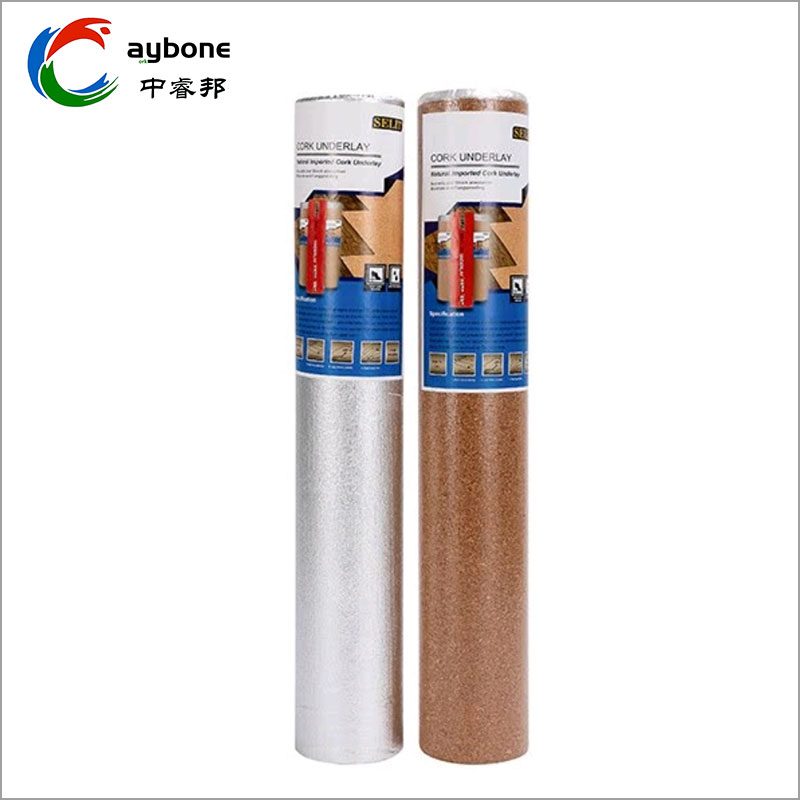
The Golden Rule: Subfloor Determines Orientation
There is no universal "correct side" for every scenario. The aluminium foil layer serves two primary functions: as a radiant heat reflector and as a vapour retarder. The cork layer provides compression resistance and sound absorption. The orientation must align with the dominant physical challenge of your subfloor.
| Subfloor Type | Recommended Facing | Primary Reason |
|---|---|---|
| Concrete (above grade, dry) | Foil UP (towards flooring) | Reflects heat upward; cork absorbs minor irregularities |
| Concrete (below grade or with moisture risk) | Foil DOWN (against concrete) | Foil acts as a vapour barrier to block rising damp |
| Wood / Plywood (suspended) | Foil UP (towards flooring) | Prevents condensation from temperature differentials |
| Over existing vinyl / ceramic tiles | Foil UP | Provides thermal break; no moisture concern from below |
| With electric underfloor heating | Foil UP (directly under flooring) | Reflects heat into the room, maximises efficiency |
The Science Behind the Foil Layer
The aluminium foil in a Cork Underlay with Aluminium Foil is not merely a shiny cosmetic addition. It has an emissivity value of approximately 0.03 to 0.05, meaning it reflects 95–97% of radiant heat back towards the source. When installed with the foil facing up—directly beneath the laminate, engineered wood, or LVT—it pushes warmth into the living space rather than allowing it to dissipate into the subfloor. Conversely, when installed with the foil facing down on a damp concrete slab, the impermeable aluminium layer interrupts the capillary rise of moisture vapour, protecting the cork from fungal decay and the floor covering from cupping or swelling.
Raybone recommends always performing a simple moisture test before deciding: tape a 500mm × 500mm polyethylene sheet to your concrete subfloor and leave it for 72 hours. If condensation appears on the underside, your slab is actively releasing vapour—in that case, install your Cork Underlay with Aluminium Foil with the foil side facing down directly onto the concrete, and seal all joints with aluminium tape for a continuous barrier.
Installation Checklist for Optimal Performance
Following a systematic sequence ensures that your Cork Underlay with Aluminium Foil performs to its full specification. Use this checklist before laying your first roll:
-
Acclimatise – Unroll the underlay and leave it in the room for 48 hours at 18–22°C.
-
Subfloor preparation – Ensure surface is clean, dry, level within 3 mm over 2 metres, and free from protrusions.
-
Moisture verification – Conduct the plastic sheet test or use a moisture metre (concrete should read < 75% RH).
-
Orientation decision – Apply the table above based on your subfloor type and heating system.
-
Laying direction – Run rolls perpendicular to the flooring planks for better load distribution.
-
Joint taping – Overlap edges by 50 mm and seal with Raybone-approved aluminium tape to prevent edge curling and vapour bypass.
-
Floating installation – Install flooring immediately after laying the underlay to avoid foot traffic damaging the cork cells.
Common Mistakes That Reduce Performance
Even experienced fitters occasionally misapply Cork Underlay with Aluminium Foil. The most frequent errors include:
-
Foil down on timber subfloors – This traps interstitial condensation between timber and foil, leading to black mould over time.
-
Foil up on wet concrete – Moisture passes through the cork, reaches the foil, condenses on the cold underside of the flooring, and causes edge swelling.
-
Skipping joint tape – Unsealed gaps allow moisture vapour to penetrate and thermal bridging to reduce insulation value.
-
Double layering – Never install two layers of foil-backed underlay; the trapped air between foils creates a thermal break but also a hidden condensation plane.
Frequently Asked Questions About Cork Underlay with Aluminium Foil
Q1: Can I install Cork Underlay with Aluminium Foil directly over underfloor heating cables, and which side should face down?
A: Yes, you can install Cork Underlay with Aluminium Foil over electric underfloor heating systems, provided the manufacturer specifies a maximum surface temperature of 27°C for the underlay (most cork products tolerate up to 28°C). The foil side must always face up—directly towards the finished flooring. This orientation reflects radiant heat upward into the room rather than downwards into the cable bed, improving heating efficiency by 15–20% and preventing the heating elements from overheating due to trapped heat below. Do not install the foil side down over heating cables, as this would reflect heat back into the cables, potentially causing thermal cut-out or accelerated insulation degradation. Always leave a 5 mm expansion gap around the perimeter to accommodate thermal movement of the cork.
Q2: What happens if I accidentally install the Cork Underlay with Aluminium Foil with the foil side facing the wrong direction on a concrete basement floor?
A: Installing Cork Underlay with Aluminium Foil with the foil facing up on a concrete basement floor (where moisture vapour is present) creates a severe failure risk. The cork layer sits directly on the damp concrete and acts as a sponge, absorbing rising moisture. The aluminium foil above then traps this moisture between the cork and the finished floor. Within 6–12 months, you will observe: (a) dark staining on the cork edges, (b) a musty odour from microbial growth, (c) visible cupping or buckling of laminate planks, and (d) a complete voiding of the flooring warranty. If you have already installed it incorrectly, the only remediation is to completely remove the flooring and underlay, allow the concrete to dry thoroughly (which may take 2–3 weeks with dehumidifiers), and reinstall the Cork Underlay with Aluminium Foil with the foil side facing down, sealing all overlapping seams with vapour-proof tape to create an unbroken moisture barrier.
Q3: Does the aluminium foil side affect soundproofing performance, or is that solely the cork layer's responsibility?
A: Soundproofing in a Cork Underlay with Aluminium Foil is a shared function, but the orientation does influence the acoustic outcome. The cork layer provides impact noise reduction (footfall, dropping objects) through its closed-cell structure, which absorbs vibrational energy. The aluminium foil contributes to airborne sound insulation by adding mass and creating a slight decoupling effect between the subfloor and the finished floor. However, the foil side's orientation matters more for structural acoustics than for raw decibel reduction. When installed with the foil facing up, the foil acts as a rigid reflective layer that helps distribute point loads more evenly across the cork, reducing localised compression and maintaining consistent acoustic performance over the floor's lifespan. When installed foil down on concrete, the acoustic benefit is marginally lower because the foil couples with the dense subfloor, transmitting more high-frequency vibration. For optimal acoustic results in apartments or multi-storey buildings, Raybone recommends foil up alongside a 2 mm perimeter acoustic strip, regardless of subfloor type, provided moisture conditions permit this orientation. The cork thickness (typically 2–5 mm) remains the dominant factor—thicker cork always outperforms thinner cork for sound dampening, irrespective of foil position.
Final Verification Before Laying Your Floor
Before you commit to the full installation, perform this quick visual check with your Cork Underlay with Aluminium Foil:
-
If your subfloor is concrete and at risk of damp → foil DOWN.
-
If your subfloor is timber, dry, or has heating → foil UP.
-
When in doubt, contact the technical team at Raybone with your subfloor photos and moisture readings—we provide free orientation verification within 24 hours.
Why Choose Raybone for Your Flooring Underlayment
Raybone manufactures premium Cork Underlay with Aluminium Foil using high-density Portuguese cork (≥ 240 kg/m³) and a 25-micron pure aluminium layer that resists tearing and oxidation. Every roll is calibrated for consistent thickness (± 0.2 mm tolerance), ensuring your finished floor sits flat without soft spots or ridges. Our products comply with EN 13986 and CE certification, and we offer tailored cutting services for large-scale projects. With over 12 years in the flooring accessory industry, Raybone has supplied underlayment solutions to over 4,500 professional installers across 30 countries.
Ready to Install with Confidence?
Correct orientation is the single most impactful decision you will make when installing your Cork Underlay with Aluminium Foil. If you are still uncertain about which side faces down for your specific subfloor, or if you need project-specific technical data sheets and acoustic test reports, contact us at Raybone today. Our in-house flooring engineers will review your installation drawings and provide a written orientation recommendation within one working day. Visit our website, email our support team, or call your regional Raybone representative—we are here to ensure your flooring project succeeds from the very first roll.
