

Which Material Is Best for a Two-Piece Male-Female Thread Ball Valve in Corrosive Environments
2026-08-18
Selecting the correct alloy for industrial valves directly impacts system longevity, safety, and total cost of ownership. For engineers and procurement specialists facing aggressive media—such as seawater, acidic slurries, or chemical feedstocks—the choice of body and trim material for a Two-Piece Male-Female Thread Ball Valve is not trivial. At HUADING, we have observed that over 60% of premature valve failures in corrosive services trace back to material mismatch rather than mechanical defects. This guide breaks down the performance of common materials using empirical corrosion data, cost-benefit analysis, and real-world installation feedback to help you make a defensible specification decision.
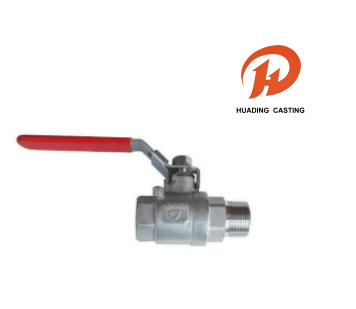
Corrosion Mechanisms That Matter
Before comparing materials, understand the primary threats:
-
General uniform corrosion – gradual wall thinning (common in carbon steel with water).
-
Pitting and crevice corrosion – localized attack under thread seals or seat pockets (critical for chloride environments).
-
Stress corrosion cracking (SCC) – tensile stress + specific ions (chlorides, caustics) at elevated temperatures.
-
Galvanic corrosion – dissimilar metals in contact (male/female threads often couple with pipe materials).
A Two-Piece Male-Female Thread Ball Valve has inherent crevices at the thread roots and body joint, making it more vulnerable than welded or flanged designs. Thus, material selection must prioritize resistance to localized attack.
Material Comparison Table for Corrosive Services
| Material | Corrosion Resistance | Max Temp (°F) | Cost Index | Best Application |
|---|---|---|---|---|
| CF8M (316 SS) | Good against organic acids, mild chlorides (< 200 ppm) | 450 | 1.0 | Water, oils, weak chemicals |
| CF3M (316L SS) | Similar to 316, better against intergranular attack after welding | 450 | 1.1 | Food/pharma, low-chloride water |
| Duplex 2205 | Excellent pitting resistance (PRE > 35), resistant to SCC up to 300°F | 600 | 2.3 | Seawater, brackish water, sour gas |
| Super Duplex 2507 | Outstanding chloride resistance (PRE > 40), high mechanical strength | 650 | 3.8 | Offshore, desalination, high-chloride brines |
| Hastelloy C-276 | Superior against wet chlorine, sulfuric acid, and oxidizing media | 800 | 7.5 | Severe chemical processing (HCl, H₂SO₄) |
| Bronze / Brass | Fair in fresh water, poor in acidic or salty media | 400 | 0.6 | Low-cost HVAC, potable water (non-corrosive) |
| PVDF (plastic) | Excellent against most acids and bases, but low pressure/temp | 280 | 0.9 | Ultra-pure water, aggressive acid drains |
PRE = Pitting Resistance Equivalent (Cr% + 3.3Mo% + 16N%). Higher is better.
Selection Decision Flowchart (Text-Based)
-
Identify the exact media – pH, chloride ppm, temperature, oxygen content.
-
Check for chlorides – If > 1000 ppm and temp > 120°F, avoid 316; choose Duplex or Super Duplex.
-
Check for reducing acids (HCl, H₂SO₄ dilute) – Hastelloy or PVDF lined.
-
Check for mechanical loads – Vibration or water hammer? Duplex offers higher yield strength (≥ 65 ksi) vs. 316 (≈ 30 ksi).
-
Evaluate thread galling risk – For stainless-on-stainless male/female threads, apply anti-seize or specify surface-coated versions (e.g., PTFE or silver plating) – HUADING offers pre-coated options for all duplex and super duplex models.
Cost vs. Lifecycle Value
A common mistake is selecting the cheapest material for initial purchase. Consider this real example for a 2-inch Two-Piece Male-Female Thread Ball Valve in seawater service (ambient temperature):
| Material | Valve Cost (USD) | Expected Life (years) | Replacement Cost/year |
|---|---|---|---|
| 316 SS | 180 | 1.5 | 120 |
| Duplex 2205 | 420 | 8 | 52.5 |
| Super Duplex 2507 | 680 | 15+ | 45 |
Despite being 3.7× more expensive upfront, Super Duplex delivers a lower annualized cost and eliminates unplanned downtime—a factor often overlooked.
Frequently Asked Questions (FAQ)
Q1: Can I use a standard 316 stainless steel Two-Piece Male-Female Thread Ball Valve for brackish water with 2000 ppm chlorides at 140°F?
A1: No. 316 SS has a critical pitting temperature (CPT) of approximately 120°F for chloride levels above 1000 ppm. At 140°F and 2000 ppm, you will likely see pitting within 6–12 months, especially at thread crevices. We strongly recommend Duplex 2205 or Super Duplex 2507 for this service. If budget constraints exist, consider a PVDF-lined body, but verify pressure rating derating at elevated temperatures. HUADING provides full corrosion charts per ASTM G48 for each alloy upon request.
Q2: How do I prevent galvanic corrosion between the male thread of the valve and a female threaded carbon steel pipe?
A2: Galvanic corrosion occurs when the valve (e.g., stainless steel) and the carbon steel pipe are coupled in an electrolyte (wet media). The carbon steel becomes the anode and corrodes preferentially. Mitigation options: (a) use a dielectric union or insulating gasket at the connection, (b) coat the carbon steel threads with a heavy-duty epoxy or zinc-rich primer, or (c) select a Two-Piece Male-Female Thread Ball Valve with the same or closer galvanic potential—for example, use a carbon steel valve with stainless steel trim (available from HUADING). Never rely solely on thread sealant for electrical isolation.
Q3: What trim materials (ball and seat) should I pair with a Super Duplex body for wet chlorine service?
A3: For wet chlorine (moist Cl₂ gas or hypochlorous acid), the body needs high resistance, but the seats and seals are equally critical. Standard PTFE seats are inadequate above 200°F; use reinforced PTFE with 25% glass fiber or PEEK for temperatures up to 450°F. The ball should be Super Duplex with hard chrome plating or solid Hastelloy C-276 to prevent galling during rotation. Also, verify that the stem O-rings are FKM (Viton™) or FFKM (Kalrez®) – not EPDM, which degrades in chlorine. HUADING offers a full trim upgrade package for severe oxidizers, with documented test reports per API 607.
Installation and Maintenance Best Practices
-
Thread sealant: Use PTFE tape or anaerobic paste compatible with the media. For stainless threads, avoid graphite-based pastes that can promote galvanic pitting.
-
Torque control: Over-torquing a Two-Piece Male-Female Thread Ball Valve can deform the body joint, increasing leak paths. Follow HUADING’s published torque tables (based on ASME B1.20.1).
-
Bleed and drain: Before opening the valve for maintenance, relieve both upstream and downstream pressure—trapped corrosive fluid in the body cavity can spray when disassembling the two-piece joint.
-
Inspection interval: For duplex valves in seawater, perform visual inspection every 6 months; for 316 in mild service, annually is sufficient.
Final Recommendation
For most industrial corrosive environments (chlorides < 5000 ppm, temp < 250°F), Duplex 2205 offers the best balance of corrosion resistance, mechanical strength, and cost. For extreme conditions (HCl, wet chlorine, high-temperature brines), invest in Super Duplex 2507 or Hastelloy C-276 and pair with upgraded seat materials. Avoid 316 unless the chloride level is consistently below 200 ppm and temperature below 120°F. Remember that the Two-Piece Male-Female Thread Ball Valve design itself—with its threaded end connections and center body seal—demands a material that resists both uniform and localized attack, because thread roots are natural stress risers.
HUADING manufactures each Two-Piece Male-Female Thread Ball Valve with full material traceability (EN 10204 3.1 or 3.2), hydrostatic testing, and optional NACE MR0175 compliance for sour services. Our engineering team provides free material selection worksheets based on your actual process data.
Ready to specify the right material for your corrosive application? Contact HUADING today at [email protected] or visit our technical portal to request corrosion curves, sample testing, or a customized quotation. We respond within 4 business hours with application-specific recommendations—because the wrong alloy costs far more than the valve itself.