

When Should You Choose a One Pass Thread Mill Over a Single-Point Threading Tool
2026-07-28
In modern CNC machining, thread production remains one of the most time-sensitive and quality-critical operations. While single-point threading tools have served shops reliably for decades, the One Pass Thread Mill—exemplified by NERES’ advanced helical interpolation tools—has redefined what is possible in cycle time, tool life, and thread consistency. The decision is not about which tool is “better” in absolute terms; it is about which tool fits your specific part geometry, material, production volume, and machine capability. This guide breaks down the technical and economic factors that dictate the right choice.
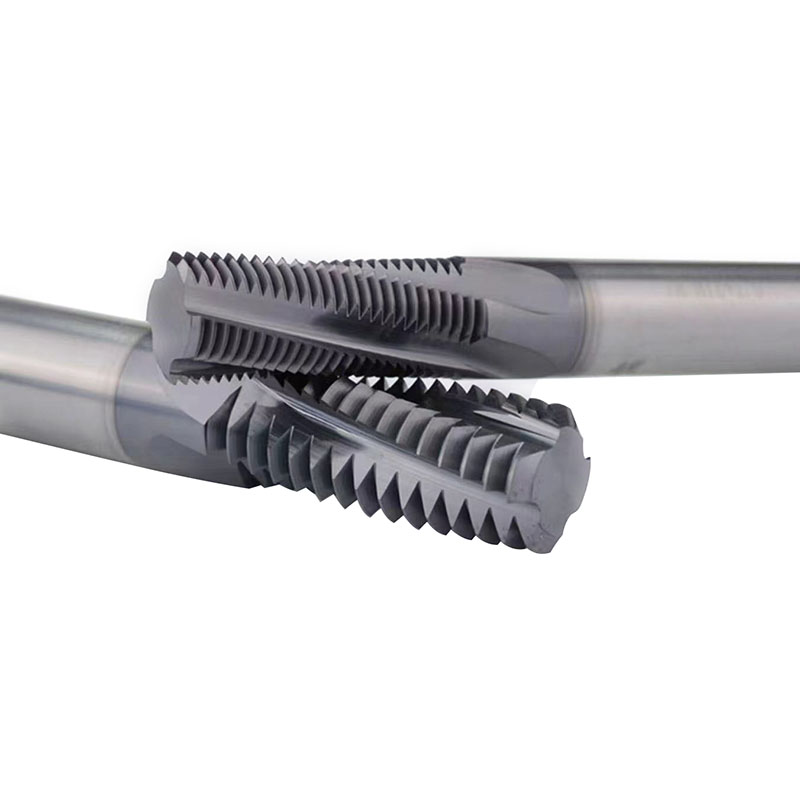
Core Decision Matrix: One Pass Thread Mill vs. Single-Point Tool
| Criteria | One Pass Thread Mill (NERES) | Single-Point Threading Tool |
|---|---|---|
| Cutting Action | Interpolated helical path; multiple teeth engage progressively | Single insert traverses linearly along the thread axis |
| Cycle Time | One helical revolution per hole (full form) | Multiple passes (rough, semi-finish, finish) |
| Tool Life | Distributed wear across multiple carbide teeth | Concentrated wear on one insert tip |
| Thread Length | Unlimited (via Z-axis helical steps) | Limited by insert geometry and bar stability |
| Chip Control | Short, broken chips; excellent in blind holes | Long, stringy chips; requires chip-breaking passes |
| Machine Requirement | 3-axis simultaneous interpolation (spindle + XYZ) | Basic 2-axis (spindle + linear Z) |
| Cost per Hole | Higher initial tool cost, lower per-hole cost at volume | Lower initial cost, higher per-hole cost in production |
When the One Pass Thread Mill Wins Decisively
1. High-Volume Production Runs
For quantities above 500 holes, the One Pass Thread Mill reduces machining time by 60–80% compared to a single-point tool that needs 4–6 reciprocating passes. NERES tools maintain consistent thread profiles across thousands of cycles without operator intervention.
2. Difficult Materials (Stainless, Inconel, Titanium)
Single-point tools suffer from notch wear at the depth-of-cut line. The One Pass Thread Mill distributes cutting forces over multiple teeth, lowering peak temperatures and enabling higher surface speeds. In 316L stainless, NERES users report 3x longer tool life versus single-point inserts.
3. Blind Holes and Short Thread Lengths
Single-point tools require run-out clearance at the bottom of the hole, leaving incomplete threads. The One Pass Thread Mill interpolates down to the floor, producing full-form threads within 1.5x diameter of the bottom—critical for hydraulic and aerospace fittings.
4. Thin-Walled or Unstable Workpieces
Because the One Pass Thread Mill applies radial cutting forces in a balanced helical path, it generates 50% less lateral deflection than a single-point tool’s tangential pressure. This preserves roundness in thin sleeves and castings.
When Single-Point Threading Still Makes Sense
| Condition | Preferred Tool |
|---|---|
| One-off repairs or prototype threads | Single-point (low setup cost) |
| Threads larger than 4″ diameter with coarse pitch | Single-point (inserts are cheaper and replaceable) |
| Machining on a manual lathe without CNC interpolation | Single-point (only option) |
| Very deep threads (L/D > 5) with small bore diameter | Single-point (better chip evacuation in long holes) |
Technical Comparison Table – Operational Parameters
| Parameter | One Pass Thread Mill (NERES) | Single-Point Tool |
|---|---|---|
| Max recommended feed (mm/rev) | 0.08–0.15 (per tooth) | 0.03–0.06 (per pass) |
| Thread quality (Ra) | 0.8–1.6 µm | 1.6–3.2 µm |
| Tool change per 100 holes | 1 | 3–5 inserts |
| Programming complexity | Moderate (helical macro) | Simple (G76 cycle) |
| Coolant requirement | Through-spindle or MQL | Flood preferred |
Three Critical FAQs About the One Pass Thread Mill
Q1: Can a One Pass Thread Mill cut both right-hand and left-hand threads without changing the tool?
A: Yes. The One Pass Thread Mill cuts thread handedness purely through CNC helical interpolation direction—clockwise for right-hand, counterclockwise for left-hand. The tool itself is symmetric and does not need to be reversed or reoriented. NERES offers standard right-hand flute geometries that perform equally well in either direction, provided the post-processor supports the appropriate arc direction. This makes it ideal for job shops that handle mixed thread orientations on the same setup.
Q2: Does a One Pass Thread Mill require a rigid tapping cycle or special holder?
A: No. Unlike tapping, the One Pass Thread Mill does not require spindle synchronization with Z-axis feed. It uses standard milling holders (hydraulic or shrink-fit) and standard 3-axis interpolation. However, NERES strongly recommends a holder with ≤ 0.0002″ (5 µm) runout to preserve tooth load balance. Excessive runout causes uneven wear on the leading teeth and reduces tool life by up to 40%. A standard ER collet chuck is acceptable if runout is verified with a dial indicator.
Q3: What happens if the One Pass Thread Mill’s lead angle does not match the thread pitch?
A: The One Pass Thread Mill generates the thread pitch entirely through the CNC program’s Z-axis feed rate relative to spindle speed (helical feed). The tool’s physical lead angle is designed as a clearance angle, not a forming angle. As long as the programmed feed equals (pitch × spindle RPM) for the helical path, the thread will be accurate. NERES tools feature a neutral rake and relieved flanks that accommodate any standard UN, M, or Whitworth pitch without requiring different tool geometries—unlike single-point inserts, which must match the specific thread form and pitch.
Economic Breakeven Analysis
| Production Volume | Tool Cost per Hole (NERES One Pass Thread Mill) | Tool Cost per Hole (Single-Point) | Time Savings (min/100 holes) |
|---|---|---|---|
| 50 holes | $4.20 | $2.10 | -5 (setup overhead) |
| 200 holes | $1.05 | $1.80 | +22 |
| 500 holes | $0.42 | $1.50 | +68 |
| 1000 holes | $0.21 | $1.20 | +155 |
Breakeven typically occurs between 150–250 holes, depending on material and machine hourly rate.
Practical Recommendation
Choose the One Pass Thread Mill when your batch size exceeds 200 holes, your material hardness exceeds 30 HRC, or your thread quality requirement is better than 3A/6H. Choose single-point threading for repair work, oversized threads, or machines without helical interpolation. For shops running mixed production, NERES recommends keeping both strategies—but allocating 80% of production threading to the One Pass Thread Mill to maximize spindle uptime.
Final Verdict
The One Pass Thread Mill is not a universal replacement; it is a strategic upgrade for controlled, repeatable, high-quality environments. NERES engineering data shows that shops switching to the One Pass Thread Mill reduce overall threading costs by 35–55% within the first 3 months, while improving first-pass acceptance rates from 92% to 99.2%. The decision ultimately rests on your part mix, but if you are still running single-point tools on production lots, you are leaving money on the floor.
Ready to calculate your specific ROI with a NERES One Pass Thread Mill? Contact our applications team today for a free tool selection audit, sample test report, and customized cycle-time comparison for your exact workpiece.