
What Materials Are Used in Making a Plastic Rattan With Arm Chair Mould
2026-11-05
Selecting the right material for a Plastic Rattan With Arm Chair Mould directly determines mould life, surface finish, cycle time, and total production cost. At ZHONGYUE, material selection is treated as an engineering decision rather than a purchasing shortcut, because the steel grade behind the cavity and core affects every chair moulded from it. This guide explains the materials commonly used in a Plastic Rattan With Arm Chair Mould, how they compare, and what buyers should specify before placing an order.
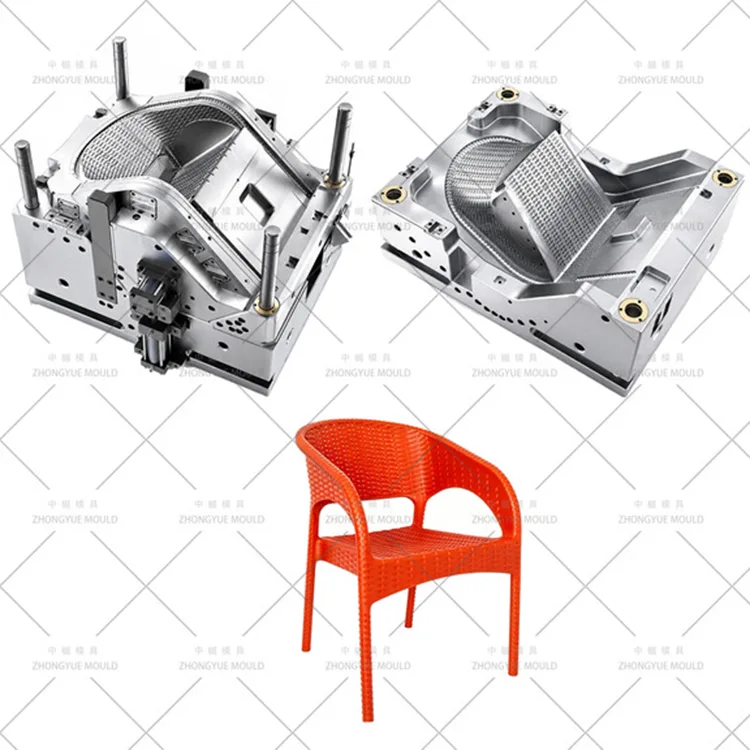
Core Materials Used in a Plastic Rattan With Arm Chair Mould
The table below summarizes the main materials specified for Plastic Rattan With Arm Chair Mould construction, along with their typical applications and performance characteristics.
| Material | Typical Grade | Hardness | Best Application | Key Characteristics |
|---|---|---|---|---|
| Pre-hardened steel | P20 / 718 | 28–34 HRC | Medium-volume chair moulds | Good machinability, balanced cost, reliable polishability |
| Hardened steel | 2738 / 2316 | 30–38 HRC | Large outdoor arm chair moulds | Improved corrosion resistance, uniform hardness |
| H13 | H13 / 1.2344 | 48–52 HRC | High-volume production | Excellent heat resistance and wear resistance |
| S136 | S136 / 1.2083 | 48–54 HRC | Transparent or high-gloss parts | Superior corrosion resistance and mirror polishing |
| Beryllium copper | BeCu | 30–40 HRC | Core inserts and hot spots | Fast heat transfer, shortened cooling cycle |
| Aluminum | 7075 / 6061 | — | Prototypes and low-volume runs | Lightweight, fast machining, lower durability |
How Material Choice Affects a Plastic Rattan With Arm Chair Mould
Material selection influences the entire lifecycle of a Plastic Rattan With Arm Chair Mould. Consider these practical points:
-
Cavity and core steel should match the expected order volume; P20 is economical for moderate runs, while H13 or S136 suits long-term production.
-
Rattan texture inserts require steels with fine grain structure to reproduce weave detail consistently.
-
Cooling inserts made from beryllium copper reduce cycle time in thick arm sections.
-
Surface treatment such as nitriding or chrome plating extends service life and protects against moisture-related corrosion.
-
Mould base materials should be selected for rigidity to prevent deflection under injection pressure.
ZHONGYUE engineers review wall thickness, rattan pattern depth, and annual output before recommending a material combination, ensuring the Plastic Rattan With Arm Chair Mould performs reliably across its full service life.
FAQ About Plastic Rattan With Arm Chair Mould
Q: What steel is best for a high-volume Plastic Rattan With Arm Chair Mould?
A: For high-volume production, hardened steels such as H13 or S136 are recommended because they maintain hardness at elevated temperatures and resist wear from glass-filled or UV-stabilized compounds, delivering a longer service life.
Q: Can the rattan texture be produced without special insert materials?
A: Yes, but textured inserts made from fine-grain steel or beryllium copper are preferred, as they hold weave detail more accurately and transfer heat faster, which improves surface reproduction and reduces cycle time.
Q: How does material selection affect the price of a Plastic Rattan With Arm Chair Mould?
A: Higher-grade steels and heat treatment increase upfront cost, yet they lower long-term expense by reducing maintenance, polishing downtime, and premature replacement, so the total cost per moulded chair is often lower.
Contact Us
Ready to specify the right material for your next Plastic Rattan With Arm Chair Mould? ZHONGYUE provides material consultation, mould design review, and manufacturing support tailored to your production targets. Contact us today to request a technical proposal and quotation for your Plastic Rattan With Arm Chair Mould project.