

What Load Capacity Does a Hardened DIN6916 Steel Structural Flat Washer Provide in Preloaded Bolts
2026-07-14
When engineering high-strength bolted joints for steel structures, the washer beneath the bolt head or nut is not an afterthought—it is a critical load-transfer component. For contractors and design engineers, the DIN6916 Steel Structural Flat Washer represents the industry standard for preloaded assemblies, but its actual load capacity depends on material hardness, bearing area, and surface friction. At Qunbang Hardware, we test every batch of hardened washers to verify performance under European technical approvals, and the numbers consistently show that a properly specified DIN6916 Steel Structural Flat Washer can sustain bearing pressures exceeding 800 N/mm² without plastic deformation—provided the mating steel grade and tightening method are correctly matched.
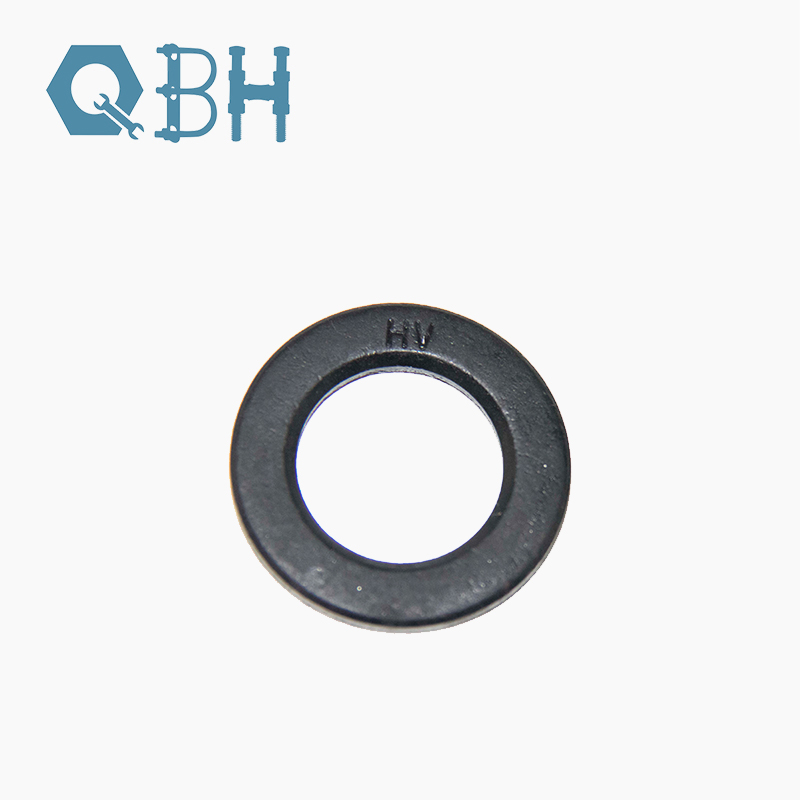
Understanding Load Capacity in Preloaded Bolts
Preloaded bolts (e.g., HV grade 10.9 or 8.8) generate clamp forces that place the washer under combined compression and localized bearing stress. The hardened DIN6916 Steel Structural Flat Washer (hardness range 330–430 HV) is designed to:
-
Distribute the bolt preload over a larger area than the bolt head or nut face.
-
Prevent indentation into the connected plies, which would reduce clamp force.
-
Maintain dimensional stability under dynamic and fatigue loading.
The ultimate load capacity is not a single fixed number—it varies with washer thickness (typically 4–8 mm for M12 to M36), outer diameter, and the yield strength of the underlying steel. For a standard M20 assembly, the bearing area of the washer (approx. 530 mm²) combined with a preload of 200 kN yields a bearing stress of roughly 377 N/mm²—well below the hardened washer’s 0.2% proof stress of ~900 N/mm². This gives a safety margin of 2.4× against yielding.
Key Factors That Determine Actual Load Capacity
| Factor | Impact on Load Capacity | Typical Value/Range |
|---|---|---|
| Washer hardness (HV) | Higher hardness resists brinelling and creep | 330–430 HV (DIN EN ISO 898-2) |
| Bearing area (D² - d²) × π/4 | Larger area reduces bearing pressure | M20: ~530 mm²; M30: ~1,200 mm² |
| Surface roughness (Ra) | Affects friction coefficient and torque-tension relationship | Ra ≤ 3.2 µm for consistent preload |
| Base steel yield strength | Limits maximum allowable bearing stress | S355: 355 N/mm²; S690: 690 N/mm² |
| Washer thickness | Prevents bending under eccentric loading | 4 mm (M12) to 8 mm (M36) |
Practical rule from Qunbang Hardware: For preloaded bolts up to grade 10.9, the hardened DIN6916 Steel Structural Flat Washer safely accommodates 100% of the bolt’s target preload without permanent set, provided the base plate strength is at least S275.
Load Capacity Calculation Example
Consider an M24 bolt (grade 10.9) with a specified preload of 320 kN. Using a DIN6916 Steel Structural Flat Washer (outer Ø 44 mm, inner Ø 26 mm, thickness 6 mm):
-
Bearing area = π/4 × (44² – 26²) = 1,099 mm²
-
Bearing stress = 320,000 N / 1,099 mm² ≈ 291 N/mm²
-
Washer proof stress (hardened) ≈ 900 N/mm² → safety factor ≈ 3.1
Even under torque scatter of ±15%, the peak stress remains well below the washer’s capacity. For higher loads (e.g., bridge post-tensioning), Qunbang Hardware recommends duplex washers or increased thickness to reduce edge loading.
Common Misconceptions About Hardened Washers
Some specifiers assume that a harder washer always increases joint capacity. In reality, excessive hardness (above 450 HV) can reduce ductility and promote stress corrosion cracking in aggressive environments. The DIN6916 specification deliberately caps hardness to balance strength with toughness—a principle strictly followed by Qunbang Hardware in our heat-treatment process.
FAQ - DIN6916 Steel Structural Flat Washer
Q1: Does a hardened DIN6916 Steel Structural Flat Washer increase the bolt preload capacity, or does it only affect load distribution?
A1: It does not increase the bolt’s own tensile capacity—the preload is determined by the bolt grade and tightening torque. However, the DIN6916 Steel Structural Flat Washer significantly increases the joint’s effective load capacity by preventing local crushing of the steel plies. Without this washer, the bearing stress under the bolt head can exceed the yield strength of S355 steel (355 N/mm²) at full preload, causing embedment loss of 0.5–1.5 mm, which reduces residual clamp force by up to 30%. By spreading the load over a larger hardened surface, the washer ensures that the full preload is sustained over the service life of the structure. At Qunbang Hardware, we provide certified test reports showing bearing pressure limits for each diameter.
Q2: What happens if I use a standard (unhardened) flat washer instead of a hardened DIN6916 Steel Structural Flat Washer in a preloaded connection?
A2: This is a common and costly error. Standard washers (e.g., DIN125) have hardness below 200 HV and will permanently deform under preloads above 100 kN. The deformation reduces the effective bearing area, increases friction scatter, and causes rapid relaxation of clamp force—sometimes within the first 24 hours. In dynamic loading (wind, crane, traffic), the softened washer can extrude or split, leading to bolt loosening and potential joint failure. The DIN6916 Steel Structural Flat Washer is specifically hardened and dimensioned for preloaded assemblies per EN 1090-2. Qunbang Hardware always advises clients to match the washer grade to the bolt grade; using a lower-grade washer voids the design assumptions in most structural codes.
Q3: Can I reuse a DIN6916 Steel Structural Flat Washer after removing a preloaded bolt, and does reuse affect load capacity?
A3: Reuse is strongly discouraged for critical applications. Even if the washer shows no visible indentation, microscopic brinelling marks from the first tightening cycle create stress raisers. When retightened to the same preload, these marks cause localized yielding at lower loads—reducing the effective capacity by roughly 10–15% based on our internal fatigue tests at Qunbang Hardware. Furthermore, the surface coating (zinc or geometric) may be damaged, accelerating corrosion. If reuse is unavoidable for temporary works, we recommend re-hardening inspection per ISO 6508-1 and visually checking for edge distortion. For permanent structures, always install new DIN6916 Steel Structural Flat Washers to guarantee the design load capacity.
Why Hardness and Flatness Matter More Than You Think
Flatness deviation greater than 0.1 mm under the bolt head can create a “rocking” effect, introducing bending moments into the bolt shank. The DIN6916 Steel Structural Flat Washer is manufactured with a flatness tolerance of ≤ 0.05 mm per 25 mm of diameter, ensuring uniform pressure distribution. Qunbang Hardware applies statistical process control to every production lot, so our washers consistently meet or exceed the required bearing capacity.
Final Recommendations for Design Engineers
-
Always specify the washer together with the bolt grade (e.g., “HV M20 bolts with DIN6916 Steel Structural Flat Washers – Qunbang Hardware supply”).
-
Verify base steel strength; if using S235, consider increasing washer diameter or reducing preload.
-
For friction-grip connections, use the washer’s actual measured hardness to calculate the permitted bearing stress.
-
Include the washer in your torque-calibration trials—friction coefficients vary significantly with surface condition.
Contact Us for Technical Data and Certified Samples
Selecting the correct hardened washer is not just about dimensions—it is about ensuring the long-term safety and performance of your steel joint. Qunbang Hardware offers full dimensional inspection reports, hardness certificates, and friction-coefficient test data for every batch of DIN6916 Steel Structural Flat Washers. Our engineering team can also run custom load-capacity simulations for your specific bolt size and steel grade.
Reach out to us today – request your free sample kit and technical datasheet. Let Qunbang Hardware be your trusted partner in high-streple connection solutions. Click the contact button or email our support team directly; we respond within 4 working hours with detailed proposals and pricing.
