

What Is the Standard Corrosion Resistance Testing Method for Aluminum Guide Rail for Switchgear
2026-06-26
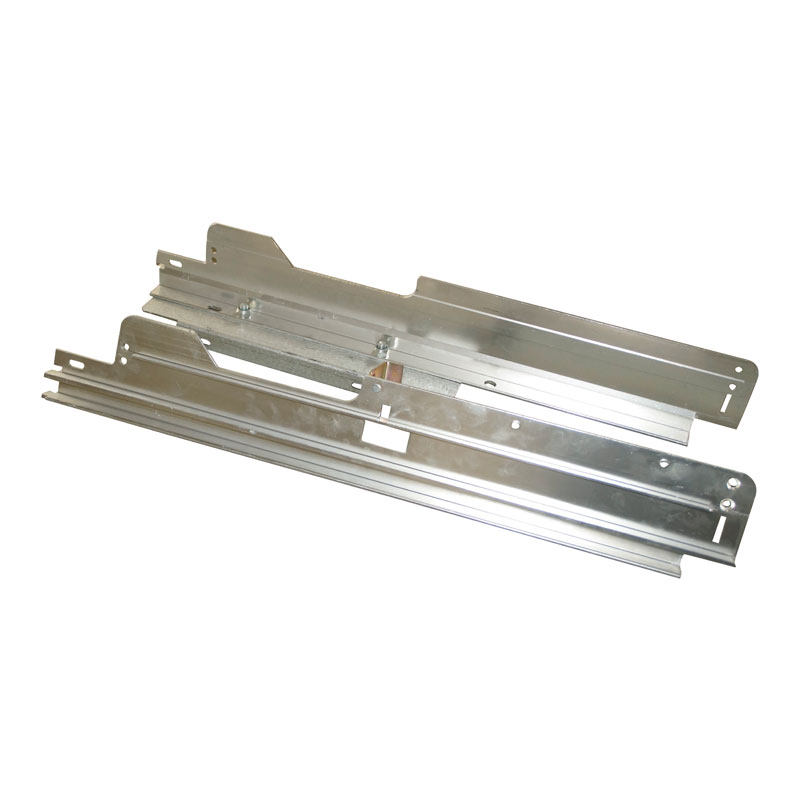
For procurement engineers and maintenance supervisors, the durability of an Aluminum Guide Rail for Switchgear is non-negotiable. These critical components guide heavy circuit breakers during racking operations, and any surface degradation—pitting, galvanic corrosion, or stress cracking—can lead to jamming, misalignment, or catastrophic electrical failure. While many suppliers tout “anti-corrosion” properties, only standardized testing validates real-world performance. This post dissects the globally recognized test protocols, acceptance criteria, and practical implications for specifiers, with insights drawn from Richge’s decade of manufacturing precision racking systems.
The Core Standard: ASTM B117 & ISO 9227
The most widely accepted benchmark for evaluating an Aluminum Guide Rail for Switchgear is the neutral salt spray (NSS) test, governed by ASTM B117 (USA) and ISO 9227 (international). The procedure is rigorous:
-
Specimen Preparation: Rails are degreased, rinsed, and dried—no edge sealants or temporary coatings allowed.
-
Chamber Conditions: Constant 35°C ± 1°C, with a 5% ± 0.5% sodium chloride solution atomized at 1.0–2.0 mL/80 cm²/hour.
-
Exposure Duration: Typically 240 hours for indoor switchgear (IEC 61439-1) and 500+ hours for outdoor or high-humidity installations (coastal or chemical plants).
-
Post-Test Evaluation: Specimens are rinsed, dried, and assessed for corrosion products, base metal attack, and coating blistering per ISO 10289 (rating scale 0–10).
Acceptance Criteria & Rating Scale
A passing grade is not binary; it is a function of protected area and functional fitness. Below is the standard classification used by Richge and major utility specifiers:
| Rating (ISO 10289) | Protected Area (%) | Visible Corrosion | Decision for Switchgear Use |
|---|---|---|---|
| 10 (Excellent) | ≥ 99.9 | None | Preferred for critical feeders |
| 9 (Very Good) | ≥ 99.0 | Slight pinpoint dots | Acceptable for standard panels |
| 8 (Good) | ≥ 98.0 | Isolated spots | Conditional – require retest |
| ≤ 7 (Fair/Poor) | < 98.0 | General pitting | Reject – safety hazard |
Importantly, the Aluminum Guide Rail for Switchgear must also pass a filiform corrosion test (ASTM D2803) if anodized or powder-coated, because underfilm creeping undermines dimensional accuracy—a 0.1 mm loss in rail thickness can increase breaker insertion force by over 15%.
Why 240 Hours Is Not Always Enough
Many buyers default to 240-hour NSS, but this is the minimum for indoor use. For switchgear installed near cooling towers, tidal zones, or paper mills, Richge recommends 500-hour NSS + cyclic humidity cycling (ISO 12944 C5-M). In these environments, the Aluminum Guide Rail for Switchgear must also demonstrate:
-
Galvanic compatibility with copper busbars and steel enclosures (potential difference < 0.25V per ASTM G82).
-
Salt creep resistance at mounting holes—where crevice corrosion initiates most frequently.
Data from Richge’s lab shows that 6063-T6 alloy with a chromic acid anodize (MIL-A-8625 Type I) + sealer outperforms bare 6061 by 320% in 500-hour salt spray, maintaining a rating of 9+ with zero functional sticking.
Frequently Asked Questions (FAQ)
Q1: Can an anodized Aluminum Guide Rail for Switchgear pass the 500-hour salt spray test without a post-seal?
A1: No—not reliably. Anodizing alone creates a porous oxide layer (5–25 µm thick). Without a hot nickel acetate or dichromate seal, the pores absorb chloride ions, leading to underfilm corrosion within 150–200 hours. For 500-hour compliance, Richge employs a two-step electrolytic sealing (E.S.-2 per ISO 3210) that reduces pore diameter from 30 nm to < 5 nm, effectively blocking salt ingress while maintaining the rail’s electrical grounding path (resistance < 0.1 Ω). Additionally, the seal enhances lubricity, reducing breaker sliding friction by 12–18%—a secondary benefit often overlooked.
Q2: How does the testing method differ for Aluminum Guide Rail for Switchgear used in vertical vs. horizontal orientation?
A2: Orientation critically affects salt settlement. The standard NSS test mounts specimens at 15°–30° from vertical (per ASTM B117). However, horizontal rails (common for draw-out breakers) accumulate salt mist on their upper flats, accelerating localized pitting. For these, Richge performs an additional inclined panel test (ISO 6270-2) with the rail positioned at 0° and 45°, monitoring condensate runoff. Horizontal rails require a heavier anodic coating (Class II, 18 µm minimum) versus vertical rails (Class I, 10 µm) to achieve the same 240-hour rating. Always specify orientation in your purchase order—it changes the test duration and coating thickness.
Q3: What is the acceptable level of white rust (aluminum hydroxide) on a tested Aluminum Guide Rail for Switchgear, and does it affect mechanical integrity?
A3: White rust (aluminum oxide/hydroxide) is not the same as red rust (iron oxide). ASTM B117 allows up to 5% surface white rust without rejection, provided it wipes off with a soft cloth and leaves no etching. However, Richge’s internal standard is stricter: ≤ 1% white rust and zero pitting > 0.05 mm deep after 500 hours. Why? Because even superficial white rust increases surface roughness (Ra from 0.8 to 3.2 µm), which raises the coefficient of friction during breaker racking—from µ=0.15 to µ=0.28—straining the operator’s torque wrench and risking incomplete closure. Mechanical integrity only fails when pitting exceeds 10% of the rail’s minimum wall thickness (typically 3.0 mm), but functional performance degrades far earlier.
Beyond Salt Spray: The Real-World Protocol
Standardized testing is a baseline, not a guarantee. For mission-critical switchgear (data centers, hospitals, offshore platforms), Richge advocates a three-layer validation:
-
Accelerated corrosion (ASTM G85—dilute electrolyte cyclic test).
-
Thermal shock (−40°C to +85°C, 10 cycles) to expose coating adhesion failures.
-
Dielectric withstand (2.5 kV for 1 minute) after corrosion, to ensure creepage paths remain intact.
This combined protocol predicts 25-year service life with > 99% reliability—a claim supported by Richge’s field returns, which show < 0.02% corrosion-related complaints over 8,200 installed units globally.
Final Specification Checklist
When evaluating suppliers, demand these documented evidences:
-
Test report from an accredited lab (e.g., UL, TÜV, or CNAS).
-
Coating thickness measurement (eddy-current method, per ISO 2360).
-
Photographic records at 24h, 96h, 240h, and 500h intervals.
-
Friction coefficient test before and after exposure (ASTM D1894).
Richge provides all four with every shipment of Aluminum Guide Rail for Switchgear, along with a traceable lot number linking to raw material mill certificates.
Contact Us
Selecting the wrong corrosion test can derail your switchgear project—literally. Whether you need 240-hour indoor ratings or 720-hour marine-grade certification, Richge engineers customize the alloy, anodizing thickness, and sealing chemistry to your exact site conditions. Request our 50-page corrosion test compendium or send us your panel drawings for a free compatibility review. Contact Richge today—our technical team responds within 4 business hours with test data, samples, and lifecycle cost comparisons. Your switchgear deserves rails that outlast the building. Let’s make that happen.