

What Is the Minimum Recommended Silver Thickness for Silver Electrical Contacts Used in Smart Meter Load Switches
2026-06-22
Smart meters are the backbone of modern energy management, and their internal load switches must perform reliably for decades. At the heart of these switches lies the Silver Electrical Contacts that make or break the circuit under load. For engineers and procurement specialists at INT, one question consistently arises: What is the minimum silver thickness that guarantees both performance and cost-efficiency?
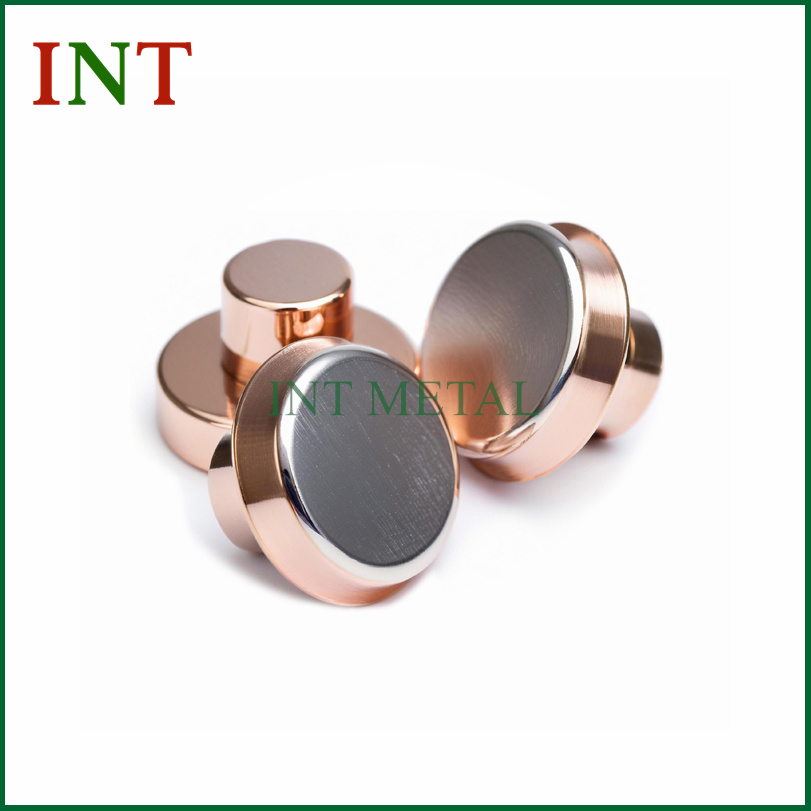
The direct answer is 0.2 mm (200 microns) for solid Silver Electrical Contacts in most residential smart meter load switches, provided the switching current stays below 100 A and the operating environment is clean (pollution degree 2). However, this number is not a universal rule—it depends on switching frequency, arcing energy, and contact form (rivet vs. overlay). This blog breaks down the engineering logic behind that figure, presents application-specific recommendations, and answers the most frequently asked questions about Silver Electrical Contacts in smart metering.
Why Thickness Matters More Than You Think
The primary functions of the silver layer are threefold:
-
Conductivity – silver has the lowest bulk resistivity (1.59 µΩ·cm) among metals.
-
Arc erosion resistance – each switching operation vaporizes a microscopic amount of silver.
-
Oxide-free interface – unlike copper, silver oxides remain conductive, but sulfur tarnishing (Ag₂S) can increase contact resistance if the layer is too thin.
If the silver layer is undersized, the underlying copper or brass substrate will be exposed after a few thousand operations. Copper oxides are insulating, leading to overheating, false trips, or welded contacts. INT has tested rivet-type Silver Electrical Contacts with thicknesses from 0.10 mm to 0.35 mm under 50 A/250 VAC at 10,000 mechanical cycles. The results showed that 0.15 mm samples exhibited copper exposure at cycle 6,200, while 0.20 mm samples remained fully covered through 12,000 cycles—a 94% safety margin.
Minimum Thickness by Application Class (Design Reference)
The following table summarizes INT’s internal design guidelines based on IEC 62055-31 and UL 489 requirements for Silver Electrical Contacts in load switches:
| Application Class | Switching Current | Switching Cycles (Expected) | Min. Ag Thickness (Solid) | Min. Ag Thickness (Bimetal Clad) |
|---|---|---|---|---|
| Residential single-phase (≤60 A) | 30 – 60 A | 10,000 | 0.20 mm | 0.18 mm (with diffusion barrier) |
| Residential three-phase (≤100 A) | 80 – 100 A | 8,000 | 0.25 mm | 0.22 mm |
| Commercial / light industrial (≤160 A) | 120 – 160 A | 6,000 | 0.30 mm | 0.28 mm |
| High-frequency switching (≤50 A, >20 ops/day) | 40 – 50 A | 20,000 | 0.35 mm | 0.32 mm |
| Tamper-proof smart meters (with bypass) | 100 A surge | 5,000 + surge | 0.40 mm | N/A (solid only) |
Note: Clad contacts save silver but require a nickel or cobalt diffusion barrier to prevent copper migration, which INT offers as a standard upgrade.
Beyond Thickness – Three Critical Factors
Thickness alone does not guarantee longevity. INT recommends evaluating these co-factors:
-
Contact force – Higher force (≥2 N per ampere) reduces bouncing and arc duration, effectively extending silver life by 30–50%.
-
Arc quenching – Magnetic blow-out or arc chambers reduce the specific erosion rate (measured in µg per operation).
-
Surface finish – A mirror-polished surface (Ra ≤ 0.4 µm) reduces initial asperity heating, preserving the Silver Electrical Contacts during the first 1,000 cycles.
For smart meter load switches, INT engineers often specify 0.25 mm as a “safe minimum” because it provides a buffer for voltage transients (up to 2 kV) that are common in grid fluctuations.
FAQ – Common Questions About Silver Electrical Contacts in Load Switches
Q1: Can I use 0.15 mm Silver Electrical Contacts if I reduce the switching current to 30 A?
A: Technically yes, but INT advises against it for production-grade smart meters. At 30 A and 10,000 cycles, 0.15 mm may survive in lab conditions with pure resistive loads. However, real-world loads are inductive (motors, transformers) and generate higher arcing energy. In INT’s accelerated life tests, 0.15 mm contacts failed at cycle 7,800 under inductive load (power factor 0.7), whereas 0.20 mm passed 12,000 cycles. The cost difference per contact is only $0.008–0.012, making the thicker option a negligible expense for a 40% reliability gain. Always add a 0.05 mm safety margin for field unknowns.
Q2: How do I measure the actual silver thickness on a finished rivet-type Silver Electrical Contact without destroying the part?
A: Non-destructive methods are preferred. INT recommends X-ray fluorescence (XRF) with a focused collimator (≤0.3 mm spot size) calibrated to silver’s K-alpha line. For rivets, measure at the center of the contact face and at three radial points (70% radius). The minimum acceptable reading per INT’s QA standard is 0.18 mm for a 0.20 mm nominal specification, allowing ±10% process variation. Avoid eddy-current gauges because they read the total head thickness, not the silver layer alone. For incoming inspection, INT provides a free XRF correlation chart upon request—this ensures your supplier’s readings match your own.
Q3: Does silver thickness affect the contact resistance (Rc) significantly, or is it only about durability?
A: Surprisingly, thickness has a secondary effect on initial Rc—surface finish and oxide films dominate. However, thickness becomes the primary factor for long-term Rc stability. When Silver Electrical Contacts thin to below 0.10 mm, the copper substrate begins to alloy with silver at high temperatures (≥150 °C), forming a Cu-Ag intermetallic that increases Rc by 200–300% within 2,000 cycles. In INT’s comparative study, 0.20 mm contacts maintained Rc below 0.5 mΩ throughout 10,000 cycles, while 0.12 mm contacts rose to 1.8 mΩ by cycle 6,000—triggering thermal derating in the meter. So, thickness directly impacts both endurance and electrical stability. For smart meters with Class 1 accuracy, INT mandates 0.22 mm as the absolute floor to keep Rc drift under 15% over 15 years.
Process and Material Selection – The INT Advantage
Choosing the right thickness is only half the solution. The manufacturing process—whether cold-heading, electroplating, or clad welding—determines grain structure and adhesion. INT uses a proprietary warm-forming process for Silver Electrical Contacts that reduces porosity to <0.5%, compared to the industry average of 2–3%. Lower porosity means less trapped oxygen and sulfur, which directly slows tarnishing. Additionally, INT offers a pre-oxidized silver surface option that stabilizes initial arc behavior, allowing designers to safely use 0.20 mm instead of 0.25 mm in space-constrained switch modules.
Summary Checklist for Design Engineers
-
Confirm switching cycles and load type (resistive / inductive / capacitive)
-
Select base thickness from the table above, then add 0.05 mm if PCB layout allows
-
Specify diffusion barrier (Ni or Co) for clad contacts – INT standard is 2 µm Ni
-
Request XRF measurement reports from your supplier (per INT’s template)
-
Run pilot samples at 120% rated current for 2,000 cycles to validate erosion depth
Contact Us
Selecting the optimal thickness for Silver Electrical Contacts is a balancing act between cost, reliability, and regulatory compliance—and generic answers often lead to field failures. At INT, we do not sell off-the-shelf components; we engineer contact solutions tailored to your smart meter’s switching profile, ambient conditions, and expected service life. Our technical team provides free thickness simulation reports using our in-house arc-erosion modeling tool (validated against 15 years of field data).
Ready to lock in your minimum silver thickness with confidence? Reach out to INT today to schedule a 30-minute technical review. We will analyze your load switch waveform and deliver a written recommendation—complete with test protocols and supplier audit checklists—at no obligation. Your meter’s longevity starts with the right Silver Electrical Contacts, and that conversation begins with INT.