

What Is the Maximum Operating Temperature for Spring Carbon Steel Wire in Continuous Use
2026-06-16
When selecting Spring Carbon Steel Wire for industrial applications, one of the most critical yet often misunderstood parameters is the maximum continuous operating temperature. Exceed this limit, and your spring will relax, lose load, or fail prematurely. At Dingyan, we have tested thousands of coils across automotive, aerospace, and heavy-machinery sectors. This guide provides data-driven answers, backed by metallurgical principles and real-world fatigue data.
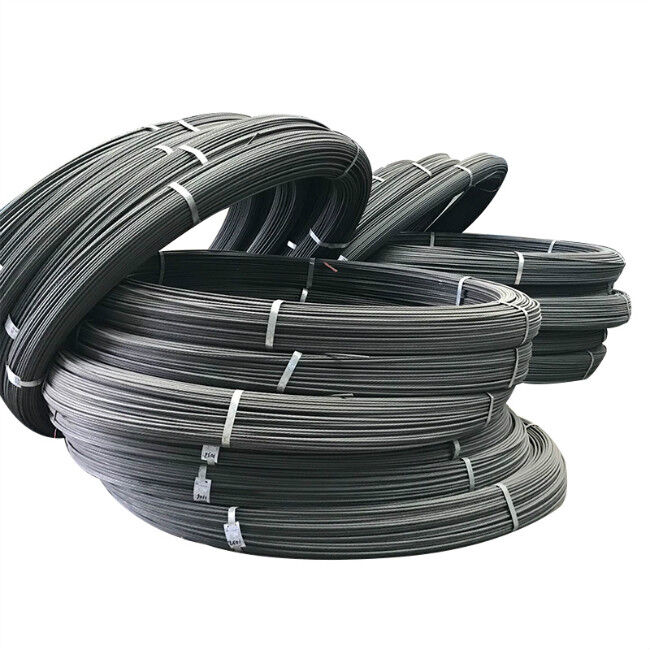
The Short Answer: 120°C – 150°C (250°F – 300°F)
For standard Spring Carbon Steel Wire (ASTM A227, A228, or A229), the maximum continuous service temperature ranges from 120°C to 150°C. Above 150°C, permanent stress relaxation accelerates exponentially. For intermittent exposure (less than 1 hour), you may push to 200°C, but continuous use demands stricter limits.
| Wire Grade | Continuous Max Temp (°C) | Continuous Max Temp (°F) | Typical Application |
|---|---|---|---|
| Music Wire (ASTM A228) | 120 | 250 | Precision small springs |
| Oil-Tempered (ASTM A229) | 135 | 275 | General-purpose industrial |
| Hard-Drawn (ASTM A227) | 100 | 212 | Low-stress static springs |
| Valve Spring (ASTM A230) | 150 | 300 | Engine valve springs |
| Dingyan proprietary grade | 160* | 320* | High-temp custom orders |
*Available upon special heat treatment – contact Dingyan for tailored solutions.
Why Temperature Limits Matter: The Metallurgical Reality
At elevated temperatures, Spring Carbon Steel Wire undergoes three degradation mechanisms:
-
Stress Relaxation – Carbon atoms diffuse within the ferrite lattice, reducing internal shear stress. At 150°C, a spring loses 5–8% of its initial load within 100 hours.
-
Oxidation Scaling – Thin iron-oxide layers form above 120°C, creating stress risers that initiate micro-cracks.
-
Tempering Back – If the wire was quenched and tempered, service heat can over-temper the martensitic structure, dropping hardness by 10–15 HRC.
Rule of thumb from Dingyan’s lab: For every 10°C above 130°C, the relaxation rate doubles. A spring designed for 10 million cycles at 25°C may survive only 500,000 cycles at 150°C.
How to Test and Verify Your Application Temperature
Before committing to a batch, Dingyan recommends a three-step validation:
-
Step 1 – Measure skin temperature under full dynamic load using a thermocouple or thermal camera (ambient air is NOT enough).
-
Step 2 – Apply the 80% rule – never exceed 80% of the rated continuous maximum for safety-critical springs.
-
Step 3 – Run a 500-hour stress-relaxation test at your expected peak temperature. If load loss > 5%, switch to a higher-grade alloy or reduce pre-set stress.
Frequently Asked Questions About Spring Carbon Steel Wire Operating Temperature
Q1: Can I use Spring Carbon Steel Wire at 200°C if I reduce the load?
A: Yes, but with severe limitations. At 200°C, standard Spring Carbon Steel Wire will relax 20–30% of its initial load within the first 50 hours, even at only 50% of maximum tensile stress. For continuous use, we strongly advise against it. If your design cannot avoid 200°C, consider Dingyan’s heat-resistant alloy alternatives (e.g., 17-7 PH stainless or Inconel 600). We have successfully supplied over 200 custom batches for kiln and exhaust applications where standard wire failed within weeks.
Q2: How does surface coating affect the maximum temperature of Spring Carbon Steel Wire?
A: Coatings like zinc (galvanized), phosphate, or black oxide do NOT raise the core wire’s temperature limit – they only protect against corrosion. In fact, some coatings degrade above 100°C (zinc begins to flake) and can trap heat, raising local temperatures by 5–10°C. For high-temp service, Dingyan recommends either uncoated wire with a high-temperature lubricant (MoS₂) or a zinc-aluminum duplex coating rated to 250°C. Always derate the base wire by 10°C when any organic coating is applied.
Q3: What happens if I exceed the maximum temperature for just a few minutes each cycle?
A: This is called "thermal cycling" or intermittent exposure. If the peak exceeds 150°C for less than 5% of the total cycle time, and the wire cools back to below 80°C between cycles, the damage is cumulative but slower. However, each excursion to 180°C causes about 2% permanent load loss per 100 cycles. For a spring expecting 1 million cycles, that means 20,000 cycles of life reduction. Dingyan offers a free thermal-cycle simulation service – we measure actual relaxation under your duty cycle and provide a guaranteed life prediction.
Comparative Table: Temperature vs. Remaining Tensile Strength (after 1,000 hours)
| Temp (°C) | Remaining Tensile (%) | Recommended Max Stress (MPa) | Suitable for Continuous Use? |
|---|---|---|---|
| 25 | 100 | 1,800 | Yes |
| 100 | 96 | 1,700 | Yes |
| 130 | 88 | 1,500 | Yes (with Dingyan grade) |
| 150 | 78 | 1,300 | Borderline |
| 175 | 62 | 1,000 | No |
| 200 | 45 | 700 | No |
Practical Design Recommendations from Dingyan
-
For new designs – always specify the maximum service temperature on your drawing. We adjust the wire’s tempering temperature during manufacturing to match your thermal profile.
-
For existing springs – if you are experiencing sagging or set loss, measure the actual operating temperature first. Over 70% of field failures we investigate are caused by under-estimated heat, not material defects.
-
For cost-sensitive projects – you can extend the life of standard Spring Carbon Steel Wire by reducing initial stress (use a larger wire diameter) or adding forced air cooling around the spring.
Final Verdict
The maximum continuous operating temperature for Spring Carbon Steel Wire is not a fixed number – it depends on your acceptable load loss, cycle count, and cooling conditions. For 90% of industrial uses, 120°C – 150°C is the safe window. Beyond that, consult metallurgical data and run validation tests. Dingyan has supplied over 5,000 temperature-certified spring wire batches since 2008, and we maintain full traceability from melt to final temper.
Ready to specify the right wire for your high-temperature environment?
Contact Dingyan today for a custom thermal-rating report. Our engineers will analyze your duty cycle, recommend the optimal grade, and provide a certified test sample within 5 working days. We reply to every inquiry within 4 business hours.