

What Is the Maximum Operating Temperature for a Silver-Plated Steel Roller in Continuous Service
2026-07-20
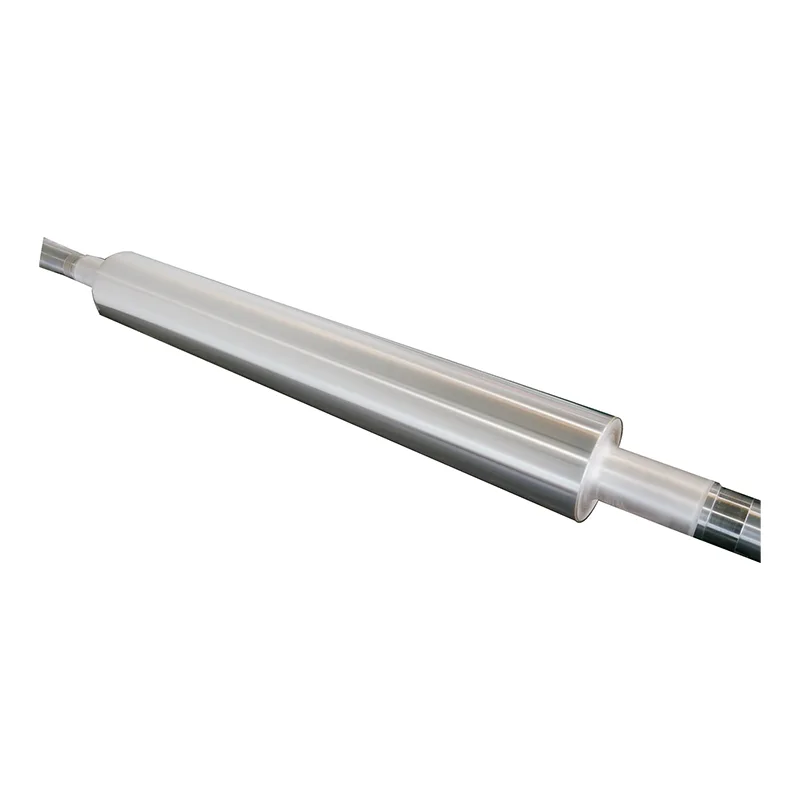
In industrial web handling, converting, and printing applications, the thermal limit of a Silver-Plated Steel Roller directly determines process stability, product quality, and maintenance intervals. For engineers and plant managers sourcing from TaiHui Roll, understanding this threshold is not a matter of guesswork—it is a function of substrate material, plating adhesion, substrate expansion coefficients, and service environment. While many assume silver plating automatically guarantees high-temperature performance, the reality is more nuanced, and the continuous-service ceiling typically falls between 120°C and 150°C for most standard configurations, with specialized variants reaching 180°C under controlled conditions.
The Thermal Threshold: Factors That Define the Limit
The maximum continuous operating temperature is not a single number. It depends on four interdependent variables:
| Factor | Impact on Temperature Limit | Typical Range |
|---|---|---|
| Base steel grade (e.g., AISI 1045 vs. 4140) | Higher alloy content reduces thermal expansion mismatch | ±5–10°C variation |
| Silver plating thickness (5–50 μm) | Thicker plating buffers diffusion but increases stress | 10–15°C improvement per 10 μm |
| Underplating (nickel or copper strike) | Prevents silver-steel intermetallic formation | Extends limit by 15–20°C |
| Ambient atmosphere (air, nitrogen, vacuum) | Oxidation rate accelerates above 150°C in air | 30°C reduction in oxidizing environments |
Critical insight: Above 150°C, silver begins to soften (recrystallization starts near 200°C), and diffusion into the steel substrate accelerates, forming brittle intermetallic layers. This leads to flaking, porosity, and eventual surface roughness—all fatal for precision roller applications.
Why Continuous Service Differs from Intermittent Exposure
In intermittent operation, a Silver-Plated Steel Roller can withstand short spikes up to 200°C without immediate failure because thermal soak time is insufficient for diffusion kinetics to degrade the interface. However, continuous service means sustained thermal equilibrium—the entire roller mass reaches steady-state temperature, and creep, oxidation, and interfacial reactions proceed uninterrupted.
TaiHui Roll engineers recommend the following conservative guidelines based on accelerated life testing (ASTM B700–20 reference):
| Operating Mode | Recommended Max Temperature | Expected Plating Life |
|---|---|---|
| Continuous (24/7) | 120°C | >8,000 hours |
| Continuous with nitrogen purge | 140°C | >6,000 hours |
| Intermittent (≤2 hours/day at peak) | 180°C | >3,000 cycles |
| Short-term emergency (≤15 min) | 200°C | Acceptable, but inspect after |
For applications requiring sustained operation above 150°C, TaiHui Roll offers a high-temperature variant with a diffusion-barrier nickel-cobalt underlayer, certified for continuous use at 170°C in dry-film laminating lines.
Practical Consequences of Exceeding the Limit
When a Silver-Plated Steel Roller operates beyond its continuous thermal ceiling, three failure modes emerge progressively:
-
Silver migration – Silver atoms diffuse into steel grain boundaries, reducing plating adhesion.
-
Oxide tarnishing – Silver oxide (Ag₂O) forms above 170°C in air, increasing coefficient of friction and degrading release properties.
-
Thermal fatigue – Differential expansion between silver (19×10⁻⁶/°C) and steel (12×10⁻⁶/°C) generates micro-cracks, which propagate under web tension.
These failures are not sudden—they manifest as gradual web-wandering, coating streaks, or erratic tension readings. Regular pyrometer monitoring and weekly surface profilometry are recommended practices from TaiHui Roll’s technical service team.
FAQ: Common Questions About Silver-Plated Steel Rollers in High-Heat Environments
Q1: Can I run a Silver-Plated Steel Roller at 160°C if I reduce web tension by 30%?
A1: Reducing tension does not lower the roller’s bulk temperature—the heat source (e.g., drying oven, friction from nip pressure, or IR radiation) still raises the steel core. At 160°C, silver recrystallization begins regardless of mechanical load. While lower tension may delay crack propagation, it does not prevent diffusion-driven adhesion loss. For sustained 160°C operation, TaiHui Roll recommends upgrading to a nickel-barrier plated roller, which has proven stable for over 5,000 hours in polyester film production lines. Without that barrier, expect visible plating separation within 1,500–2,000 hours.
Q2: How do I measure the actual surface temperature of my Silver-Plated Steel Roller during production?
A2: Contact thermocouples are unreliable on rotating rollers due to triboelectric noise and slippage. The industry-standard method is dual-wavelength infrared pyrometry, emissivity set to 0.25–0.30 for polished silver surfaces. Mount the pyrometer at a 45° angle, 150–200 mm from the surface, and take readings at three axial positions (drive side, center, operator side) every 30 minutes during ramp-up. TaiHui Roll provides a free temperature-mapping template with every roller shipment, including correction factors for ambient reflections. Remember that surface temperature can be 8–12°C lower than core temperature under heavy web loads—so always measure at the surface and apply the manufacturer’s derating curve.
Q3: Does periodic cooling (e.g., air knives or water-jacketed journals) extend the maximum continuous temperature for a Silver-Plated Steel Roller?
A3: Active cooling can effectively shift the continuous-service envelope. Forced-air cooling reduces surface temperature by 20–30°C in many converting setups, allowing a standard Silver-Plated Steel Roller to run at 140°C ambient oven temperature while maintaining a 120°C roller surface. However, cooling introduces thermal gradients—the journal may stay cool while the face runs hot, inducing bowing. TaiHui Roll has engineered internally water-circulated rollers that maintain face-to-journal temperature differential under 5°C, enabling stable 155°C continuous operation in gravure printing applications. Always consult the roller’s thermal-map certificate before adding external cooling; improper airflow can create localized hot spots worse than uniform high temperature.
Maintenance Best Practices for High-Temperature Service
To maximize the service life of your Silver-Plated Steel Roller, TaiHui Roll advises a three-tier inspection protocol:
-
Daily: Visual check for discoloration (golden-brown tint indicates silver oxide—reduce temperature by 10°C).
-
Weekly: Stylus profilometry (Ra and Rz) – an increase of >0.2 μm over baseline signals diffusion onset.
-
Quarterly: Eddy-current thickness measurement to verify remaining silver layer ≥80% of original.
Additionally, always specify your continuous operating temperature, dwell time, and ambient gas composition when ordering. TaiHui Roll uses finite-element thermal simulation to validate each roller’s design against your exact process curve—no generic sizing, no assumptions.
Contact Us
Every production line has unique thermal dynamics, and the data above serves as a starting point—not a substitute for application-specific engineering. If your process demands precise temperature management, extended plating life, or a custom high-temp variant, the technical team at TaiHui Roll is ready to review your operating parameters and deliver a thermal-validation report within 48 hours. Reach out through our website’s engineering inquiry form or email our support desk directly—include your current oven profile, web material, and line speed, and we will recommend the optimal Silver-Plated Steel Roller configuration with guaranteed continuous-temperature performance. Let us help you run hotter, longer, and with zero unexpected downtime. Contact TaiHui Roll today—because your roller’s temperature limit should never be your production bottleneck.