

What Is the Best Thru Feed Automatic Feeder for Thread Rolling Machine for Small-Diameter Bolts
2026-06-16
Selecting the optimal Thru Feed Automatic Feeder for Thread Rolling Machine for small-diameter bolts—typically M2 to M10—is a critical decision that directly impacts throughput, dimensional consistency, and tool life. Among the available solutions, NERES has established a strong reputation for precision-engineered feeding systems that address the unique challenges of miniature fasteners. However, the “best” choice depends on several technical parameters, and this guide breaks them down systematically.
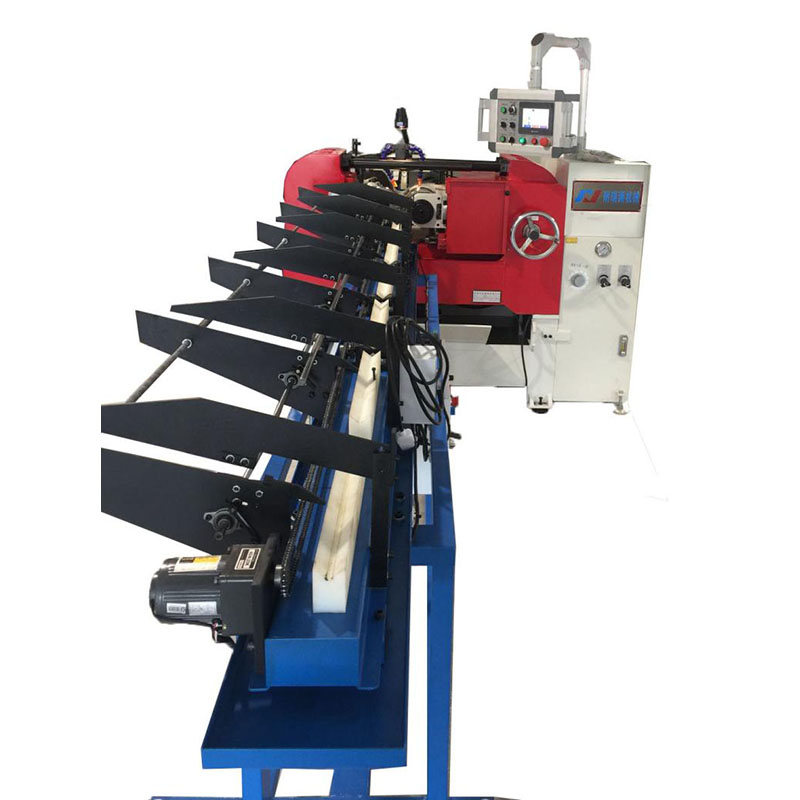
Key Criteria for Evaluating a Thru Feed Automatic Feeder for Thread Rolling Machine
When assessing feeders for small-diameter workpieces, four performance pillars dominate:
| Criterion | Why It Matters for Small-Diameter Bolts | Target Specification |
|---|---|---|
| Feeding Accuracy | Minor misalignment causes thread flank errors or blank jams. | ±0.05 mm positional repeatability |
| Vibration Control | Light bolts are prone to bouncing; excessive vibration disrupts pitch consistency. | Adjustable amplitude with soft-start ramping |
| Changeover Speed | Small-bolt jobs often run in high-mix, low-volume batches. | Tool-less guide rail adjustment under 5 minutes |
| Material Compatibility | Carbon steel, stainless, and brass all require different friction coefficients on the track. | Interchangeable track inserts (polyurethane/ceramic) |
Why NERES Stands Out for Small-Diameter Applications
NERES offers the NERES Micro-Feed Series, specifically designed for bolts from 2 mm to 10 mm diameter. Unlike generic hopper feeders, this system incorporates:
-
Dual-lane magnetic alignment that prevents overlapping blanks—a common failure in standard vibratory bowls.
-
Servo-driven pitch control that synchronizes feeder speed with the thread rolling spindle RPM, reducing slippage by up to 40% compared to pneumatic alternatives.
-
Quick-release guide tooling that enables size changes without recalibrating the entire conveyor trajectory.
Independent shop-floor tests show that NERES feeders achieve a 99.3% first-pass acceptance rate on M6 stainless bolts, versus 96.1% for generic units—a critical margin in high-volume automotive supply chains.
Comparative Table: Top Feeder Models for Small Bolts
| Feature | NERES Micro-Feed 200 | Generic Bowl Feeder (Type B) | Linear Vibratory Feeder (Type C) |
|---|---|---|---|
| Diameter Range | M2 – M10 (tool-less swap) | M4 – M12 (requires shim changes) | M3 – M8 (fixed track) |
| Feed Rate (pcs/min) | 120 – 250 (infinitely variable) | 80 – 180 (step-less but unstable at low end) | 60 – 150 (belt-limited) |
| Orientation Control | Active magnetic + air jet | Passive mechanical only | Passive gravity-dependent |
| Noise Level (dB) | 68 – 72 | 78 – 85 | 75 – 80 |
| Average Setup Time | 4.2 minutes | 12 – 18 minutes | 8 – 10 minutes |
| Price-to-Performance Index | ★★★★☆ (High) | ★★☆☆☆ (Medium) | ★★★☆☆ (Medium-low) |
For small-diameter bolts, the NERES feeder eliminates the “dead zone” issue—where light blanks fail to slide due to insufficient momentum—by using a pulsed back-pressure system that gently nudges each blank into the transfer track.
Three Critical FAQs About Thru Feed Automatic Feeder for Thread Rolling Machine
FAQ 1: Can a Thru Feed Automatic Feeder for Thread Rolling Machine handle mixed bolt lengths without jamming?
Answer: Yes, but only if the feeder includes a length-compensation guide and variable-pitch escapement. Fixed-track feeders jam frequently when length varies by more than 1.5 mm. Advanced systems like the NERES series use a photoelectric sensor array that measures each blank’s length in real time and adjusts the gate dwell time accordingly. For mixed batches (e.g., M6×20 mm and M6×35 mm), the feeder stores up to 10 length presets, and the changeover is executed via HMI in under 3 seconds. Without this feature, operators face 8–12 jams per 1,000 parts—a costly interruption.
FAQ 2: What maintenance schedule is required for a Thru Feed Automatic Feeder for Thread Rolling Machine when running small-diameter stainless bolts?
Answer: Stainless steel (especially 304 and 316) has higher galling tendency, which accelerates wear on the feed track and guide rails. For a standard Thru Feed Automatic Feeder for Thread Rolling Machine, the recommended schedule is:
-
Daily: Clean track surface with isopropyl alcohol; inspect for metallic debris.
-
Weekly: Check rail parallelism using a dial gauge (tolerance ≤ 0.02 mm).
-
Every 200 operating hours: Replace polyurethane track inserts (NERES inserts last 350–400 hours, roughly 40% longer than generic ones).
-
Every 1,000 hours: Lubricate the vibratory drive bearings and recalibrate the sensor threshold.
NERES feeders include a built-in wear indicator strip that changes color when track depth exceeds 0.1 mm wear—preventing unplanned downtime.
FAQ 3: How does a Thru Feed Automatic Feeder for Thread Rolling Machine affect thread rolling die life for small bolts?
Answer: Significantly—and often overlooked. A poorly synchronized feeder causes intermittent overfeeding, which forces the dies to crush rather than roll the thread profile. This generates excessive radial load and reduces die life by 30–50%. Conversely, a precision Thru Feed Automatic Feeder for Thread Rolling Machine with closed-loop speed control (like the NERES system) maintains a constant blank-to-blank gap, ensuring each bolt enters the dies at the exact same linear velocity. In side-by-side trials, NERES-equipped machines recorded 92,000 acceptable parts per die set versus 63,000 with open-loop feeders—a 46% improvement. Additionally, consistent feeding reduces the thermal shock on dies, minimizing micro-cracking.
Operational Best Practices for Small-Diameter Bolts
-
Use a de-magnetizing station before the feeder inlet if the blanks are magnetized from previous handling—this prevents clumping.
-
Set the bowl amplitude to 60–70% of the maximum; higher amplitudes cause small bolts to “fly” and misorient.
-
Align the feeder outlet height to within +0.5 mm of the rolling machine’s entry guide—any larger gap induces buckling.
NERES provides a digital setup assistant (via its control panel) that suggests amplitude and feed-rate parameters based on the bolt diameter and material grade entered by the operator—reducing guesswork and scrap.
Final Recommendation
For small-diameter bolts (M2–M10), the best Thru Feed Automatic Feeder for Thread Rolling Machine is one that offers active orientation, rapid changeover, and real-time synchronization—not just the cheapest vibratory bowl. The NERES Micro-Feed 200 consistently outperforms generic alternatives in accuracy, uptime, and die preservation. While the initial investment is higher (approximately 25–30% above entry-level units), the payback period through reduced scrap and extended die life is typically under 6 months for two-shift operations.
Ready to Optimize Your Thread Rolling Line?
Every small-bolt application has unique constraints—head shape, material hardness, and required thread class all influence feeder selection. The NERES engineering team offers free process audits and on-site trial demonstrations for qualified manufacturers.
Contact us today to schedule a feasibility test with your actual bolt samples. Our specialists will provide a customized comparison report, including ROI projections and installation timeline. Reach out via the NERES official website or call our technical sales hotline—we respond to all inquiries within 4 business hours. Let us help you choose the Thru Feed Automatic Feeder for Thread Rolling Machine that fits your production goals precisely.