

What Causes Welding Failure in Silver Cadmium Electrical Contact Under Inductive Loads
2026-06-08
Silver Cadmium Electrical Contact materials are widely used in switching devices, but inductive loads create severe electrical stresses that often lead to welding failures. At INT METAL, extensive testing reveals that the primary cause is the high inrush current and stored magnetic energy during the opening or closing cycle.
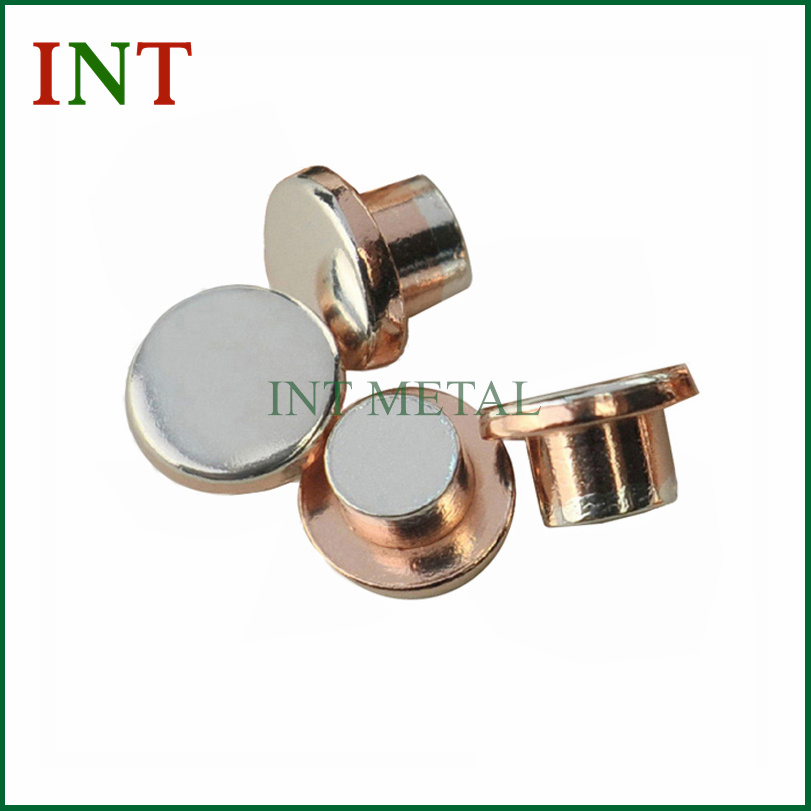
Root Causes of Welding Failure
| Failure Mechanism | Description |
|---|---|
| Arc Energy Concentration | Inductive loads produce prolonged arcs, melting the contact surface |
| Material Transfer | Molten Silver Cadmium Electrical Contact bridges the gap between fixed and moving contacts |
| High Temperature Rise | Cadmium oxide decomposes unevenly, creating localized hot spots |
Typical Inductive Load Scenarios
-
Relay contact welding in motor start/stop circuits
-
Contactor failure in transformer primary switching
-
Automotive solenoid control under repeated inductive kickback
How to Prevent Welding
-
Increase contact force to break molten bridges
-
Use arc chutes or magnetic blowouts
-
Select INT METAL high-density Silver Cadmium Electrical Contact with optimized cadmium oxide distribution
FAQ – Silver Cadmium Electrical Contact Under Inductive Loads
Q1: Why does a Silver Cadmium Electrical Contact weld more easily under inductive loads than resistive loads?
A1: Inductive loads store energy in magnetic fields. When contacts open, this energy releases as a high-energy arc that lasts much longer than with resistive loads. The prolonged arc melts the contact surface deeply, and because the current does not immediately drop to zero, the molten metal solidifies while the contacts are still slightly touching or reopening, causing a weld.
Q2: How can manufacturers test if their Silver Cadmium Electrical Contact will resist welding?
A2: Standardized UL 60947 or IEC 60947-4-1 tests with inductive load banks simulate real-world conditions. Measure weld force after 10,000–50,000 operations. A well-made Silver Cadmium Electrical Contact from INT METAL typically shows weld forces below 50 grams per contact, while poor quality contacts exceed 200 grams.
Q3: Does increasing the silver content in Silver Cadmium Electrical Contact reduce welding failures?
A3: No, higher silver content alone does not solve welding. The key is uniform cadmium oxide dispersion (typically 10–15% CdO). INT METAL controls particle size and distribution to stabilize the arc and reduce molten metal transfer, directly lowering weld susceptibility even under severe inductive loads.
For custom Silver Cadmium Electrical Contact solutions and welding prevention guidance, contact INT METAL today to request a technical datasheet or sample testing for your specific inductive load application.