

What Are the Welding Preheat Requirements for Wear Resistant Hot Rolled Heavy Steel Plate Structural Grades
2026-09-04
When fabricating heavy-duty components for mining, earthmoving, and material handling, the welding procedure for Wear Resistant Hot Rolled Heavy Steel Plate Structural grades often determines the success or failure of the entire assembly. Unlike standard mild steel, these specialized plates combine high hardness (typically 360–500 HBW) with significant carbon equivalents (CEV), making them susceptible to hydrogen-induced cold cracking and martensite formation in the heat-affected zone (HAZ). For over a decade, Sanhe has supplied these advanced steel grades to global heavy industries, and field data consistently show that proper preheat management is the single most critical variable in achieving crack-free, service-ready welded joints.
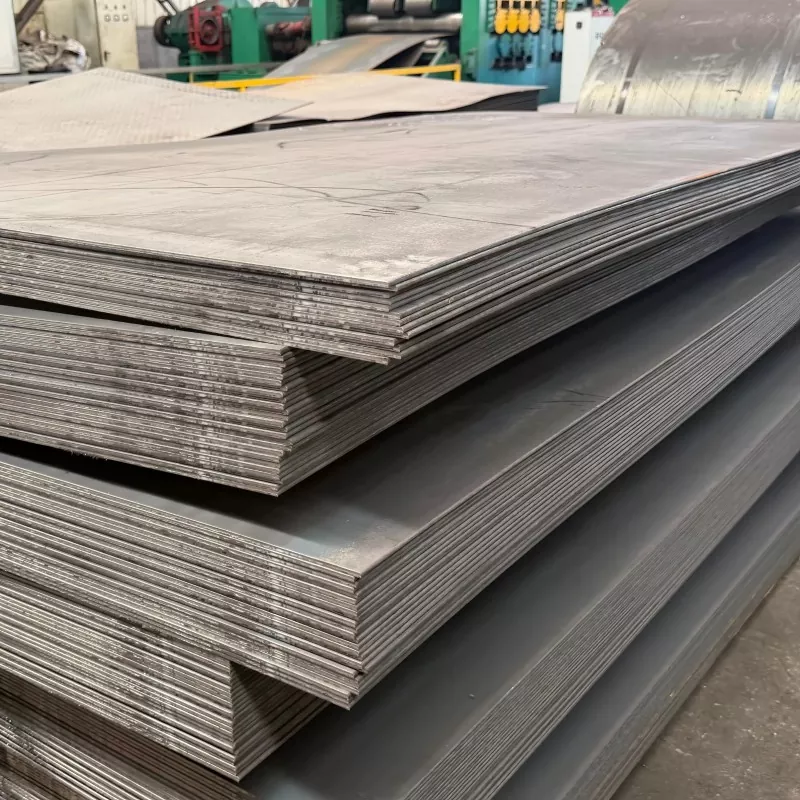
Why Preheat Is Non‑Negotiable
Preheating slows the cooling rate after welding, allowing hydrogen to diffuse out of the weld metal and reducing the hardness peak in the HAZ. For Wear Resistant Hot Rolled Heavy Steel Plate Structural, the required preheat temperature is never a fixed number—it depends on plate thickness, carbon equivalent (CEV), hydrogen content of the consumable, and joint restraint. A generalized baseline, however, starts at 100°C for plates under 20 mm and rises to 150–200°C for thicknesses above 50 mm, assuming low-hydrogen electrodes (H4 or H5 designation).
Minimum Preheat Temperatures by Thickness and CEV
The table below consolidates Sanhe’s internal welding guidelines, which align with AWS D1.1 and EN 1011‑2 recommendations for Wear Resistant Hot Rolled Heavy Steel Plate Structural grades:
| Plate Thickness (mm) | CEV ≤ 0.45 (%) | CEV 0.46–0.55 (%) | CEV > 0.55 (%) | Interpass Temp. Max (°C) |
|---|---|---|---|---|
| 6 – 15 | 75 °C | 100 °C | 125 °C | 250 |
| 16 – 30 | 100 °C | 125 °C | 150 °C | 275 |
| 31 – 50 | 125 °C | 150 °C | 175 °C | 300 |
| 51 – 80 | 150 °C | 175 °C | 200 °C | 325 |
Note: These values assume a maximum diffusible hydrogen of 5 ml/100g (H5). For H10 electrodes, add 25–50 °C to all figures.
Additional Control Measures
Beyond setting the torch temperature, three complementary practices are essential:
-
Heating rate – For plates over 40 mm, ramp up at ≤200 °C per hour to avoid thermal shock.
-
Temperature verification – Use contact thermocouples or infrared pyrometers at least 75 mm from the weld groove, not on the surface flame.
-
Post‑weld treatment – When the joint is highly restrained, maintain preheat for 2–4 hours after welding, followed by a slow cooling in insulating blankets.
Sanhe routinely provides certified welding procedure specifications (WPS) for each batch of Wear Resistant Hot Rolled Heavy Steel Plate Structural, ensuring that shop floors can translate these numbers into reproducible, qualified procedures without guesswork.
Practical Workflow for Production Welding
-
Clean the groove – Remove oil, rust, and moisture within 50 mm of the joint.
-
Apply uniform preheat – Use induction or resistance heating for better uniformity than oxy‑fuel.
-
Monitor interpass temperature – Do not allow the temperature to drop below the minimum preheat between passes.
-
Select low‑hydrogen consumables – Basic flux‑cored wires or solid wires with H4 classification are mandatory.
-
Control heat input – Keep energy between 1.0 and 2.5 kJ/mm; excessive input softens the wear‑resistant layer.
Frequently Asked Questions
Q: Can I weld Wear Resistant Hot Rolled Heavy Steel Plate Structural without preheat if I use austenitic stainless steel electrodes?
A: No. While austenitic filler metals (e.g., E309L) have higher tolerance to hydrogen and can reduce cracking risk, they do not eliminate the need for preheat when the base plate is thick (≥20 mm) or has CEV > 0.48. The thermal expansion mismatch between austenitic weld metal and the martensitic HAZ creates shear stresses that, without preheat, often lead to toe cracking during cooling. Sanhe advises using preheat even with austenitic fillers—at least 75 °C for thin sections and 100 °C for heavier gauges—and always backing it with a hydrogen‑controlled shop environment.
Q: How do I determine the exact preheat temperature for a specific thickness if I don’t have the mill certificate with CEV?
A: This is a common field challenge. Without a certified CEV, the conservative approach is to use the maximum value from the table above for the given thickness—i.e., assume CEV > 0.55. Additionally, you can perform a simple spot hardness test on a sample coupon after a trial weld; if the HAZ hardness exceeds 350 HV10, increase preheat by 25 °C increments until the hardness drops below that threshold. Sanhe includes a detailed CEV calculation and a preheat calculator on every product data sheet, so customers rarely face this guesswork. For urgent cases, we recommend retaining a mobile spectrometer to verify actual chemistry on‑site.
Q: Does the preheat requirement change if I am welding Wear Resistant Hot Rolled Heavy Steel Plate Structural to a mild steel backing plate?
A: Yes, significantly. The rule of thumb is to apply the preheat required for the more demanding base material—in this case, the wear‑resistant plate. However, because the mild steel side has lower thermal conductivity and higher ductility, you can often reduce the preheat by 20–30 °C when the wear‑resistant plate thickness is less than 30 mm and the mild steel section is at least twice as thick. That said, Sanhe recommends always qualifying a mock‑up joint under your actual shop conditions, because the differential expansion rates can cause distortion even if cracking is avoided. For production, we suggest 100 °C as a safe minimum when joining these dissimilar thicknesses, with active interpass monitoring on the wear‑resistant side.
Quality Assurance and Documentation
Every shipment from Sanhe includes full traceability—from ladle analysis to mechanical properties—so that welding engineers can select preheat parameters with confidence. We also offer on‑site technical support for large‑scale fabrication projects, helping teams calibrate heating equipment and validate procedure qualification records (PQR) specifically for Wear Resistant Hot Rolled Heavy Steel Plate Structural.
Ready to Optimize Your Welding Process?
Getting preheat right is the difference between a component that lasts 10,000 hours and one that fails in the first 500. Sanhe provides not only premium Wear Resistant Hot Rolled Heavy Steel Plate Structural but also the technical documentation, WPS templates, and metallurgical support to make your welding operations predictable and profitable.
Contact us today to request custom‑cut plates, certified welding procedures, or a technical consultation for your specific application. Our engineering team is ready to review your joint designs, thickness combinations, and shop capabilities—ensuring your next heavy‑steel project meets every performance target, on time and within budget. Reach out via our website or email, and let’s build something that lasts.