

What Are the Most Common Hole Patterns Available for a Pre-Drilled Carbon Steel Plate
2026-07-23
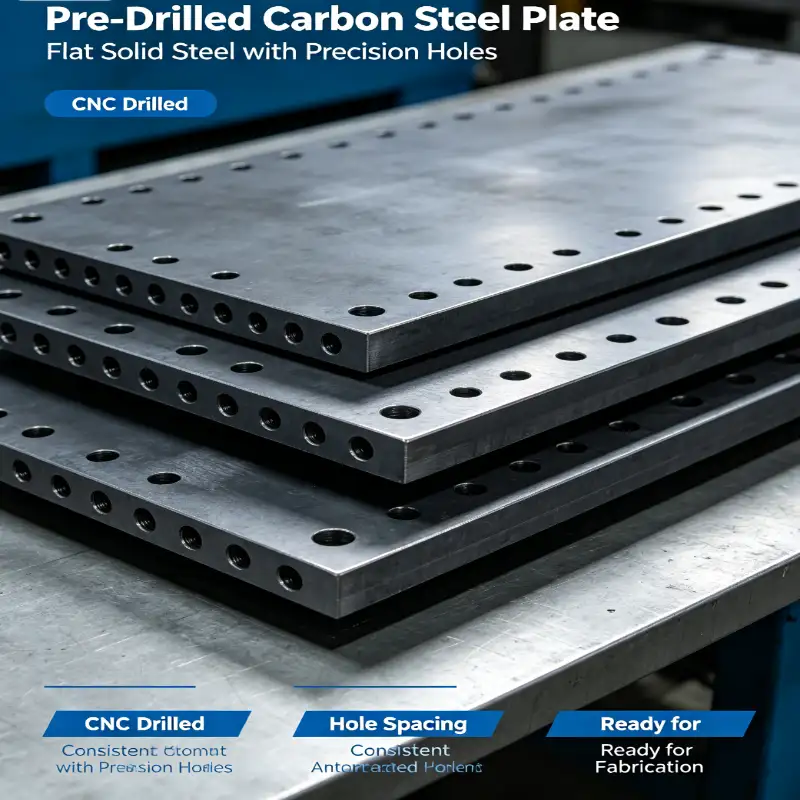
When engineers and fabricators specify a PRE-DRILLED CARBON STEEL PLATE, the hole pattern is often the deciding factor between a smooth assembly and a costly field modification. At Shunchen, we have supplied thousands of metric tons of perforated plates across infrastructure, mining, and heavy equipment sectors, and we consistently see that choosing the right hole layout directly impacts structural integrity, bolt shear capacity, and installation speed. This guide breaks down the industry-standard hole patterns, their typical applications, and the critical tolerances that every specifier should verify before placing an order.
Standard Hole Pattern Categories
Hole patterns on a PRE-DRILLED CARBON STEEL PLATE fall into three functional families: structural bolting, drainage/filtration, and modular anchoring. The table below summarizes the most requested configurations based on our Shunchen production records over the last 24 months.
| Pattern Name | Typical Hole Diameter | Center-to-Center Spacing | Primary Application |
|---|---|---|---|
| Structural Staggered (Diamond) | 18–30 mm | 2.5× – 3.5× diameter | Beam splices, column base plates, seismic connections |
| Square Grid (Orthogonal) | 10–25 mm | 40–100 mm (fixed module) | Platform flooring, walkway grating, machine bedplates |
| Slotted (Oval) Pattern | 22×40 mm to 30×60 mm | Varies by slot length | Expansion joints, thermal movement connections, adjustment points |
| Flanged Bolt Circle (PCD) | 14–36 mm | Equal angular spacing on a defined radius | Pipe flanges, gearbox mounts, hydraulic manifold plates |
| Perforated (Round Hole) Array | 3–12 mm | 1.5× – 2× diameter | Acoustic panels, screen decks, filtration housings |
Detailed Breakdown of Each Pattern
1. Structural Staggered (Diamond) Pattern
This is the default choice for load-bearing connections. Holes are arranged in rows offset by half the spacing, creating uniform shear planes across the joint. For a PRE-DRILLED CARBON STEEL PLATE used in high-rise steel frames, Shunchen recommends a minimum edge distance of 1.5× the hole diameter to prevent tear-out. This pattern accommodates both ASTM A325 and A490 high-strength bolts.
2. Square Grid Pattern
When modularity is priority, the square grid offers predictable alignment with pre-fabricated support structures. It is the most economical pattern to CNC-drill because traverse movements are linear. However, for a PRE-DRILLED CARBON STEEL PLATE exposed to dynamic loads, square grids are less fatigue-resistant than staggered layouts—a fact that Shunchen engineers always highlight during design reviews.
3. Slotted (Oval) Pattern
Slotted holes are not strictly "round," but they are increasingly specified to accommodate thermal expansion in processing plants. The slot width matches the bolt shank, while the length provides 10–30 mm of adjustment. Shunchen produces slotted patterns with fully radiused ends to avoid stress concentration cracks.
4. Flanged Bolt Circle (PCD – Pitch Circle Diameter)
Commonly found on circular plates, the PCD pattern requires angular precision within ±0.5°. For a PRE-DRILLED CARBON STEEL PLATE destined for API 6A flanges, Shunchen uses laser-projected layout verification to ensure all holes fall within the specified chordal tolerance.
5. Perforated Round-Hole Array
Though often confused with expanded metal, this pattern is purely drilled. It serves ventilation, lightening, and screening purposes. The open area percentage typically ranges from 23% to 46%, depending on the staggered pitch.
Critical Tolerances You Cannot Ignore
Beyond pattern geometry, three tolerance classes define a quality PRE-DRILLED CARBON STEEL PLATE:
-
Hole diameter tolerance: +0.5 mm / -0.0 mm for clearance holes; +0.05 mm for reamed fit holes.
-
Positional tolerance: ±0.8 mm between adjacent holes; ±1.5 mm over 1,000 mm pitch.
-
Edge margin: Minimum 1.2× hole diameter for sheared edges; 1.5× for flame-cut edges.
Shunchen applies ISO 2768-mK as a baseline, but we always confirm the customer’s structural code (AISC, Eurocode 3, or GB 50017) before programming the CNC drilling line.
Frequently Asked Questions (FAQ) About Pre-Drilled Carbon Steel Plate
Q1: Can I request a custom hole pattern that is not listed in standard catalogs?
A: Absolutely. Shunchen accepts fully custom hole patterns provided you supply a DXF or DWG file with explicit coordinates. Our CNC drilling machines read digital layouts directly, so we can execute asymmetric patterns, mixed-diameter arrays, or even tapered hole clusters. The only constraints are the plate width (max 3,200 mm) and thickness (6–150 mm). We will generate a layout verification drawing within 24 hours for your approval—no extra charge for the first revision.
Q2: How do I decide between a staggered pattern and a square grid for a heavy-load baseplate?
A: Choose a staggered (diamond) pattern if your PRE-DRILLED CARBON STEEL PLATE will bear cyclic or eccentric loads, because the offset hole arrangement distributes stress over a wider net section and reduces the likelihood of rupture along a straight bolt line. Choose a square grid only if your supporting structure has fixed, equally spaced beams and you prioritize drilling speed over fatigue performance. For crane rails or press foundations, Shunchen strongly recommends staggered patterns with a 60° pitch angle.
Q3: What surface preparation is recommended after drilling to maintain hole accuracy?
A: Drilling creates microscopic burrs and heat-affected zones that can alter effective hole diameter by up to 0.2 mm. Shunchen automatically deburrs both faces of every PRE-DRILLED CARBON STEEL PLATE using a rotary brush station. For holes intended for tension-control bolts, we recommend a light chamfer (0.5–1.0 mm × 45°) on the entry side to ease bolt starting. If the plate will be hot-dip galvanized afterward, inform us in advance—we will oversize holes by 0.5 mm to compensate for zinc buildup, preserving your final fit-up clearance.
Pattern Selection Workflow – A Quick Checklist
To streamline your specification process, Shunchen uses this five-step filter with every client:
-
Define load type (static, cyclic, or impact).
-
Determine bolt grade and tightening method (torque or tension).
-
Confirm edge distance relative to plate thickness.
-
State required adjustment allowance (if any).
-
Specify coating thickness if post-drill galvanizing is planned.
Following this sequence typically reduces RFQ revision cycles by 40%.
Final Consideration – Why Supplier Experience Matters
Drilling a hole is simple; drilling hundreds of identical holes with consistent positional accuracy across a 12-meter PRE-DRILLED CARBON STEEL PLATE is a manufacturing discipline. Shunchen operates six high-speed CNC gantry drills with automatic tool changers and in-process dimensional feedback. Every batch undergoes a first-article inspection using a coordinate measuring machine (CMM), and we retain drill-log data for full traceability. This is not standard practice for many local workshops—but it is our daily routine.
Ready to lock in your hole pattern and get a firm production quote?
Contact Shunchen today with your plate grade, thickness, and hole layout sketch. Our technical sales team will respond within 4 business hours with a detailed proposal, including drilling lead time, tolerance commitment, and certified mill test reports.