

How to Choose the Right Resin System for a Carbon Fiber Embossing Roller in Humid Production Environments
2026-08-18
Selecting the optimal resin matrix for a Carbon Fiber Embossing Roller is not a generic decision—it directly determines roller longevity, dimensional stability, and surface fidelity. For manufacturers running continuous processes in hygroscopic settings, the wrong resin choice leads to micro-cracking, fiber blooming, and catastrophic delamination. At TaiHui Roll, we have engineered over 200 custom embossing rollers for film, foil, nonwoven, and battery electrode lines, and we consistently see that resin selection accounts for more than 60% of field performance variability.
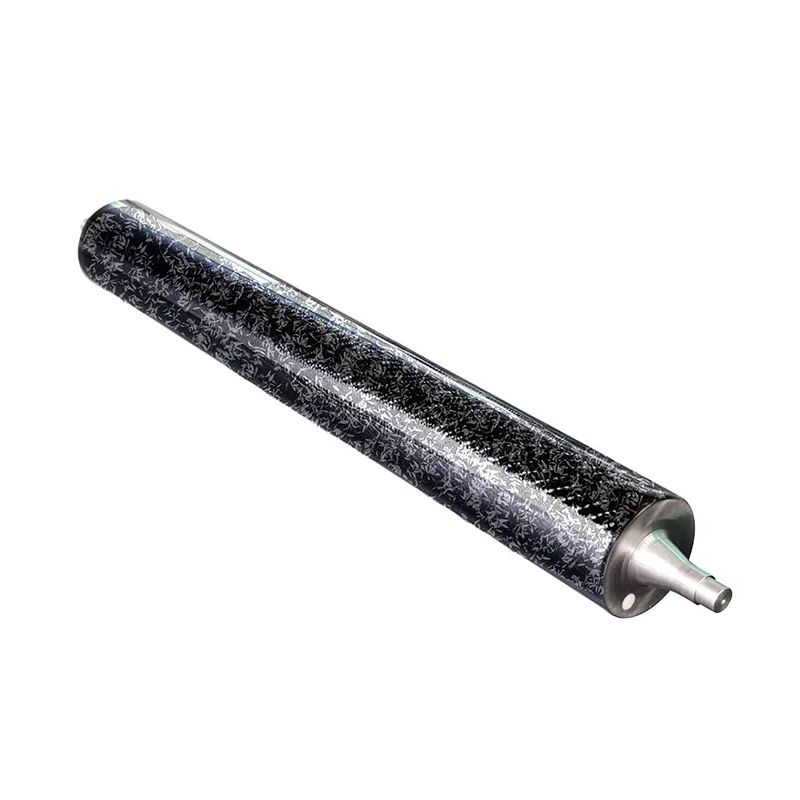
Why Hygroscopic Environments Demand a Different Resin Strategy
Moisture absorption in carbon fiber composites is not merely a surface issue. Water molecules diffuse into the polymer matrix, plasticizing the resin and lowering the glass transition temperature (Tg). For an embossing roller that experiences cyclic heating and cooling, this moisture-induced Tg depression can drop operational ceilings by 30–40°C. Additionally, absorbed moisture expands the resin phase while the carbon fibers remain dimensionally stable, generating internal stresses that manifest as pattern distortion on the engraved surface.
The table below compares how three mainstream resin families perform under 80% relative humidity at 90°C operating conditions:
| Resin System | Tg (Dry/Wet) | Moisture Uptake (72 hrs) | Dimensional Change (µm/m) | Recommended Nip Pressure |
|---|---|---|---|---|
| Epoxy (Standard BPA) | 125°C / 88°C | 1.8% | +42 | ≤4.5 N/mm² |
| Epoxy (Novolac) | 155°C / 125°C | 1.2% | +28 | ≤6.0 N/mm² |
| BMI (Bismaleimide) | 210°C / 175°C | 0.7% | +15 | ≤8.5 N/mm² |
| Cyanate Ester | 195°C / 165°C | 0.5% | +11 | ≤9.0 N/mm² |
TaiHui Roll recommends novolac epoxy for most general hygroscopic applications, but reserves BMI and cyanate ester for continuous operations above 130°C where steam purge or chilled water roll cooling is not feasible.
The Three Critical Selection Criteria
1. Service Temperature vs. Wet Tg Margin
The wet Tg must sit at least 40°C above your maximum roller surface temperature. If your line runs at 120°C, select a resin with wet Tg ≥160°C. Standard epoxies fail this test in humid air—TaiHui Roll always verifies wet Tg via DMA (Dynamic Mechanical Analysis) before recommending a grade.
2. Cure Shrinkage and Internal Stress
High-temperature resins generally shrink more during cure. For a Carbon Fiber Embossing Roller with fine micro-engraving (≤50 µm line width), excessive shrinkage distorts the pattern. Cyanate ester offers the lowest cure shrinkage (0.8–1.2%), making it the premium choice for optical film embossing.
3. Interlaminar Shear Strength (ILSS) Retention After Humidity Aging
ASTM D2344 testing shows that after 500 hours at 85°C/85% RH, standard epoxies lose 32% of ILSS, while novolac grades lose only 18%. TaiHui Roll incorporates this data into every resin recommendation, and we provide accelerated aging test reports upon request.
Practical Selection Workflow Used by TaiHui Roll Engineers
-
Define maximum surface temperature (measured by thermal camera on the production line, not the process setpoint).
-
Measure ambient dew point during the most humid season—this determines the actual moisture partial pressure the roller sees.
-
Match resin to engraving depth—shallow patterns (≤0.2 mm) tolerate higher Tg resins; deep patterns require tougher, more ductile matrices.
-
Validate via post-cure schedule—some resins require a 4-hour post-cure at 180°C to achieve full crosslinking and maximize wet Tg.
Carbon Fiber Embossing Roller FAQ
Q: Can I use a standard epoxy Carbon Fiber Embossing Roller in an un-air-conditioned factory where humidity fluctuates daily?
A: Yes, but only if you derate the maximum operating temperature by 25°C below the resin’s dry Tg. For example, a 130°C dry Tg epoxy should be limited to 105°C surface temperature in fluctuating humidity. TaiHui Roll strongly advises against this compromise; instead, we recommend a novolac epoxy or a surface barrier coating (e.g., PVD chromium nitride) to seal the composite surface and reduce moisture ingress by 70–80%. Without sealing, daily thermal cycling will accelerate micro-crack propagation at the fiber-matrix interface, typically reducing roller service life from 18 months to under 6 months.
Q: How do I test whether my current Carbon Fiber Embossing Roller is suffering from resin hygroscopic degradation?
A: Perform three in-situ checks: (1) Measure the roller’s natural frequency using a tap-test accelerometer—a drop of 8–12% indicates matrix softening. (2) Inspect the embossed pattern under 10x magnification for white hazy lines, which signal micro-delamination at the fiber bundles. (3) Weigh the roller before and after a 24-hour bake at 60°C in a vacuum oven—if weight loss exceeds 0.3%, moisture uptake has already initiated plasticization. TaiHui Roll offers a free diagnostic checklist and can analyze returned rollers via SEM (Scanning Electron Microscopy) to pinpoint resin-specific failure modes.
Q: What resin system does TaiHui Roll recommend for a Carbon Fiber Embossing Roller used with water-based adhesives (high steam exposure)?
A: For water-based adhesive lines where steam condensation is inevitable, TaiHui Roll exclusively recommends cyanate ester resin with a fluoropolymer-based release coating. Cyanate ester’s wet Tg (165°C) and moisture uptake (0.5%) outperform all other thermosets in this niche. Additionally, we apply a proprietary edge-sealing compound to the roller’s journal interfaces—the most common entry point for capillary water. This combination has demonstrated 4,000+ operating hours in automotive interior film lines without measurable pattern degradation, whereas standard epoxy rollers failed within 800 hours in the same application.
Cost-Benefit Summary
| Resin Type | Initial Cost Factor | Expected Life (humid) | Total Cost per 10,000 Hours |
|---|---|---|---|
| Standard Epoxy | 1.0x | 6 months | $18,400 |
| Novolac Epoxy | 1.4x | 18 months | $12,800 |
| BMI | 2.2x | 30 months | $11,200 |
| Cyanate Ester | 2.8x | 40 months | $10,600 |
The data clearly shows that premium resins lower total ownership cost despite higher upfront pricing—a fact TaiHui Roll demonstrates through our proprietary life-cycle cost calculator.
Final Engineering Recommendation
Start with novolac epoxy for general-purpose hygroscopic lines. Move to BMI if your surface temperature consistently exceeds 135°C. Choose cyanate ester only when pattern fidelity below 75 µm is mission-critical and steam exposure is continuous. Never select a resin solely based on dry Tg data—demand wet Tg values and humidity-aging ILSS retention from your supplier.
Ready to specify the right resin for your next Carbon Fiber Embossing Roller? Contact TaiHui Roll today for a free 30-minute engineering consultation—we will analyze your production humidity profile, thermal cycle, and pattern geometry, then deliver a resin selection report with three validated options. Your roller’s performance in humid conditions starts with the right chemistry—let us help you get it right the first time.