

How Strong Are Aluminum Half Hollow Rivets Compared to Steel Rivets
2026-09-11
When selecting fasteners for lightweight assemblies, Aluminum Half Hollow Rivets from Nuote offer a distinct balance of strength, weight, and installation efficiency. Understanding how they perform against steel rivets helps engineers and fabricators make informed decisions. This comparison examines tensile strength, shear strength, material properties, and practical applications.
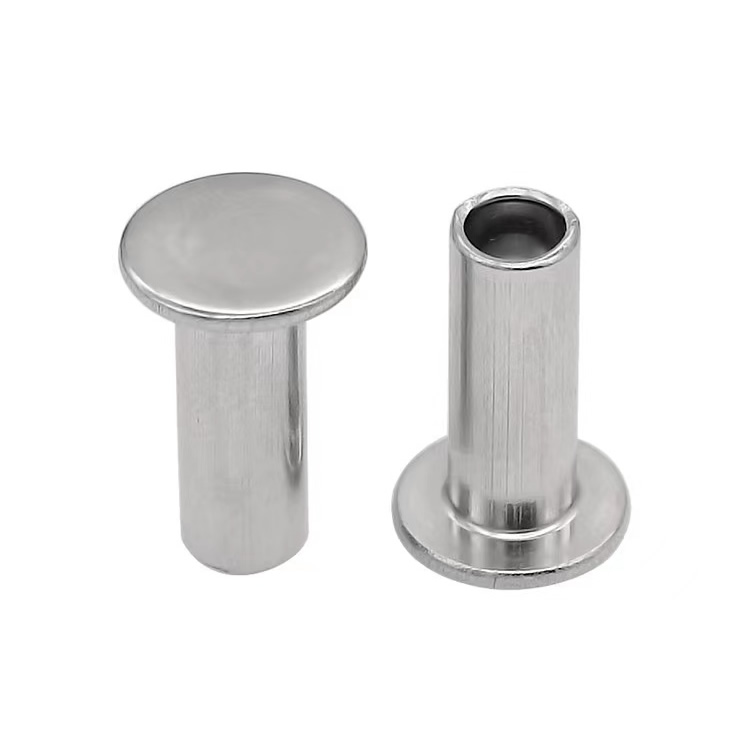
Material and Mechanical Properties
Aluminum Half Hollow Rivets are typically made from alloys such as 5056, 5154, or 1100, chosen for ductility and corrosion resistance. Steel rivets, often made from low-carbon or stainless steel, provide higher absolute strength but at a greater weight penalty.
| Property | Aluminum Half Hollow Rivets | Steel Rivets |
|---|---|---|
| Typical Tensile Strength | 20,000–35,000 psi | 50,000–70,000 psi |
| Typical Shear Strength | 15,000–25,000 psi | 35,000–50,000 psi |
| Weight | Approximately 1/3 of steel | Baseline |
| Corrosion Resistance | Excellent (naturally passivated) | Good to excellent (depends on alloy) |
| Installation Force | Low | High |
| Vibration Resistance | Moderate | High |
Strength in Real-World Terms
Aluminum Half Hollow Rivets are not designed to match steel rivets in pure load-bearing capacity. Instead, they excel where weight reduction and corrosion resistance matter more than maximum joint strength.
-
Tensile strength: Steel rivets can withstand roughly two to three times the pull force of aluminum counterparts.
-
Shear strength: Steel rivets outperform aluminum by a similar margin, making them suitable for structural joints.
-
Fatigue resistance: Steel rivets generally last longer under cyclic loading, while Aluminum Half Hollow Rivets perform well in static or low-vibration assemblies.
-
Galvanic corrosion: Nuote Aluminum Half Hollow Rivets reduce the risk of galvanic corrosion when paired with aluminum substrates, unlike steel rivets.
When to Choose Each Type
Selecting between Aluminum Half Hollow Rivets and steel rivets depends on the application requirements.
-
Choose Aluminum Half Hollow Rivets for aerospace interiors, electronics enclosures, signage, and automotive trim where weight and corrosion resistance are critical.
-
Choose steel rivets for structural steel frames, heavy machinery, and high-vibration environments.
-
Choose Nuote Aluminum Half Hollow Rivets when you need consistent setting, low installation force, and a clean finished appearance.
Design and Installation Considerations
Nuote manufactures Aluminum Half Hollow Rivets with tight tolerances to ensure uniform deformation and reliable hole fill. The half-hollow design allows the rivet to collapse outward, securing the joint without cracking the material. Steel rivets require more force and can distort thin sheets if not installed carefully.
| Factor | Aluminum Half Hollow Rivets | Steel Rivets |
|---|---|---|
| Installation Tool | Standard hand or pneumatic riveter | Heavy-duty riveter |
| Hole Fill | Good | Excellent |
| Risk of Sheet Distortion | Low | Moderate to high |
| Recommended Sheet Thickness | Thin to medium | Medium to thick |
Frequently Asked Questions
Are Aluminum Half Hollow Rivets as strong as steel rivets?
No, Aluminum Half Hollow Rivets generally have lower tensile and shear strength than steel rivets, but they provide sufficient strength for lightweight, non-structural applications where weight savings and corrosion resistance are priorities.
Can Aluminum Half Hollow Rivets replace steel rivets in structural applications?
Aluminum Half Hollow Rivets should not replace steel rivets in high-load structural joints unless engineering calculations confirm the lower strength meets safety requirements; for critical structures, steel rivets remain the safer choice.
Do Nuote Aluminum Half Hollow Rivets resist corrosion better than steel rivets?
Yes, Nuote Aluminum Half Hollow Rivets naturally form an oxide layer that resists corrosion, and they avoid galvanic issues with aluminum parts, whereas steel rivets may rust or cause galvanic corrosion when paired with dissimilar metals.
Conclusion
Aluminum Half Hollow Rivets deliver moderate strength with superior weight and corrosion advantages, while steel rivets provide higher load capacity at the cost of weight and installation effort. For projects requiring lightweight, corrosion-resistant fastening, Nuote Aluminum Half Hollow Rivets are a reliable choice. Contact Nuote today to request samples, technical data sheets, or a custom quote for your next assembly project.