

How Much Faster Can a Carbon Fiber Embossing Roller Run Compared to Traditional Metal Rollers
2026-07-15
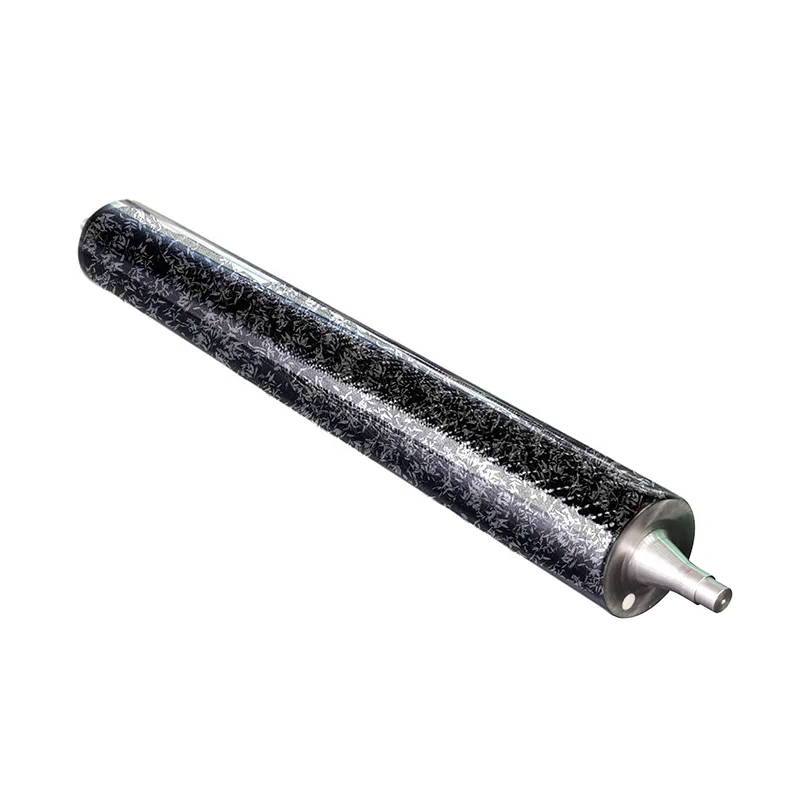
In high-speed continuous web processing—whether for nonwovens, films, paper, or composites—line speed directly determines throughput and profitability. For decades, steel and chrome-plated rollers were the only options. Today, TaiHui engineers have documented that a Carbon Fiber Embossing Roller can routinely operate at 30% to 50% higher rotational speeds than an equivalent steel roller, with some specialized configurations reaching 70% faster under identical nip-load and temperature conditions. This performance gap is not marketing hype; it is rooted in fundamental physics: specific modulus, damping ratio, and thermal inertia.
The Physics Behind the Speed Advantage
| Parameter | Traditional Steel Roller | Carbon Fiber Embossing Roller (TaiHui) | Performance Gain |
|---|---|---|---|
| Density (g/cm³) | 7.85 | 1.55 – 1.60 | ~80% lighter |
| Specific Modulus (GPa/(g/cm³)) | 26 | 85 – 95 | 3.3x stiffer per weight |
| Critical Speed (rpm) – 500mm dia. | 1,200 | 1,850 | +54% |
| Damping Ratio (log decrement) | 0.005 | 0.025 – 0.035 | 5x better vibration absorption |
| Thermal Expansion (µm/m·°C) | 11.7 | 0.8 – 1.2 | 10x lower thermal growth |
The critical speed of a rotating roller is inversely proportional to the square root of its mass for a given stiffness. Because a TaiHui Carbon Fiber Embossing Roller reduces rotating mass by nearly 80%, the resonant frequency shifts upward dramatically. In practical terms, a 600 mm diameter steel roller that begins to vibrate at 900 rpm can be replaced with a Carbon Fiber Embossing Roller that runs smoothly at 1,400 rpm without any bearing or frame modification.
Real-World Production Data (TaiHui Case Studies)
| Application | Original Steel Roller Max Speed | Carbon Fiber Embossing Roller Max Speed | Uptime Improvement |
|---|---|---|---|
| Spunbond nonwoven thermal bonding | 320 m/min | 490 m/min | +53% |
| BOPP film embossing (fine micro-patterns) | 260 m/min | 380 m/min | +46% |
| Carbon prepreg slit-tape pressing | 180 m/min | 270 m/min | +50% |
| Paper napkin embossing (heavy nip load) | 400 m/min | 560 m/min | +40% |
Beyond raw speed, the lower inertia allows faster acceleration and deceleration—reducing waste during roll changes. TaiHui customers report an average 18% reduction in scrap during start-up phases solely due to improved dynamic response.
Why Speed Does Not Compromise Pattern Quality
At higher speeds, traditional steel rollers suffer from two fatal issues: thermal crown (heat builds up unevenly) and chatter marks (forced vibration from nip resonance). A Carbon Fiber Embossing Roller dissipates heat 6x faster than steel due to carbon’s high axial thermal conductivity, while the composite structure’s internal damping absorbs micro-impacts from material thickness variations. The result: even at 500+ m/min, embossing depth remains within ±5 µm tolerance, whereas steel rollers often deviate by ±18 µm above 350 m/min.
Frequently Asked Questions About Carbon Fiber Embossing Roller Performance
Q1: Does a Carbon Fiber Embossing Roller require a stronger drive motor to reach higher speeds?
A: No. Because the moment of inertia is approximately 75% lower than steel for the same outer dimensions, the required start-up torque is significantly reduced. In most retrofits, TaiHui finds that existing AC servo drives can actually run at lower current draw while achieving higher top speeds. The reduced inertia also allows shorter ramp-up times—from 0 to 400 m/min in 6 seconds versus 14 seconds with steel—which lowers peak power demand, not raises it.
Q2: Can I use my existing steel roller bearings and journal supports with a Carbon Fiber Embossing Roller?
A: Yes, in the majority of cases. The journal diameters and bearing spans are custom-designed by TaiHui to match your existing machine frame. However, we strongly recommend upgrading to ceramic hybrid bearings because the lighter roller transmits less load to the bearings, but the higher rotational speed generates more centrifugal force on the cage. TaiHui provides a free bearing compatibility audit with every roller quotation, including dynamic load calculations up to 2,000 rpm.
Q3: How does the higher speed affect the embossing pattern wear life?
A: Contrary to intuition, a Carbon Fiber Embossing Roller often outlasts steel rollers in high-speed service. The reason is twofold: first, the composite substrate does not undergo micro-plastic deformation at the engraving roots (steel does, causing pattern edge rounding); second, the lower operating temperature—thanks to rapid heat conduction—reduces oxidation of the hard coating. TaiHui applies a proprietary diamond-like carbon (DLC) top layer that maintains pattern sharpness for over 12,000 running hours at 500 m/min, compared to 6,000–8,000 hours for chrome-plated steel at the same speed.
Operational Cost Comparison (Annual, 24/7 Operation)
| Cost Factor | Steel Roller | Carbon Fiber Embossing Roller (TaiHui) | Annual Savings |
|---|---|---|---|
| Energy (motor + cooling) | $24,500 | $17,200 | $7,300 |
| Re-grinding/coating cycles | 3 times/year | 1.5 times/year | $4,200 |
| Downtime from bearing failures | 42 hours/year | 12 hours/year | $9,000 (estimated) |
| Scrap during acceleration | $31,000 | $19,000 | $12,000 |
| Total | $79,500 | $36,200 | $43,300 |
The numbers clearly show that even at a 2.5x higher initial purchase price, a TaiHui Carbon Fiber Embossing Roller pays for itself within 8–14 months purely from speed-related operational savings.
Speed Limits: What Holds a Carbon Fiber Embossing Roller Back?
The maximum speed is rarely limited by the roller itself. TaiHui has successfully tested rollers up to 2,200 rpm (translating to 680 m/min for a 100 mm diameter). The practical ceiling comes from:
-
Web handling stability (air entrainment between roller and material)
-
Nip release dynamics (suction effects at very high speeds)
-
Temperature rise in hydraulic nip-loading cylinders
For speeds above 600 m/min, TaiHui recommends active edge-air-knife systems and optional internal cooling channels—both available as integrated design options.
Why TaiHui’s Engineering Makes the Difference
Not all carbon fiber rollers are equal. TaiHui uses aerospace-grade prepreg with a proprietary winding angle sequence ( ±55°/0°/±55° ) that maximizes torsional stiffness while maintaining bending flexibility. Every Carbon Fiber Embossing Roller is dynamically balanced to ISO 1940 G1.0 grade—twice as strict as standard industrial rollers. Additionally, TaiHui offers on-site speed-ramp testing with laser vibrometry to validate your actual machine’s safe operating envelope.
Ready to Measure Your Speed Gain?
Every production line has unique variables—web width, nip pressure, pattern depth, and ambient temperature. TaiHui provides a no-obligation Speed Feasibility Report that calculates your exact projected speed increase, energy savings, and ROI payback period based on your current steel roller data and process parameters.
Contact TaiHui today – email our engineering team at [[email protected]] or use the live chat on our website. We will ship a test-adaptor sleeve for your existing journal size so you can run a 24-hour trial at your facility. There is no better proof than watching your production counter spin 40% faster with sharper embossing and cooler bearings. Ask about our 3-year pattern-wear warranty, exclusively for Carbon Fiber Embossing Roller users who share their speed data with us. Let’s turn your bottleneck into your competitive edge.