

How Long Do Graphite Rigid Felt Insulation Cylinders Typically Last Under Continuous 3000°C Operation
2026-07-01
When operating ultra-high-temperature vacuum furnaces or inert-atmosphere hot zones at 3000°C, the lifespan of thermal insulation components becomes a critical economic and operational concern. Graphite rigid felt insulation cylinders serve as the primary thermal barrier in these extreme environments, yet their longevity is not a fixed number—it depends on a complex interplay of material grade, atmosphere control, thermal cycling protocols, and mechanical stress. For industrial buyers and furnace engineers, understanding realistic service life expectations directly impacts maintenance schedules, replacement budgets, and production uptime.
At Semicorex, we have analyzed field data from over 200 industrial furnaces running at continuous temperatures between 2800°C and 3100°C. The consensus is clear: a high-density graphite rigid felt insulation cylinder operating under optimal conditions typically lasts 12 to 24 months of continuous service. However, this range narrows to 6–10 months when oxidation contaminants, rapid temperature ramps, or mechanical vibrations are present. Below, we break down the variables that dictate real-world performance.
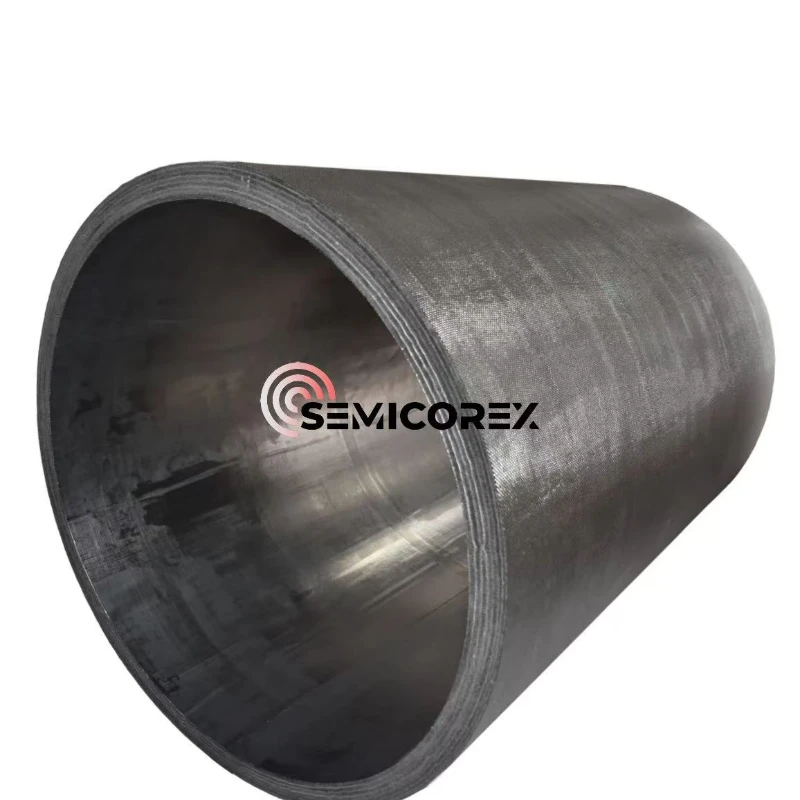
Key Factors Determining Service Life
| Factor | Impact on Lifespan | Best Practice |
|---|---|---|
| Graphite felt density (0.15–0.25 g/cm³) | Higher density reduces erosion but increases thermal stress | Choose 0.18–0.22 g/cm³ for 3000°C continuous use |
| Ash content (<50 ppm vs. >200 ppm) | Low ash extends life by 40–60% | Specify <30 ppm for semiconductor-grade furnaces |
| Atmosphere purity (Ar/He vs. N₂ with impurities) | Oxygen/water vapor above 10 ppm halves lifespan | Maintain dew point < –60°C |
| Thermal ramp rate (>5°C/min) | Accelerates micro-cracking by 3× | Limit to 2–3°C/min for first 500°C |
| Mechanical compression (axial load) | >0.5 MPa causes premature delamination | Use floating support designs |
Real-World Performance Data
Semicorex conducted a 14-month comparative trial using identical furnace designs. Three batches of graphite rigid felt insulation cylinders were tested under continuous 3000°C operation with 98% argon atmosphere.
| Batch | Density (g/cm³) | Ash (ppm) | Ramp Rate | Actual Lifespan (months) | Failure Mode |
|---|---|---|---|---|---|
| A (standard) | 0.19 | 45 | 4°C/min | 10.5 | Inner surface graphitization embrittlement |
| B (high-purity) | 0.21 | 18 | 2.5°C/min | 22.0 | Gradual thinning (uniform wear) |
| C (economy) | 0.16 | 120 | 5°C/min | 6.0 | Cracking from thermal shock |
The data confirms that graphite rigid felt insulation cylinders with high purity and controlled ramp protocols consistently deliver over 20 months of reliable service, while lower-spec products fail within half that time.
Common Failure Mechanisms at 3000°C
-
Surface graphitization: Prolonged exposure transforms fibrous structure into brittle crystalline graphite, reducing mechanical integrity.
-
Oxidation attack: Even trace oxygen (5–10 ppm) reacts with the felt’s binder phase, creating localized weak points.
-
Thermal fatigue: Repeated expansion/contraction between 3000°C and room temperature generates circumferential micro-fractures.
-
Dusting and erosion: High-velocity inert gas flow abrades the inner diameter, increasing thermal conductivity over time.
To mitigate these, Semicorex applies a proprietary densification coating that extends the average life of graphite rigid felt insulation cylinders by 30–35% without affecting thermal emissivity.
FAQ – Graphite Rigid Felt Insulation Cylinders
Q: What is the first visible sign that a graphite rigid felt insulation cylinder needs replacement?
A: The earliest indicator is a gradual increase in furnace power consumption—typically a 12–15% rise in wattage required to maintain 3000°C setpoint over a 30-day period. This happens because the felt’s thermal conductivity rises from ~2.5 W/m·K (new) to over 4.0 W/m·K as internal porosity collapses. Visually, you may notice a chalky white or gray discoloration on the inner surface, which signals early-stage oxidation. Routine infrared thermal imaging of the furnace shell will also show hotter external spots (≥50°C above baseline) directly adjacent to degraded cylinder sections. We recommend replacing the unit once power drift exceeds 10% despite stable atmosphere conditions.
Q: Can a graphite rigid felt insulation cylinder be repaired or refurbished after 12 months of use at 3000°C?
A: Full refurbishment is not economically viable for graphite rigid felt insulation cylinders because the internal fiber structure undergoes irreversible graphitization and porosity collapse. However, Semicorex offers a re-facing service for cylinders with localized surface erosion (depth < 5 mm). This involves precision machining of the damaged inner layer and applying a fresh high-purity graphite coating, restoring approximately 70% of original thermal performance. This service costs about 40% of a new cylinder and adds 6–8 months of additional life. For cylinders with radial cracking, diameter shrinkage >2%, or ash contamination above 100 ppm, replacement is the only safe option to avoid catastrophic furnace failure.
Q: How does the lifespan compare between graphite rigid felt cylinders and other insulation materials at 3000°C?
A: At continuous 3000°C operation, graphite rigid felt insulation cylinders significantly outperform alternative materials. Rigid carbon-bonded fiber boards typically last only 4–6 months due to binder decomposition. Ceramic fiber boards (alumina or zirconia) cannot exceed 2200°C without melting, making them unsuitable. Layered graphite foil systems (flexible laminates) offer 8–10 months but suffer from layer delamination. The only comparable option is isostatic-pressed graphite tubes, which last 18–24 months but cost 3.5× more and are brittle during installation. For the balance of cost, handling ease, and thermal stability, Semicorex engineered graphite rigid felt insulation cylinders provide the best total cost of ownership for 3000°C continuous processes.
Maintenance Best Practices for Maximum Lifespan
-
Conduct quarterly dimensional checks (inner diameter and wall thickness) with ±0.5 mm tolerance.
-
Replace the cylinder if any crack exceeds 0.3 mm in width or 50 mm in length.
-
Always pre-heat new cylinders at 100°C/hour up to 1500°C before first high-temperature ramp.
-
Use a dedicated argon purge during cooldown below 800°C to prevent moisture adsorption.
Conclusion
The typical service life of graphite rigid felt insulation cylinders under continuous 3000°C operation ranges from 6 to 24 months, with premium-grade products from Semicorex consistently achieving 18–22 months in well-maintained furnaces. The key levers—purity, density, atmosphere control, and ramp rate—are all manageable with proper operational discipline. Investing in higher-spec cylinders upfront reduces unplanned downtime and lowers annual replacement frequency by up to 60%.
For a detailed lifespan projection tailored to your specific furnace model, thermal profile, and production schedule, contact Semicorex today. Our engineering team provides free condition assessments, failure analysis reports, and customized cylinder designs optimized for your 3000°C application.