

How Does Z Section Steel Profile Design Influence Structural Stability?
2026-11-05
A structural engineer compares two purlin designs for the same roof. Both use the same steel grade and the same nominal depth. The first design uses a plain Z Section Steel with no edge stiffener and a web thickness of 2.0 millimeters. The second uses a Z section with a 15 millimeter edge stiffener and the same web thickness. The second section carries 40 percent more load before failure, even though the steel consumption is only 8 percent higher. The difference is not the material. It is the profile geometry. The Z section is a cold formed, thin walled member, and its stability is governed by buckling, not by yielding. This guide explains how the profile design influences structural stability.
1. Why Is the Stability of a Z Section Steel Governed by Geometry Rather Than by Material Strength?
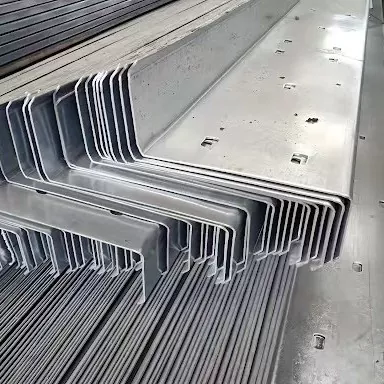
A Z Section Steel is a cold formed, thin walled open section. The wall thickness is typically 1.5 to 3.0 millimeters, while the depth is 100 to 300 millimeters. The high depth to thickness ratio means that the section is slender. When the section is loaded in compression or bending, it does not fail by yielding of the steel. It fails by buckling of the thin elements. The buckling can occur in the web, in the flange, or in the edge stiffener, and the buckling mode determines the load capacity. In our factory, we produce Z Section Steel for purlin and sheeting rail applications. Tianjin Shunchen Hongye Enterprise Management Co., Ltd. has been manufacturing cold formed sections for over 18 years.
The material strength sets an upper bound, but the geometry determines how much of that strength can be used. A high strength steel with a slender web will buckle at a low stress, and the extra strength is wasted. A well designed profile with a stockier web and a proper edge stiffener can use the full strength of a lower grade steel.
2. How Does the Web Depth to Thickness Ratio Control Local Buckling?
The web is the vertical element that carries the shear and the bending stress. When the web is in compression, it can buckle locally. The local buckling stress is inversely proportional to the square of the web depth to thickness ratio. A web with a ratio of 100 buckles at a much lower stress than a web with a ratio of 60. The table below shows the local buckling stress for different web depth to thickness ratios.
| Web depth to thickness ratio | Local buckling stress (MPa) | Effective width ratio | Design implication |
| 50 | 420 | 0.95 | Full web effective |
| 80 | 280 | 0.82 | Slight reduction in effective width |
| 120 | 160 | 0.60 | Significant reduction; check effective section |
| 160 | 95 | 0.42 | Heavy reduction; consider web stiffener |
| 200 | 62 | 0.30 | Web buckling governs; redesign required |
In our factory, we limit the web depth to thickness ratio to 150 for standard purlin sections. Above this ratio, we recommend a longitudinal web stiffener or a thicker web. Shunchen provides the section properties and the effective width calculation for each profile.
3. How Do Edge Stiffeners and Flange Width to Thickness Ratio Influence Distortional Buckling?
The flange of a Z section is in compression when the section is in bending. The flange can buckle locally, but it can also buckle in a mode called distortional buckling. In distortional buckling, the flange and the edge stiffener rotate as a unit about the junction between the flange and the web. The capacity in this mode depends on the stiffness of the edge stiffener and on the flange width to thickness ratio. A plain flange with no stiffener has a very low distortional buckling capacity. A flange with a return lip or a bulb stiffener has a much higher capacity. The table below shows the effect of the edge stiffener on the distortional buckling moment.
| Edge stiffener type | Stiffener depth (mm) | Distortional buckling moment (kNm) | Relative capacity |
| No stiffener | 0 | 4.2 | 1.00 |
| Simple lip | 10 | 5.8 | 1.38 |
| Simple lip | 15 | 6.9 | 1.64 |
| Return lip | 15 + 5 | 8.1 | 1.93 |
| Bulb stiffener | 15 | 8.6 | 2.05 |
Structural engineer's note: The edge stiffener is the single most cost effective improvement for a Z section. A 15 millimeter simple lip adds about 5 percent to the steel weight but increases the distortional buckling moment by 64 percent. A return lip or a bulb stiffener adds a little more weight but delivers nearly double the capacity. In our factory, we recommend a minimum lip depth of 12 millimeters for any Z section with a flange width above 60 millimeters. Tianjin Shunchen Hongye Enterprise Management Co., Ltd. rolls the lip in the same pass as the flange, so there is no additional handling cost.
4. Why Does the Non Symmetric Shape of the Z Section Create a Lateral Torsional Buckling Risk?
The Z section is point symmetric about its centroid. It is not symmetric about either axis. This means that the shear center does not coincide with the centroid, and the section is susceptible to lateral torsional buckling when it is bent about the major axis. The compression flange tends to move laterally, and the section twists. The resistance to this mode depends on the lateral restraint provided by the sheeting and on the torsional stiffness of the section. In a roof system, the sheeting provides lateral restraint to the top flange, but the bottom flange is often unrestrained. In a wind uplift condition, the bottom flange is in compression and the top flange is restrained, so the buckling direction reverses. In our factory, we recommend that the designer check both the gravity load case and the uplift load case, and provide lateral restraint to the appropriate flange in each case. Shunchen provides the section properties including the warping constant and the torsion constant for the lateral torsional buckling calculation.
The bracing design is as important as the section design. A Z section with a good edge stiffener can still fail by lateral torsional buckling if the bracing is missing or if the bracing is attached to the wrong flange.
5. How Should Designers Specify and Verify Z Section Steel Profiles for Stability?
The specification should include five items. The first is the nominal depth and the flange width. The second is the steel thickness and the yield strength. The third is the edge stiffener type and depth. The fourth is the web stiffener requirement, if any. The fifth is the bracing requirement for the gravity and uplift load cases. The verification should include three checks. The first is the local buckling check using the effective width method. The second is the distortional buckling check using the direct strength method. The third is the lateral torsional buckling check using the design code. In our factory, we provide the section properties for each profile so that the designer can perform these checks. Tianjin Shunchen Hongye Enterprise Management Co., Ltd. also offers a design review service for critical roof projects.
We recommend that the designer specify the section by its full designation, including the edge stiffener, not just by the nominal depth. A specification that says "Z 200" is ambiguous. A specification that says "Z 200 x 70 x 2.0 with 15 mm return lip" is unambiguous and can be verified at delivery.
Frequently Asked Questions About Z Section Steel Profile Design and Stability
Summary for Structural Designers and Roofing Contractors
The structural stability of a Z Section Steel profile is governed by its geometry, not by its material strength. The web depth to thickness ratio controls local buckling, the edge stiffener and flange width to thickness ratio control distortional buckling, and the non symmetric shape creates a lateral torsional buckling risk that must be addressed by bracing. The specification should include the depth, the flange width, the thickness, the edge stiffener, the web stiffener, and the bracing requirement. The verification should include the local, distortional, and lateral torsional buckling checks. Tianjin Shunchen Hongye Enterprise Management Co., Ltd. has been manufacturing cold formed sections for over 18 years and provides full section property and design review support for our customers.