

How Does Sheet Metal Fabrication for Racks Work?
2026-04-27
Abstract: Sheet metal fabrication for racks is a highly engineered manufacturing process used to create durable, precise, and scalable storage and structural solutions across industries such as data centers, logistics, industrial automation, and retail systems. This article explains how the process works, what materials and techniques are involved, and how companies like Xinyang deliver customized rack solutions that solve real-world operational challenges such as load stability, space optimization, and long-term durability.
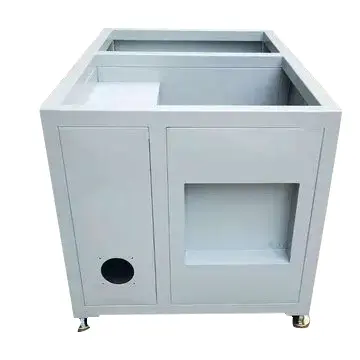
Table of Contents
Article Outline
- Definition and scope of rack fabrication using sheet metal
- Material selection and mechanical properties
- Step-by-step manufacturing workflow
- Engineering design and load considerations
- Industrial advantages and customization value
- Quality assurance and compliance requirements
- Industry use cases and deployment scenarios
- Role of Xinyang in delivering engineered rack systems
Understanding Sheet Metal Fabrication for Racks
Sheet metal fabrication for racks refers to the process of transforming flat metal sheets into structured rack systems through cutting, bending, punching, welding, and assembly. These racks serve as foundational components in industrial environments where organization, load-bearing strength, and spatial efficiency are critical.
Unlike generic storage solutions, fabricated racks are engineered for specific load capacities and environmental conditions. Whether used in server rooms, warehouses, or manufacturing plants, they must maintain structural integrity under continuous operational stress.
Companies such as Xinyang specialize in customizing these systems to match precise industrial requirements, ensuring both durability and adaptability.
Key Materials Used
The performance of a fabricated rack heavily depends on material selection. Below is a comparison of commonly used materials:
| Material | Strength | Corrosion Resistance | Typical Use |
|---|---|---|---|
| Cold Rolled Steel | High | Medium (requires coating) | Industrial racks, heavy storage |
| Stainless Steel | High | Excellent | Food, medical, clean environments |
| Aluminum | Medium | High | Lightweight racks, portable systems |
| Galvanized Steel | High | High | Outdoor and warehouse storage |
Material selection is often guided by load requirements, environmental exposure, and lifecycle expectations.
Manufacturing Process Steps
The fabrication of racks follows a structured workflow designed to ensure precision and repeatability:
- Design & Engineering: CAD models define dimensions, load distribution, and assembly structure.
- Material Cutting: Laser cutting or CNC punching is used for precision shaping.
- Forming: Press brakes bend sheets into structural components.
- Welding & Joining: MIG or TIG welding ensures structural integrity.
- Surface Treatment: Powder coating or galvanizing enhances durability.
- Assembly & Testing: Final racks are assembled and load-tested.
Xinyang integrates automated production systems to reduce tolerances and improve consistency across batches.
Design Considerations
Rack design is not only about shape but also structural engineering. Key considerations include:
- Load-bearing capacity and stress distribution
- Modularity for scalability
- Ventilation and thermal management (especially for electronics racks)
- Ease of assembly and maintenance
- Compatibility with automation systems
Engineers at Xinyang often simulate stress conditions using digital modeling tools to ensure optimal structural performance before production begins.
Benefits of Fabricated Metal Racks
- High structural strength and durability
- Customizable design for industry-specific needs
- Efficient space utilization
- Long service life with minimal maintenance
- Scalability for evolving operations
Compared to wooden or plastic alternatives, metal racks offer superior reliability in demanding environments such as logistics hubs and industrial warehouses.
Common Problems & Solutions
Despite its advantages, rack fabrication can face challenges:
- Deformation under heavy load: Solved by reinforcing structural beams.
- Corrosion in humid environments: Addressed through galvanization or powder coating.
- Improper load distribution: Fixed via improved design simulations.
- Assembly complexity: Reduced through modular design systems.
Xinyang applies strict engineering validation to minimize these risks before delivery.
Quality Control Standards
Quality assurance is essential in rack fabrication. Key checkpoints include:
- Dimensional accuracy verification
- Weld strength testing
- Load capacity validation
- Surface coating inspection
- Corrosion resistance testing
Each rack produced by Xinyang undergoes multi-stage inspection to ensure compliance with industrial usage standards.
Industrial Applications
Sheet metal fabricated racks are widely used in:
- Data centers for server housing
- Warehousing and logistics storage systems
- Manufacturing assembly lines
- Retail display structures
- Automotive parts storage systems
The adaptability of metal racks makes them essential infrastructure across modern industrial ecosystems.
Why Choose Xinyang
Xinyang provides advanced sheet metal fabrication for racks with a focus on precision engineering, material optimization, and scalable production capabilities. With years of industry experience, the company delivers tailored solutions for global clients requiring high-performance rack systems.
From concept design to final production, Xinyang ensures each rack meets strict mechanical and operational requirements, supporting industries that demand reliability and efficiency.
FAQ
Q1: What is sheet metal fabrication for racks?
It is the process of forming metal sheets into structured rack systems using cutting, bending, welding, and finishing techniques.
Q2: Which material is best for industrial racks?
Cold rolled steel and stainless steel are most commonly used due to their strength and durability.
Q3: Can racks be customized?
Yes, companies like Xinyang provide fully customized rack solutions based on load, size, and application requirements.
Q4: How long do metal racks last?
With proper coating and maintenance, they can last for many years even in harsh environments.
Q5: Are these racks suitable for automation systems?
Yes, modern fabricated racks are designed to integrate with automated storage and retrieval systems.
Sheet metal fabrication for racks continues to evolve with advancements in automation and material science. For businesses seeking durable, scalable, and precision-engineered rack systems, Xinyang provides reliable manufacturing expertise and end-to-end customization support.
For professional consultation or custom solutions, contact us at Xinyang today to discuss your project requirements.