Abstract
Diagonal support is a fundamental structural reinforcement method widely used in steel construction, mechanical frameworks, and industrial installations. It plays a critical role in distributing loads, preventing deformation, and improving resistance against lateral forces such as wind, vibration, and seismic activity. This article explores how diagonal support works, why it is essential in modern engineering systems, and how it helps solve common structural stability challenges faced by engineers, contractors, and facility managers.
With insights from real-world applications and manufacturing experience from Shenghui Metal, this guide provides a practical understanding of diagonal support systems and how they contribute to safer and more durable structures.
1. Introduction to Diagonal Support
In structural engineering, stability is not achieved by vertical and horizontal members alone. Many failures in frameworks occur due to lateral instability rather than vertical load overload. This is where diagonal support becomes essential.
Diagonal support systems are designed to transfer lateral loads into axial forces along diagonal members, significantly improving rigidity. Whether used in steel frames, towers, industrial racks, or machinery bases, these supports ensure structures remain stable under dynamic and static conditions.
2. What is Diagonal Support?
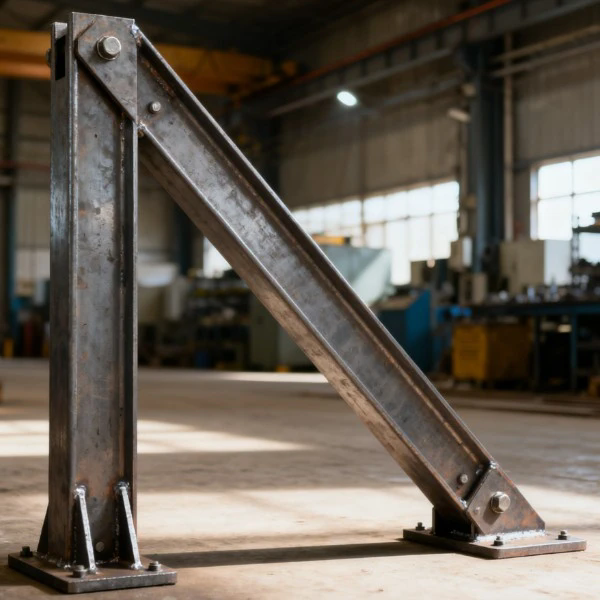
Diagonal support refers to structural members installed at an angle between vertical and horizontal components of a frame. These members form triangular geometries, which are inherently strong and resistant to deformation.
Key characteristics include:
-
Angle-based reinforcement (typically 30°–60°)
-
Load redistribution across structural joints
-
Increased torsional rigidity
-
Reduced sway and vibration
Manufacturers like Shenghui Metal design precision-engineered diagonal support components to meet industrial load requirements and ensure compatibility across different structural systems.
3. Why Diagonal Support Matters
Many structural problems arise not from vertical load failure, but from lateral instability. Without diagonal support, frames can suffer from:
-
Excessive swaying under wind loads
-
Progressive deformation over time
-
Joint fatigue and material cracking
-
Reduced lifespan of structures
Diagonal support directly addresses these issues by forming rigid triangular units that prevent geometric distortion. This is especially important in high-rise frameworks, industrial platforms, and heavy machinery bases.
4. Engineering Principles Behind Diagonal Support
The effectiveness of diagonal support is based on fundamental mechanical and structural engineering principles.
Core principles include:
-
Triangulation: A triangle is the most stable geometric shape in engineering structures.
-
Force decomposition: External loads are broken into axial forces along diagonal members.
-
Load path optimization: Forces are redirected efficiently to foundation points.
These principles ensure that diagonal support systems significantly reduce bending stress in primary structural members.
5. Industrial Applications
Diagonal support systems are widely used across multiple industries. Their adaptability makes them a critical component in modern construction and manufacturing.
-
Steel building frameworks
-
Warehouse racking systems
-
Transmission towers
-
Industrial machinery bases
-
Bridge reinforcement structures
At Shenghui Metal, diagonal support components are engineered for heavy-duty environments where precision and durability are critical.
6. Structural Support Comparison Table
|
Support Type
|
Strength
|
Flexibility
|
Best Use Case
|
|
Vertical Support
|
High compression resistance
|
Low lateral stability
|
Basic load-bearing columns
|
|
Horizontal Support
|
Moderate
|
Moderate stability
|
Beam reinforcement
|
|
Diagonal Support
|
Very high overall stability
|
Excellent resistance to sway
|
Seismic and wind-prone structures
|
7. Installation Considerations
Proper installation is critical to ensuring diagonal support performance. Engineers must consider alignment, load paths, and connection integrity.
-
Ensure precise angle positioning
-
Use high-strength fasteners or welding techniques
-
Avoid overloading single diagonal members
-
Check joint compatibility with primary structure
Products from Shenghui Metal are designed with installation efficiency in mind, reducing on-site errors and improving construction speed.
8. Common Engineering Mistakes
Despite its simplicity, diagonal support systems are often improperly implemented. Common mistakes include:
-
Incorrect angle alignment reducing effectiveness
-
Using undersized materials for load requirements
-
Neglecting dynamic load conditions
-
Poor joint welding quality
Avoiding these mistakes significantly increases structural lifespan and safety performance.
9. Maintenance and Inspection
Even though diagonal support systems are low-maintenance, periodic inspection is essential in industrial environments.
-
Check for corrosion in metal components
-
Inspect weld integrity
-
Monitor structural deformation
-
Ensure fastening systems remain tight
Preventive maintenance ensures long-term performance and reduces unexpected structural failures.
10. Frequently Asked Questions
Q1: Why is diagonal support stronger than horizontal support?
Because it forms triangular structures that distribute loads more efficiently and reduce deformation.
Q2: Where is diagonal support most commonly used?
It is widely used in steel structures, towers, industrial racks, and seismic-resistant buildings.
Q3: Can diagonal support be retrofitted into existing structures?
Yes, in many cases it can be added to improve stability without major reconstruction.
Q4: Does Shenghui Metal provide customized diagonal support systems?
Yes, Shenghui Metal offers customized engineering solutions tailored to specific structural requirements.
11. Conclusion & Contact
Diagonal support is a critical engineering solution that enhances structural integrity, reduces risk of deformation, and extends the lifespan of infrastructure systems. Its effectiveness lies in simple yet powerful geometric principles that transform unstable frameworks into rigid, load-resilient systems.
With advanced manufacturing capabilities, Shenghui Metal provides high-quality diagonal support components designed for demanding industrial applications.
For engineering consultation, customization options, or bulk orders, please contact us today to discuss how Shenghui Metal can support your structural projects with reliable and cost-effective solutions.