

How Does a Plastic Industrial Crate Mould Improve Manufacturing Efficiency and Product Quality?
2026-08-19
Article Summary
Plastic industrial crates are essential products in logistics, storage, agriculture, manufacturing, and supply chain industries. However, producing high-quality plastic crates requires more than just selecting suitable raw materials. The mould design, manufacturing precision, durability, and production performance of a Plastic Industrial Crate Mould directly influence the final product quality, production cost, and business competitiveness.
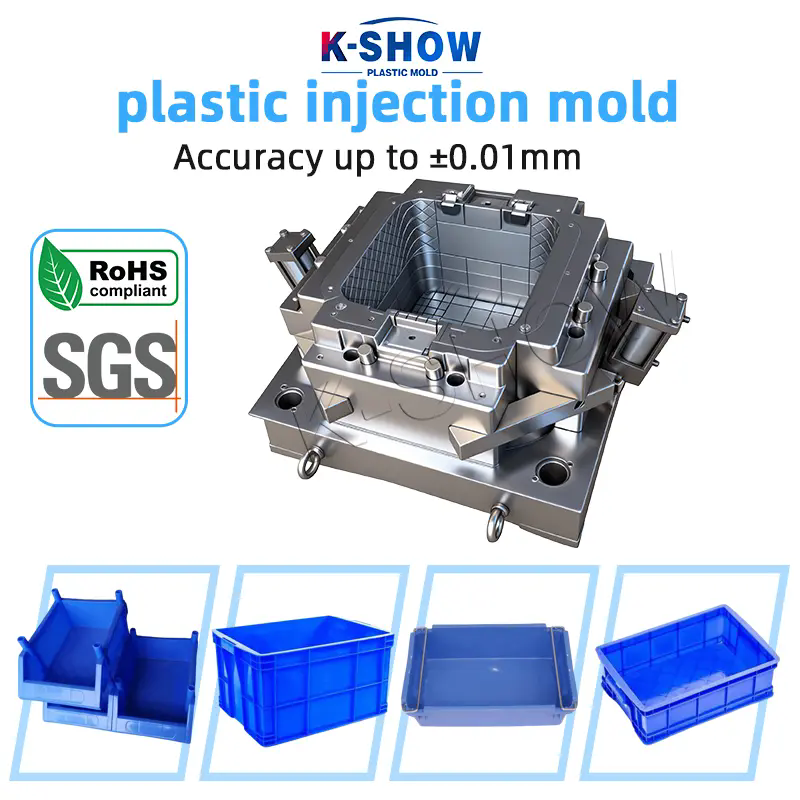
This article explains how a Plastic Industrial Crate Mould works, why professional mould solutions are important, what challenges manufacturers often face during production, and how KSHOW helps customers achieve reliable and efficient crate manufacturing solutions. From structural design to maintenance considerations, this guide provides practical insights for businesses looking to improve their plastic crate production process.
Table of Contents
- 1. Understanding the Role of Plastic Industrial Crate Mould
- 2. How Does a Plastic Industrial Crate Mould Work?
- 3. Key Design Factors That Determine Mould Performance
- 4. Common Production Challenges and Practical Solutions
- 5. Benefits of Choosing a Professional Plastic Industrial Crate Mould
- 6. Why Choose KSHOW for Plastic Crate Mould Solutions?
- 7. How to Maintain a Plastic Industrial Crate Mould for Long-Term Use
- 8. Frequently Asked Questions
1. Understanding the Role of Plastic Industrial Crate Mould
Plastic industrial crates are widely used for transporting and storing goods because they are lightweight, reusable, corrosion-resistant, and easy to handle. Industries such as food processing, beverage distribution, automotive parts, electronics, agriculture, and warehouse logistics depend on durable plastic crates to maintain efficient operations.
Behind every high-performance plastic crate is a precisely engineered Plastic Industrial Crate Mould. The mould determines the shape, strength, surface finish, stacking ability, and overall reliability of the finished crate. A well-designed mould allows manufacturers to produce thousands or even millions of consistent products while maintaining stable quality.
Unlike simple plastic products, industrial crates usually require reinforced structures, ventilation openings, locking systems, and load-bearing designs. These complex requirements make mould accuracy extremely important. Small errors in mould manufacturing can lead to problems such as uneven walls, deformation, weak corners, poor stacking performance, and increased production waste.
KSHOW focuses on developing practical mould solutions that help manufacturers overcome these challenges. Through advanced mould design concepts and manufacturing experience, KSHOW supports customers in creating plastic crates that meet different application requirements.
2. How Does a Plastic Industrial Crate Mould Work?
A Plastic Industrial Crate Mould works through an injection moulding process. During production, plastic materials are heated until they become molten and are injected into the mould cavity under high pressure. After cooling and solidifying, the mould opens and releases the finished crate.
Although the process appears simple, every stage requires accurate control. The mould must be designed to manage material flow, cooling speed, pressure distribution, and product release.
- Material Preparation: Plastic resin is selected according to product requirements, including strength, impact resistance, temperature tolerance, and environmental conditions.
- Injection Process: Molten plastic enters the mould cavity and fills every section of the crate structure.
- Cooling Stage: Cooling channels inside the mould control temperature and help maintain product accuracy.
- Mould Opening: The finished crate is removed through an efficient ejection system without damaging the product.
- Quality Inspection: Manufacturers check dimensions, strength, appearance, and performance before packaging.
A high-quality Plastic Industrial Crate Mould improves the entire production cycle by reducing defects, shortening cycle time, and increasing manufacturing stability. This is why mould quality is one of the most important factors for plastic product manufacturers.
3. Key Design Factors That Determine Mould Performance
Designing a reliable industrial crate mould requires careful consideration of multiple technical factors. The goal is not only to create a mould that produces the correct shape but also to ensure long-term production efficiency.
- Structural Strength: Industrial crates need to withstand heavy loads, repeated transportation, and stacking pressure. The mould design must support strong ribs, reinforced corners, and stable structures.
- Cooling System Design: Proper cooling channels help prevent shrinkage, warping, and uneven thickness. Efficient cooling also improves production speed.
- Material Flow Balance: A well-designed runner and gate system ensures plastic fills the cavity evenly, reducing defects and improving surface quality.
- Precision Manufacturing: Accurate machining and assembly directly affect mould lifespan and product consistency.
- Easy Maintenance: A professional mould should allow convenient cleaning, inspection, and replacement of wearing components.
Manufacturers that ignore these factors may experience higher maintenance costs, increased downtime, and unstable product quality. Investing in professional mould design helps create a more predictable and profitable production process.
4. Common Production Challenges and Practical Solutions
Producing plastic industrial crates involves many technical challenges. Manufacturers often need to balance product strength, production speed, cost control, and appearance requirements. A poorly designed Plastic Industrial Crate Mould can create unnecessary difficulties during daily operations.
Understanding these common problems helps businesses select better mould solutions and avoid costly production interruptions.
-
Problem: Uneven Product Thickness
Uneven wall thickness can reduce crate strength and cause deformation during transportation. This issue usually occurs when plastic flow is not properly controlled inside the mould cavity.
Solution: Professional mould designers optimize the cavity structure, gate position, and filling process to achieve balanced material distribution. -
Problem: Short Mould Lifespan
Industrial crates are usually produced in large quantities, meaning moulds must handle continuous injection cycles. Low-quality materials or inaccurate manufacturing can result in early wear.
Solution: Using durable mould steel, precision machining technology, and proper surface treatment can significantly extend service life. -
Problem: Product Deformation After Cooling
Plastic shrinkage and uneven cooling may cause warped crate structures, making stacking difficult.
Solution: Optimized cooling channel layouts and accurate temperature control improve dimensional stability. -
Problem: High Production Costs
Frequent mould repairs, excessive material waste, and long production cycles increase manufacturing expenses.
Solution: A high-performance Plastic Industrial Crate Mould reduces defects, improves efficiency, and lowers long-term operating costs.
5. Benefits of Choosing a Professional Plastic Industrial Crate Mould
Selecting the right mould supplier has a direct impact on production performance. A professionally manufactured mould offers advantages that go beyond basic product forming.
- Higher Production Efficiency: Precision mould structures allow faster injection cycles and stable output, helping manufacturers meet large-volume orders.
- Consistent Product Quality: Accurate mould dimensions ensure every crate has the same structure, size, and performance.
- Reduced Manufacturing Waste: Better material flow control minimizes defective products and reduces raw material consumption.
- Long-Term Cost Savings: Durable moulds require fewer repairs and replacements, improving overall return on investment.
- Flexible Customization: Different industries require different crate designs. Professional mould manufacturers can provide customized solutions based on size, load capacity, and application requirements.
For companies involved in large-scale plastic crate production, mould quality is not simply a production tool choice. It is an important factor affecting business efficiency, customer satisfaction, and market competitiveness.
6. Why Choose KSHOW for Plastic Crate Mould Solutions?
KSHOW provides professional Plastic Industrial Crate Mould solutions designed to meet the demanding requirements of modern plastic manufacturing. With a focus on precision, reliability, and practical application needs, KSHOW helps customers develop moulds suitable for different industrial environments.
Every project requires careful consideration of product structure, production volume, material characteristics, and equipment compatibility. KSHOW works closely with customers to understand these requirements and provide mould designs that support efficient manufacturing.
The advantages of working with KSHOW include:
- Professional Design Capability: KSHOW develops mould structures based on real production requirements, helping customers achieve better product performance.
- Precision Manufacturing: Accurate processing technology ensures mould components fit correctly and operate reliably.
- Quality-Focused Production: Strict attention is given to mould details, helping reduce production issues after delivery.
- Customized Solutions: KSHOW can support different crate sizes, designs, and functional requirements.
- Long-Term Partnership Approach: KSHOW aims to provide dependable mould solutions that support customers' continuous growth.
Choosing an experienced mould partner allows manufacturers to avoid common production problems and build a stronger foundation for efficient plastic product manufacturing.
7. How to Maintain a Plastic Industrial Crate Mould for Long-Term Use
Even a high-quality Plastic Industrial Crate Mould requires proper maintenance to maintain performance over many production cycles. Regular maintenance reduces unexpected downtime and extends mould service life.
- Regular Cleaning: Remove plastic residue, dust, and contaminants from mould surfaces to maintain product quality.
- Inspection of Wear Parts: Check ejector pins, guide components, and other moving parts regularly.
- Proper Lubrication: Apply suitable lubricants to moving components to reduce friction and wear.
- Cooling System Maintenance: Keep cooling channels clean to ensure stable production temperatures.
- Professional Repair Management: When problems appear, timely inspection and repair prevent larger damage.
A well-maintained mould can provide stable production performance for a longer period, helping manufacturers maximize their investment.
8. Frequently Asked Questions
What materials are commonly used for Plastic Industrial Crate Mould?
Plastic Industrial Crate Moulds are usually manufactured from high-quality mould steels that provide excellent hardness, wear resistance, and durability. The specific material selection depends on production volume, crate design complexity, expected service life, and customer requirements. For large-scale production, stronger mould materials are preferred because they can withstand repeated injection cycles and maintain dimensional accuracy over time.
How long can a Plastic Industrial Crate Mould be used?
The service life of a Plastic Industrial Crate Mould depends on several factors, including mould material quality, design accuracy, production conditions, maintenance procedures, and injection cycle frequency. A professionally designed and properly maintained mould can support long-term industrial production while maintaining stable product quality.
Why is mould design important for plastic crate production?
Mould design directly affects product strength, appearance, production speed, and manufacturing costs. A well-designed mould ensures balanced plastic filling, efficient cooling, smooth demoulding, and consistent product dimensions. Poor mould design may lead to defects such as cracks, deformation, uneven thickness, and increased production waste.
Can KSHOW provide customized Plastic Industrial Crate Mould solutions?
Yes. KSHOW can develop customized mould solutions based on different crate sizes, structural designs, application scenarios, and production requirements. Custom mould development allows manufacturers to create products that better match their market needs and operational goals.
What should manufacturers consider before purchasing a crate mould?
Manufacturers should evaluate several important factors before selecting a mould supplier:
- Product design requirements and expected load capacity.
- Production quantity and required mould lifespan.
- Compatibility with existing injection moulding machines.
- Mould manufacturing accuracy and quality control process.
- Supplier experience and technical support capability.
Careful evaluation helps businesses choose a mould solution that provides better production stability and long-term value.
Conclusion
A Plastic Industrial Crate Mould plays a critical role in modern plastic manufacturing. From product strength and appearance to production efficiency and cost control, every aspect of crate production is influenced by mould quality.
Manufacturers that invest in precision-engineered mould solutions can achieve more stable production, reduce waste, improve product consistency, and respond more effectively to market demands.
KSHOW provides professional Plastic Industrial Crate Mould solutions designed around real manufacturing challenges. With reliable design concepts, accurate manufacturing processes, and customized support, KSHOW helps businesses create efficient and dependable plastic crate production systems.
If you are looking for a reliable Plastic Industrial Crate Mould solution that improves production efficiency and product quality, please contact us today. KSHOW is ready to provide professional mould solutions tailored to your manufacturing requirements.