

How Does a Plastic Basket Mould Improve Production Efficiency and Product Quality?
2026-08-24
Article Summary: A well-engineered Plastic Basket Mould is essential for producing baskets with consistent dimensions, clean perforations, strong handles, smooth surfaces, and reliable stacking performance. Because plastic baskets often contain thin walls, dense grid structures, deep cavities, and multiple openings, mould design has a direct influence on filling, cooling, ejection, cycle time, and finished-product quality. This guide explains the major engineering considerations involved in selecting and developing a basket mould, common production problems, and practical ways to improve mould reliability. With professional mould design and manufacturing capabilities, ZHONGYUE provides customized solutions for shopping baskets, storage baskets, laundry baskets, vegetable baskets, rattan-style baskets, and other injection-molded containers.
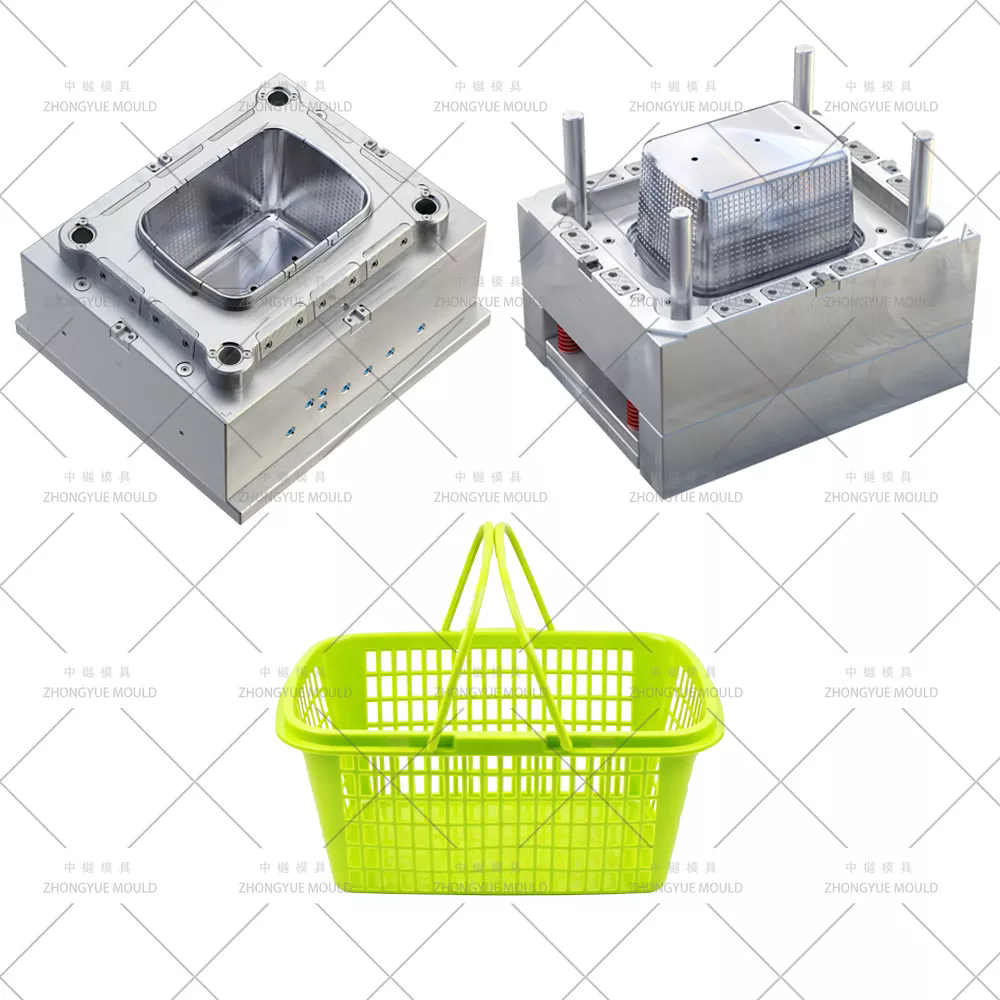
Table of Contents
- What Makes a Plastic Basket Mould Challenging?
- How Should a Plastic Basket Mould Be Designed?
- How Does Cooling Affect Basket Mould Performance?
- How Can Perforations Be Produced Cleanly?
- Which Materials and Steel Should Be Considered?
- How Can the Mould Improve Production Efficiency?
- What Production Problems Should Manufacturers Avoid?
- How Can Buyers Choose the Right Supplier?
- What Quality Checks Should Be Performed?
- What Types of Plastic Baskets Can Be Produced?
- Frequently Asked Questions
- Conclusion
1. What Makes a Plastic Basket Mould Challenging?
At first glance, a plastic basket appears to be a relatively simple household product. In reality, manufacturing a basket efficiently through injection molding can require considerably more attention than producing a simple solid plastic component.
A typical basket may combine a large overall size with thin walls, numerous openings, reinforcing ribs, rounded corners, handles, textured surfaces, and stacking features. Every one of these characteristics influences how molten plastic enters the cavity, fills the narrow sections, cools, shrinks, and is finally ejected.
The mould therefore has to achieve several objectives simultaneously:
- Provide balanced plastic flow throughout the cavity.
- Maintain consistent wall and rib dimensions.
- Prevent excessive deformation during cooling.
- Produce clean openings without unwanted flash.
- Allow reliable and smooth ejection.
- Support fast production cycles.
- Maintain dimensional consistency over long production runs.
These requirements become even more important for large baskets or designs with complicated mesh and rattan-style patterns. A small weakness in mould construction can become a recurring production problem when thousands or millions of parts are manufactured.
ZHONGYUE approaches basket mould development by considering the product structure, injection process, cooling strategy, ejection system, mould steel, and expected production volume as one integrated system.
2. How Should a Plastic Basket Mould Be Designed?
Good mould design starts before any steel is cut. The product drawing should be reviewed from a manufacturing perspective so potential problems can be identified during the design stage rather than after mould production.
Draft Angle and Ejection
Basket walls are often relatively deep, which means insufficient draft can make ejection difficult. When the molded part grips the core, excessive ejector force may cause scratches, deformation, whitening, or even cracking.
Appropriate draft angles help the basket release from the mould more smoothly. At the same time, draft must be balanced against the customer's dimensional and appearance requirements.
Wall Thickness and Rib Structure
Uniformity is particularly important for baskets. Large variations in wall thickness can create differences in cooling and shrinkage, increasing the risk of warpage or sink marks.
Ribs should provide sufficient structural reinforcement without creating unnecessarily thick areas. For a basket intended for repeated handling, the design should also reinforce high-stress areas such as corners, rims, and handle connections.
Parting Line Strategy
The parting line determines how the mould opens and how the product is released. For baskets containing many openings, the parting surface must be carefully planned to prevent flash around perforations.
A poorly positioned parting line can create difficult trimming work and inconsistent appearance. A well-planned design reduces secondary processing and makes production more repeatable.
Handle Design
Handles are among the most highly stressed areas of many baskets. If the transition between the handle and basket body is too abrupt, stress can concentrate in a small region.
A stronger design distributes the load more gradually. Flow direction, local reinforcement, corner radii, and gate position should all be considered when developing the mould.
3. How Does Cooling Affect Basket Mould Performance?
Cooling is one of the most important factors in injection moulding cycle efficiency and dimensional stability. A basket may have a large surface area and relatively thin structural sections, making uneven cooling particularly problematic.
When one region cools significantly faster than another, different areas of the plastic can shrink at different rates. This can result in:
- Warped basket walls.
- Uneven rims.
- Twisted corners.
- Difficulty during stacking.
- Dimensional deviations.
- Longer cooling cycles.
A balanced cooling circuit helps maintain a more consistent mould temperature. In demanding areas, specialized cooling inserts can improve heat transfer and shorten the time required for the part to reach an appropriate ejection temperature.
ZHONGYUE may use beryllium-copper inserts in suitable areas of basket moulds where improved thermal conductivity can help accelerate heat removal. The exact cooling arrangement should be determined according to the basket geometry, material, wall thickness, expected cycle time, and machine conditions.
| Cooling Concern | Possible Production Effect | Design Response |
|---|---|---|
| Uneven mould temperature | Warping and inconsistent dimensions | Balance cooling circuits |
| Insufficient heat transfer | Longer cycle time | Improve cooling-channel layout or use conductive inserts where appropriate |
| Overheating around deep cores | Local deformation | Optimize core cooling |
| Unbalanced cooling near ribs | Twisting or shrinkage differences | Review local cooling and wall thickness |
4. How Can Perforations Be Produced Cleanly?
The perforated structure is one of the defining characteristics of many plastic baskets. Holes, slots, grids, and decorative openings must remain open and accurately formed after injection molding.
However, dense perforations create several technical challenges. Plastic must flow through narrow regions while filling the surrounding structure. Poor venting or an unsuitable flow path can lead to short shots, weld lines, trapped air, or weak connections between ribs.
Flash is another concern. If the parting surfaces around the openings do not close accurately, excess plastic can enter the gap and form burrs around the holes.
Effective basket mould development should therefore consider:
- Opening dimensions and spacing.
- Rib thickness.
- Gate location.
- Flow balance.
- Venting.
- Parting-surface accuracy.
- Local cooling.
- Ejection forces.
Precision CNC machining and EDM processes are particularly useful when the basket contains detailed grids, narrow slots, or complex decorative patterns.
5. Which Materials and Steel Should Be Considered?
Mould steel has a direct influence on service life, machining quality, polishing performance, maintenance requirements, and production stability. The best choice depends on the product, production volume, plastic material, surface requirements, and expected operating conditions.
For many basket mould applications, pre-hardened mould steels can provide a practical combination of machinability, strength, and surface finishing capability. For example, ZHONGYUE's basket mould solutions may use 2738 steel in suitable applications because of its balance of hardness and polishability.
However, steel selection should not be made simply by choosing the hardest material available. A practical mould design considers the entire production requirement.
| Consideration | Why It Matters |
|---|---|
| Production volume | Determines the required mould durability and maintenance strategy. |
| Plastic material | Different resins can impose different wear and processing requirements. |
| Surface finish | Influences polishing, texturing, and steel selection. |
| Basket size | Affects structural strength, cooling, and mould construction. |
| Cycle target | Influences cooling design and overall mould configuration. |
6. How Can the Mould Improve Production Efficiency?
For basket manufacturers, mould cost is only one part of the total production equation. Cycle time, rejection rate, maintenance frequency, labor requirements, and mould lifespan can have a much larger effect on long-term operating costs.
A properly engineered mould can improve efficiency in several ways.
Shorter Cooling Time
Because cooling frequently represents a significant part of the injection cycle, improving heat transfer can directly influence output. A well-balanced cooling system can help the part reach stable ejection conditions faster.
Lower Scrap Rates
Stable filling, appropriate venting, accurate perforations, and controlled shrinkage reduce defects. Every rejected basket represents lost resin, machine time, labor, and production capacity.
Reduced Secondary Processing
Clean parting lines and properly designed openings can reduce the need for manual trimming. This is particularly valuable when baskets contain dozens or hundreds of openings.
More Stable Long-Term Production
A production mould should not only perform well during its first trial. It should remain predictable after repeated cycles. Durable mould components, appropriate steel, precision machining, and accessible maintenance features contribute to long-term stability.
7. What Production Problems Should Manufacturers Avoid?
Understanding common defects can help buyers identify potential risks before approving a mould design.
| Problem | Potential Cause | Possible Improvement |
|---|---|---|
| Short shot | Unbalanced flow, insufficient venting, or unsuitable processing conditions | Review gate, runner, venting, and filling balance |
| Flash around holes | Parting mismatch or excessive injection pressure | Improve parting accuracy and process control |
| Warping | Uneven shrinkage or cooling | Balance wall thickness and cooling |
| Handle cracking | Stress concentration or unfavorable flow direction | Strengthen transitions and optimize flow |
| Visible weld lines | Multiple flow fronts meeting in visible areas | Review gate location, flow path, and mould temperature |
| Sticking during ejection | Insufficient draft or excessive friction | Review draft, surface finish, and ejection layout |
Not every defect originates from the mould itself. Resin grade, moisture content, machine settings, injection speed, holding pressure, mould temperature, and cooling conditions can also affect final quality. For this reason, mould troubleshooting should evaluate the complete molding process rather than changing one parameter blindly.
8. How Can Buyers Choose the Right Supplier?
Selecting a Plastic Basket Mould supplier should involve more than comparing quotations. A lower initial price may not represent lower total production cost if the mould requires extensive modification, produces unstable parts, or has a short service life.
Before placing an order, buyers should evaluate the supplier's ability to handle:
- Product design review and DFM analysis.
- Complex perforation and mesh structures.
- Cooling system development.
- Gate and runner design.
- Precision CNC machining.
- EDM processing for detailed features.
- Mould trial and sample evaluation.
- Dimensional inspection.
- Production troubleshooting.
- After-sales technical support.
It is also useful to ask how the supplier handles design changes. Basket products are frequently customized for different capacities, handle shapes, patterns, logos, and stacking requirements. A supplier capable of adapting the mould architecture can make future product development more manageable.
9. What Quality Checks Should Be Performed?
A successful mould project should include quality control at multiple stages rather than relying solely on the final sample.
- Design verification: Check draft, wall thickness, parting lines, ejection, flow considerations, and cooling accessibility before machining.
- Machining inspection: Verify critical dimensions and detailed cavity features during mould manufacturing.
- Assembly inspection: Confirm that mould components align correctly and operate smoothly.
- Trial molding: Produce samples under controlled conditions to evaluate filling, appearance, ejection, and deformation.
- Sample measurement: Check critical dimensions, hole geometry, basket flatness, handle strength, and stacking characteristics.
- Correction and optimization: Address identified issues before final approval.
ZHONGYUE's manufacturing approach includes DFM review, precision machining, mould trials, and sample inspection. Its manufacturing resources include more than 20 CNC machines and an experienced engineering team, supporting projects from mould development through production validation.
10. What Types of Plastic Baskets Can Be Produced?
A customized Plastic Basket Mould can be developed for many different product categories. The mould structure should be adapted to the intended application rather than treating every basket as the same type of product.
- Shopping Baskets: Designed for supermarkets, retail stores, and commercial environments, often incorporating handles and branding areas.
- Storage Baskets: Used for household organization and may require decorative patterns or reinforced rims.
- Laundry Baskets: Usually require large ventilation openings, comfortable handling features, and sufficient structural strength.
- Vegetable Baskets: Often require ventilation structures and easy-clean surfaces.
- Rattan-Style Baskets: Combine plastic durability with decorative woven or simulated-rattan patterns.
- Shower Caddies: Require drainage openings, compact structures, and appropriate surface finishing.
- Industrial Baskets: May require thicker ribs, reinforced corners, stronger handles, and higher load-bearing capability.
Depending on the product, mould configuration can also be adapted for different cavity quantities, runner systems, ejection methods, and automation requirements.
11. Frequently Asked Questions
What is a Plastic Basket Mould used for?
A Plastic Basket Mould is used to manufacture injection-molded plastic baskets such as shopping baskets, laundry baskets, storage baskets, vegetable baskets, shower caddies, and decorative rattan-style baskets.
Why is cooling so important for basket moulds?
Baskets often have large dimensions, thin walls, and complicated rib structures. Uneven cooling can produce different shrinkage rates, resulting in warpage, twisting, dimensional instability, and longer cycle times. A balanced cooling system helps improve consistency and production efficiency.
Can ZHONGYUE customize a basket mould?
Yes. ZHONGYUE develops customized mould solutions according to basket dimensions, opening patterns, wall thickness, handle structure, surface requirements, production volume, and customer specifications.
Can one mould design support different basket sizes?
A product family can be developed with related structural principles for different basket sizes. However, whether components can be shared depends on the specific dimensions, geometry, production requirements, and desired level of standardization.
How can flash around basket openings be reduced?
Flash can be influenced by parting-surface accuracy, mould alignment, injection pressure, material behavior, and local geometry. Precise machining, appropriate parting design, and suitable molding conditions are important for producing clean openings.
How can basket handle cracking be prevented?
Handle cracking can often be reduced by improving the transition geometry, distributing stress more effectively, strengthening critical areas, and optimizing plastic flow. The final solution should also consider resin properties and molding conditions.
What information should be provided when requesting a mould quotation?
Useful information includes the basket drawing or 3D model, dimensions, expected material, annual production volume, surface requirements, preferred cavity quantity, injection machine information, and any special requirements for handles, logos, stacking, or packaging.
How long can a Plastic Basket Mould last?
Mould life depends on steel selection, mould construction, plastic material, production conditions, maintenance, cycle frequency, and product geometry. A suitable steel grade and well-maintained mould can provide reliable performance over extended production runs.
12. Conclusion
A high-quality Plastic Basket Mould is more than a cavity that reproduces the shape of a basket. Its cooling system, flow design, perforation structure, ejection mechanism, steel selection, machining accuracy, and maintenance strategy all influence the final manufacturing result.
For basket manufacturers, the most important objective is not simply obtaining a mould that produces the first acceptable sample. The real goal is achieving stable, repeatable, and economical production over the mould's working life.
When the product contains thin ribs, numerous openings, deep walls, handles, decorative textures, or strict stacking requirements, early engineering analysis becomes especially valuable. Proper design can reduce warpage, flash, short shots, ejection problems, manual trimming, and unnecessary cycle time while improving finished-product consistency.
ZHONGYUE provides customized injection mould development for shopping baskets, storage baskets, laundry baskets, vegetable baskets, rattan-style baskets, and other plastic container applications. From DFM analysis and precision machining to mould trials and production support, the objective is to create a mould that matches the customer's actual manufacturing requirements.