

How Does a Metal Bellows Expansion Joint Reduce Vibration and Noise in Pipes
2026-10-21
Piping systems in industrial plants rarely operate in a perfectly steady state. Pumps pulse, compressors surge, and fluid flow generates turbulent energy that travels through the pipe wall as vibration and radiated noise. Left unchecked, this dynamic energy accelerates fatigue in welds, loosens supports, and degrades the working environment. A Metal Bellows Expansion Joint from Tianshun addresses this problem at its source by combining flexibility, damping, and structural isolation in a single engineered component. This article explains the mechanisms involved and shows how to specify the right product for your system.
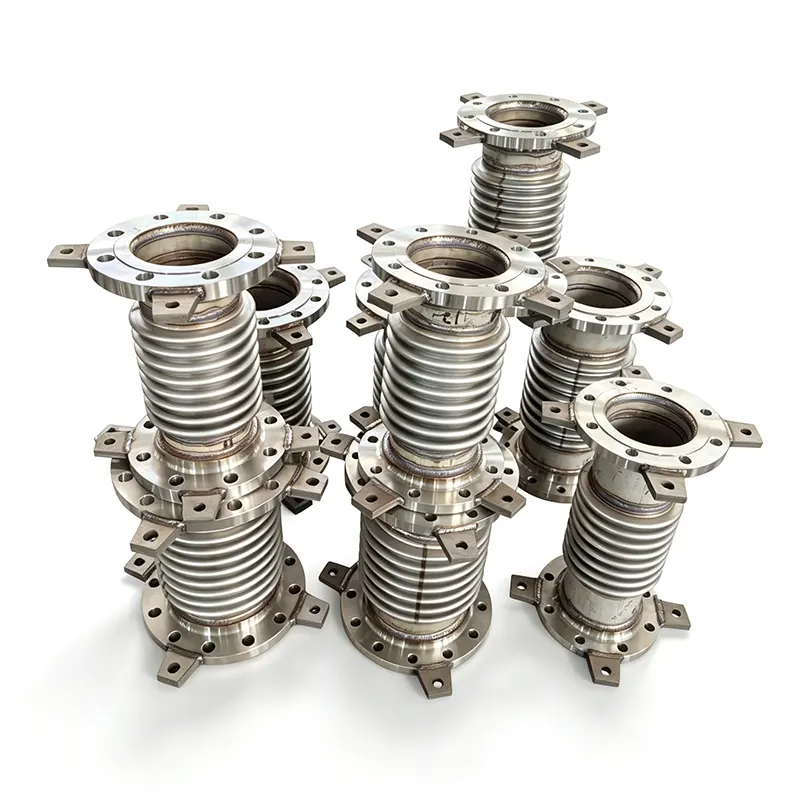
The Three Mechanisms Behind Vibration and Noise Reduction
A Metal Bellows Expansion Joint does not simply "absorb" movement. It reduces vibration and noise through three distinct physical mechanisms that work together.
-
Elastic decoupling of the pipe run. The corrugated bellows acts as a low-stiffness spring in the axial, lateral, and angular directions. This breaks the continuous metallic path that would otherwise transmit structure-borne vibration from equipment to downstream piping.
-
Mechanical damping within the convolution stack. As pressure pulsations deflect the bellows, energy is dissipated through hysteresis in the thin-wall convolutions and through friction in adjacent components such as tie rods, liners, and covers.
-
Acoustic impedance mismatch. The bellows geometry and the internal liner create changes in acoustic impedance that reflect part of the pressure wave, reducing the amplitude that propagates along the pipe.
How Each Component Contributes
The table below summarizes the role of key construction features in vibration and noise control.
| Component | Primary Function | Effect on Vibration & Noise |
|---|---|---|
| Corrugated bellows | Flexible pressure boundary | Decouples structure-borne vibration; provides axial and lateral compliance |
| Internal liner | Protects bellows from flow-induced erosion | Smooths flow, reduces turbulence-generated noise |
| Tie rods | Restrain pressure thrust | Maintain stability under pulsation without transmitting bending loads |
| External cover | Mechanical protection | Limits radiated noise and shields convolutions from debris |
| Restraining rings | Control convolution shape | Prevent squirm and improve damping under cyclic loading |
Design and Selection Considerations
Achieving measurable noise and vibration reduction requires more than choosing a flexible element. Tianshun applies the following selection framework for every Metal Bellows Expansion Joint project.
-
Determine the excitation source. Identify pump pulse frequency, compressor blade-pass frequency, and flow-induced turbulence spectra before selecting bellows stiffness.
-
Match spring rate to the isolation target. Lower axial stiffness improves isolation but must remain compatible with pressure thrust and buckling limits.
-
Specify the correct liner. A liner with adequate clearance prevents flow-induced vibration while protecting the bellows from particulate erosion.
-
Account for fatigue life. Cyclic deflection from vibration consumes fatigue capacity, so the design must be verified against the expected number of cycles.
-
Verify against recognized standards. Design, testing, and marking should follow EJMA and applicable ASME B31.3 requirements.
Practical Application Notes
Installation quality directly affects performance. Misalignment introduces pre-load that stiffens the assembly and reduces isolation efficiency. Supports should be positioned so the Metal Bellows Expansion Joint carries only its intended movement, not the weight of adjacent pipe. In high-noise applications, combining the expansion joint with acoustic insulation and resilient pipe supports delivers the best overall result.
FAQ
Q: Can a Metal Bellows Expansion Joint reduce noise from pump pulsation?
A: Yes. By decoupling the pipe run and introducing an acoustic impedance change, the Metal Bellows Expansion Joint reduces the amplitude of pressure pulsations transmitted downstream, which lowers both structure-borne vibration and radiated noise when combined with proper support design.
Q: Does adding a liner improve noise reduction?
A: A liner primarily protects the bellows from erosion and smooths flow, which reduces turbulence-generated noise. It should be specified with correct clearance so it does not itself become a source of flow-induced vibration.
Q: How do I know which bellows stiffness is right for vibration isolation?
A: Select the lowest spring rate that still satisfies pressure thrust, buckling, and fatigue requirements. Tianshun engineers evaluate your pump or compressor excitation frequency against the bellows natural frequency to confirm effective isolation.
Q: Can vibration cause a Metal Bellows Expansion Joint to fail prematurely?
A: Yes. Uncontrolled cyclic deflection consumes fatigue life. The joint must be designed for the expected cycle count per EJMA guidance, and piping should be aligned and supported to prevent unintended pre-load.
Contact Us
Protecting your piping system from vibration and noise starts with the right partner. Tianshun designs and manufactures Metal Bellows Expansion Joint solutions engineered for your specific excitation, pressure, and temperature conditions. Contact our engineering team today to discuss your application and request a tailored selection report.