

How Do You Properly Size a TET Style Conduit Body for Rigid Conduit Runs
2026-06-24
Sizing a TET Style Conduit Body correctly is one of the most overlooked steps in commercial and industrial electrical installations. An undersized body makes wire pulling nearly impossible; an oversized one wastes material and space. For contractors and engineers working with rigid metal conduit (RMC) or intermediate metal conduit (IMC), the TET Style Conduit Body—with its triangular, T-shaped configuration—offers a compact yet accessible junction point. But proper sizing isn't about guesswork. It demands a systematic approach based on NEC Article 314, conductor fill limits, and trade size compatibility. At HUADING, we manufacture TET Style Conduit Body solutions that meet UL 514B and CSA standards, but even the best product fails if the size is wrong. This guide walks you through the exact sizing process, from raceway trade size to cubic capacity, with practical tables and FAQs to eliminate field errors.
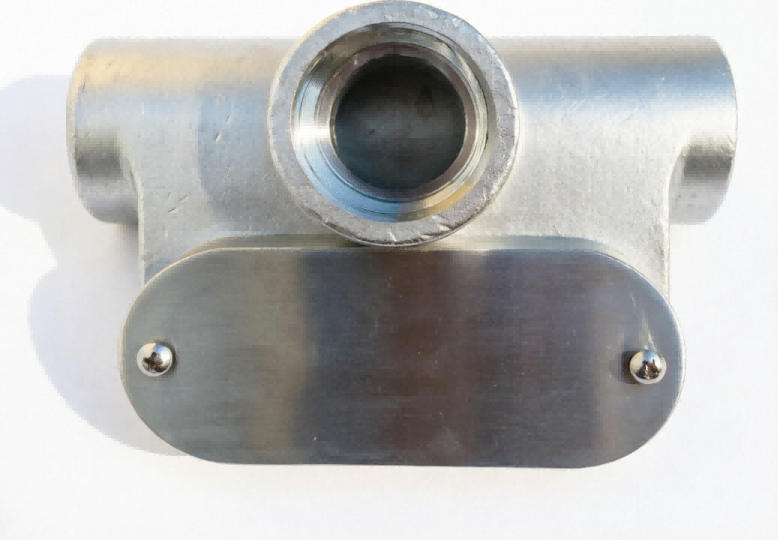
Step 1: Match the Conduit Trade Size First
The most fundamental rule: the entry hub of your TET Style Conduit Body must match the nominal trade size of your rigid conduit. If you run 1-inch RMC, you need a 1-inch TET Style Conduit Body. However, this is only the starting point. Many electricians stop here, but conduit bodies are not simply "pass-through" fittings—they have internal volumes that limit how many conductors and what gauge you can splice or pull through.
Critical check: Verify that the hub threads are NPT (National Pipe Taper) compatible with your rigid conduit. HUADING designs all TET Style Conduit Body hubs with precision-cut tapered threads to ensure a rain-tight or concrete-tight seal when combined with suitable compounds.
Step 2: Calculate Conductor Fill Using NEC Table 314.16(B)
Conduit bodies are classified as "pull boxes" under the NEC when they contain splices or terminations. For a TET Style Conduit Body, the internal volume must accommodate the total area of all conductors. Use this formula:
Minimum volume (cu. in.) = Total conductor area (from NEC Chapter 9, Table 5) × Number of conductors × 1.2 (for splices if applicable)
For straight pulls, the length of the body must be at least 8 times the trade diameter of the largest conduit entering. For angle or U-pulls, the distance from the entry to the opposite wall must be at least 6 times the trade diameter. A TET Style Conduit Body inherently provides better clearance for angle pulls due to its T-shape, but you still must run the numbers.
Step 3: Verify Cubic Capacity Against Your Wire Gauge and Count
Below is a quick reference table for common TET Style Conduit Body sizes from HUADING, showing maximum allowable conductors for THHN/THWN copper (based on 75°C column, without splices). These values assume no more than 3 current-carrying conductors and an ambient temperature of 30°C.
| Trade Size (inches) | Internal Volume (cu. in.) | Max #12 AWG Conductors | Max #10 AWG Conductors | Max #8 AWG Conductors | Max #6 AWG Conductors |
|---|---|---|---|---|---|
| ½" | 5.5 | 5 | 4 | 2 | 1 |
| ¾" | 8.0 | 7 | 6 | 4 | 2 |
| 1" | 12.5 | 11 | 9 | 6 | 4 |
| 1¼" | 18.0 | 16 | 13 | 9 | 6 |
| 1½" | 25.0 | 22 | 18 | 12 | 8 |
| 2" | 38.0 | 33 | 27 | 18 | 12 |
Note: Values are for reference only. Always consult the NEC and the specific HUADING product data sheet for certified fill capacities.
Step 4: Consider Pulling Tension and Bending Radius
Even if the cubic capacity checks out, a TET Style Conduit Body must allow a smooth pulling radius. For rigid conduit, the bending radius of the body's internal chamber should not be less than the minimum bending radius of the conductor (typically 5× to 8× the cable diameter for multi-conductor cables). HUADING engineers each TET Style Conduit Body with swept internal corners that reduce friction and jacket damage—but you still need to upsize if your pull includes 4 or more 90° bends upstream.
Step 5: Account for Future Expansion and Grounding
A professional installation always sizes one trade size larger than the minimum calculation when:
-
The pull length exceeds 100 feet.
-
You anticipate adding two or more circuits in the future.
-
You are using aluminum conductors (which require larger volumes due to lower ampacity per area).
Additionally, every TET Style Conduit Body must have a tapped grounding hole (usually ¼"-20 or 10-32). HUADING provides pre-tapped grounding bosses on all models, but verify that the lug fits without crowding conductors.
FAQ – Common Questions About the TET Style Conduit Body
Q: Can I use a TET Style Conduit Body for a splice on a 480V feeder, or is it only for pulls?
A: You can absolutely use a TET Style Conduit Body for splices, provided the total volume of all spliced conductors, wire nuts, and tape does not exceed the body's internal cubic capacity as listed in NEC Table 314.16(B). For 480V feeders, you must also maintain proper spacing between phases (minimum 1 inch of air gap for uninsulated live parts) and use only UL-listed splicing methods. HUADING bodies are tested to 600V and carry UL 514B listing, so they are suitable for feeder splices as long as you derate for temperature if the ambient exceeds 40°C. Remember that splicing increases fill volume by roughly 30% due to connectors—always upsize by at least one trade size if you have more than two splices.
Q: How do I determine if I need a TET Style Conduit Body versus a TEB or TEC style for the same rigid conduit run?
A: The difference lies in the cover orientation and access direction. A TET Style Conduit Body has a T-shaped configuration with the cover on the top of the branch leg, making it ideal for horizontal runs where you need to access conductors from above. A TEB (LB style) has a cover on the back, which works best for wall-mount entries. A TEC (C style) has a cover on the front and is used for straight-through access. For rigid conduit runs that change direction horizontally (e.g., from a ceiling down to a wall), the TET Style Conduit Body gives you the most comfortable pulling angle because the branch leg aligns with the conduit run while the cover faces upward. HUADING offers all three styles, but if you are pulling heavy-gauge conductors (1/0 and larger), the TET Style Conduit Body provides a straighter pulling path than a TEB, reducing stress on insulation.
Q: What happens if I install a TET Style Conduit Body that is one size smaller than the conduit trade size—can I use reducing washers?
A: Reducing washers are permitted by NEC 314.3 for connecting smaller conduits to larger hubs, but they are NOT permitted to connect a larger conduit to a smaller TET Style Conduit Body hub. The hub entry must be equal to or larger than the conduit trade size. If you have a 1¼-inch rigid conduit, you cannot reduce it into a 1-inch TET Style Conduit Body using a bushing—this violates NEC 314.17(C) because the hub threads won't engage fully, and the pull will fail due to abrupt obstruction. The correct approach is to either upsize the TET Style Conduit Body to 1¼ inches or install a reducer fitting ahead of the body and then a short nipple, but this adds two additional joints and increases labor. HUADING recommends always matching the hub size to the largest conduit entering, and if you must reduce, do so after the body, not before.
Final Checklist Before Ordering
-
Trade size matches largest conduit hub.
-
Internal volume ≥ total conductor area + splice allowance.
-
Pull length and number of bends do not exceed design limits.
-
Grounding tap is accessible and properly sized.
-
Cover gasket is rated for the environment (wet/dry/hazardous).
-
HUADING part number corresponds to your required hub configuration and material (aluminum, malleable iron, or stainless steel).
Contact Us for Expert Sizing Support
Properly sizing a TET Style Conduit Body is not a one-size-fits-all decision—it depends on your specific conduit schedule, wire type, ambient conditions, and local code amendments. At HUADING, our technical team reviews over 200 conduit body sizing requests every month, providing certified fill calculations and 3D CAD models to eliminate field rework. Whether you need a standard off-the-shelf TET Style Conduit Body or a custom-drilled configuration for offshore or petrochemical projects, we deliver UL-listed products with full traceability. Contact HUADING today via our website or call our engineering support line—send us your one-line diagram and conduit schedule, and we will reply with a verified size recommendation within 24 hours. Your project deserves accuracy, not approximation. Reach out now and secure the right fit from the start.