

How do you calculate the weight of a stainless steel 180° elbow for shipping and installation planning
2026-06-01
Accurately determining the weight of a Stainless Steel 180° Elbow is a critical step in logistics and on-site assembly. For professionals at HengDi, precise weight calculation ensures safe lifting, cost-effective freight, and proper structural support. This guide breaks down the formulas, industry data, and practical considerations for shipping and installation planning.
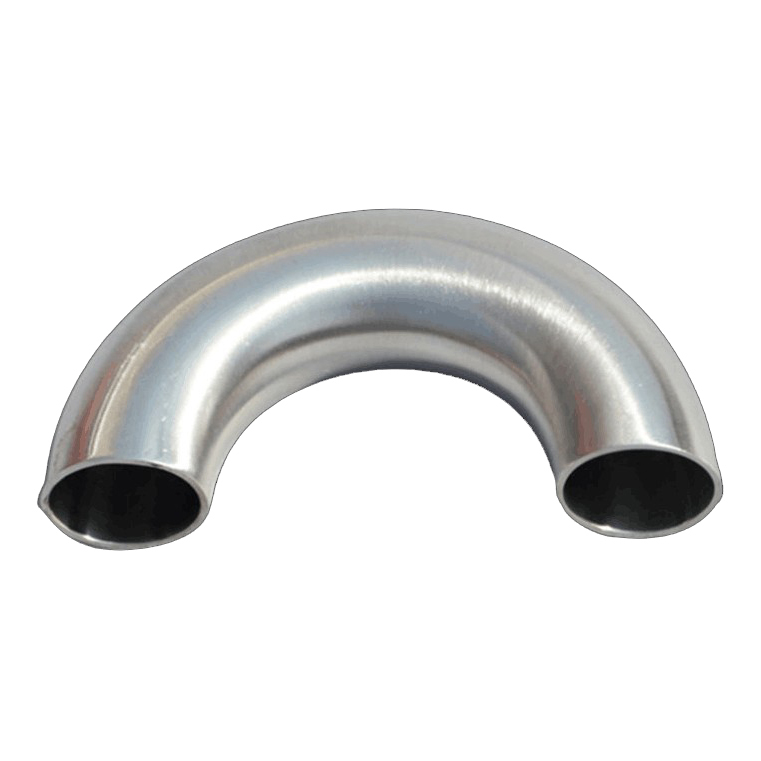
The Core Formula for Weight Calculation
The weight of a Stainless Steel 180° Elbow is derived from its volume multiplied by the density of stainless steel (typically 7.93 g/cm³ for 304/304L or 7.98 g/cm³ for 316/316L). The standard engineering formula is:
Weight (kg) = 0.02466 × (OD - WT) × WT × R / 1000 × 1.5 × π
Where:
-
OD = Outside diameter (mm)
-
WT = Wall thickness (mm)
-
R = Centerline radius (usually 1.5D or 1D)
-
1.5 = Adjustment factor for 180° bend (twice the material of 90°)
For quick estimation, HengDi recommends using the following table based on ASME B16.9 standards.
| Nominal Size (Inches) | OD (mm) | Wall Thickness Sch 40S (mm) | Approx. Weight of Stainless Steel 180° Elbow (kg) |
|---|---|---|---|
| 1 | 33.4 | 3.38 | 1.2 |
| 2 | 60.3 | 3.91 | 3.8 |
| 3 | 88.9 | 5.49 | 9.5 |
| 4 | 114.3 | 6.02 | 17.2 |
| 6 | 168.3 | 7.11 | 46.5 |
Why Accurate Weight Matters for Shipping and Installation
Underestimating weight leads to crane overloading and customs delays. Overestimating increases freight costs. When planning a shipment of a Stainless Steel 180° Elbow, HengDi advises factoring in:
-
Sea freight: Based on chargeable weight (actual vs dimensional weight).
-
Land transport: Axle load limits and lifting equipment capacity.
-
Installation: Support bracket strength and bolt torque requirements.
Step-by-Step Calculation Example
For a 4-inch Sch 40S Stainless Steel 180° Elbow (OD=114.3mm, WT=6.02mm, R=1.5D=171.45mm):
-
Volume = π × (OD-WT) × WT × (π×R) = 3.1416×108.28×6.02×(3.1416×171.45) ≈ 1,105,000 mm³
-
Convert to cm³ = 1105 cm³
-
Multiply by density (7.93 g/cm³) = 8,762 g ≈ 17.6 kg
This matches closely with industry standard tables. HengDi provides certified weight tags with every Stainless Steel 180° Elbow to eliminate guesswork.
Stainless Steel 180° Elbow FAQ
Question 1: Does the manufacturing method (seamless vs welded) affect the weight of a Stainless Steel 180° Elbow?
Answer: Yes, but the difference is minimal for standard schedules. A seamless Stainless Steel 180° Elbow has uniform wall thickness and no internal weld bead, making it slightly lighter (1-2% on average) than a welded version of the same OD and schedule. However, for shipping and installation planning, HengDi recommends using the nominal weight from ASME standards because both types fall within the same tolerance range (±5%). Always refer to the mill test certificate for exact per-piece weight.
Question 2: How do I calculate the dimensional (volumetric) weight for air freight of a Stainless Steel 180° Elbow?
Answer: Dimensional weight (DIM weight) is calculated as (Length × Width × Height in cm) / 5000 for international air freight. For a Stainless Steel 180° Elbow, the length is approximately the centerline radius × 2 (since 180° forms a full U-shape). Example: A 6-inch elbow with R=254mm has a length of 508mm, width of 340mm, height of 254mm. Volume = 508×340×254 = 43,870,880 cm³. DIM weight = 43,870,880/5000 = 8,774 kg. Compare this with the actual physical weight (approx 46 kg for Sch 40S). Air freight charges are based on the higher of the two—here, DIM weight dominates. HengDi can help optimize packing orientation to reduce DIM charges.
Question 3: Does painting or surface coating add significant weight to a Stainless Steel 180° Elbow?
Answer: No, coating adds negligible weight for shipping and installation planning. A standard epoxy or PTFE coating on a Stainless Steel 180° Elbow adds less than 0.5% to total mass. For example, a 50 kg elbow gains only 0.25 kg from coating. However, HengDi notes that certain heavy-duty linings like glass-reinforced nylon can add 1-2 kg for large diameters (12 inches and above). Always request coating weight data from your supplier. For most stainless steel applications, the weight contribution of coatings is within the ±5% tolerance allowed by lifting equipment, so no recalculation is needed.
Final Checklist for Logistics Planning
| Task | Tool / Reference |
|---|---|
| Confirm actual weight | HengDi weight certificate |
| Measure crate dimensions | Tape measure + DIM calculator |
| Select lifting slings | Crane capacity > 2× elbow weight |
| Verify support stands | Load rating per elbow |
Contact Us
Need precise weight data or a customized shipping plan for your Stainless Steel 180° Elbow project? Contact HengDi today. Our engineering team provides certified weight calculations, free packing optimization advice, and real-time freight quotes to streamline your installation planning. Reach out via our website or email [email protected] for immediate support.