

How Do Pre-Insulated Pipe Supports Improve Thermal Performance and Installation Efficiency?
2026-08-26
Article Summary: Pre-Insulated Pipe Supports are engineered to solve a common problem in insulated piping systems: maintaining mechanical support without creating a thermal bridge. Conventional pipe supports can interrupt insulation, allowing heat transfer, condensation, moisture penetration, corrosion, and unnecessary energy loss. A properly designed pre-insulated support integrates structural strength with thermal isolation, helping the piping system maintain its intended operating conditions while simplifying installation. This article explains how these supports work, what materials and design factors matter, where they are used, how to select the right configuration, and how Tianshun can support demanding industrial piping projects.
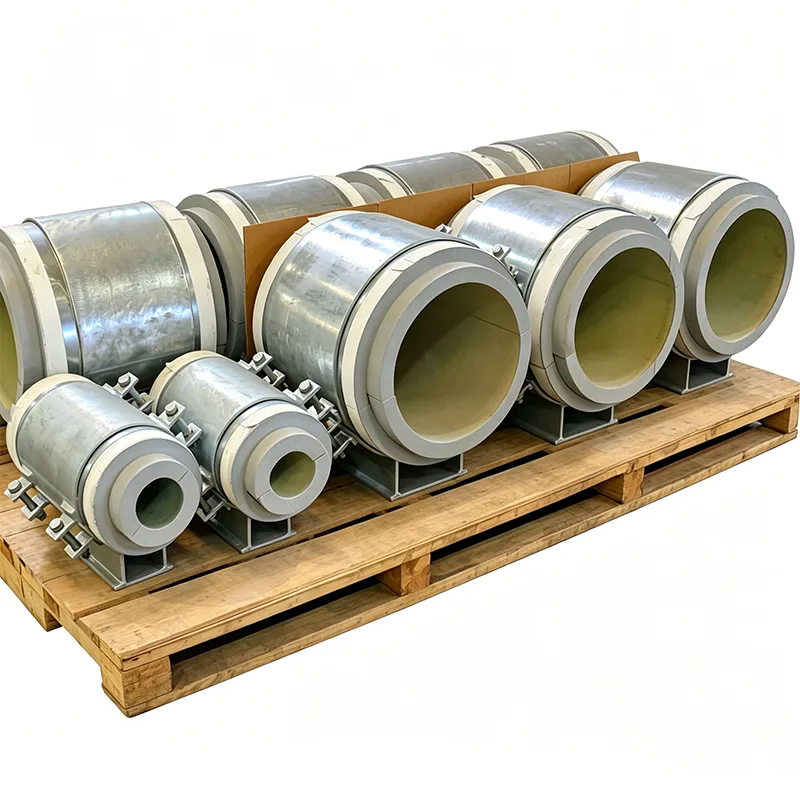
Table of Contents
- Article Outline
- Why Conventional Pipe Supports Create Thermal Problems
- How Pre-Insulated Pipe Supports Work
- What Makes Up a Pre-Insulated Pipe Support?
- What Problems Can Pre-Insulated Pipe Supports Solve?
- Where Are Pre-Insulated Pipe Supports Used?
- How to Select the Right Pre-Insulated Pipe Supports
- How Do They Handle Thermal Movement?
- How Can Installation Quality Be Improved?
- What Quality Checks Should Buyers Consider?
- Pre-Insulated vs. Conventional Pipe Supports
- Why Choose Tianshun?
- Frequently Asked Questions
- Conclusion
Article Outline
- Understand the thermal bridge problem created by conventional supports.
- Learn how an integrated insulation block maintains thermal continuity.
- Review the main structural and insulation components.
- Identify suitable applications for cold, hot, and cryogenic piping.
- Evaluate load capacity, insulation thickness, temperature, movement, and environmental conditions.
- Improve installation efficiency by using factory-assembled support systems.
- Review quality-control considerations before purchasing.
- Understand how Tianshun can provide customized support solutions.
Why Conventional Pipe Supports Create Thermal Problems
Insulation is installed around process piping for a clear purpose: to control heat transfer and maintain the temperature of the fluid inside the pipe. However, the insulation system is only as effective as its weakest connection point. Pipe supports are often one of those weak points.
A conventional steel pipe shoe or clamp can create a direct conductive path between the pipe and the supporting structure. When the pipe carries chilled water, refrigerant, LNG, or another low-temperature medium, the support can become a thermal bridge. Heat from the surrounding environment travels through the support toward the cold pipe. If the surface temperature falls below the surrounding air's dew point, condensation may develop around the support.
Moisture is not merely a cosmetic problem. Repeated condensation can damage insulation, increase corrosion risk, degrade protective materials, and raise long-term maintenance requirements. In severe environments, water penetration can become particularly difficult to detect because the external insulation may look intact while moisture accumulates inside.
Hot piping presents the opposite challenge. A poorly isolated support can allow excessive heat to escape from the pipe into the structure. This can increase energy consumption, raise surrounding surface temperatures, and reduce the effectiveness of the overall thermal-management system.
Pre-Insulated Pipe Supports address this weak point by incorporating a load-bearing insulation section into the support assembly. Instead of cutting away insulation at every support location and rebuilding the thermal barrier around the steelwork, the support is designed to preserve thermal continuity as part of the original assembly.
How Do Pre-Insulated Pipe Supports Work?
The basic principle is straightforward: the support must carry the mechanical load while limiting unwanted heat transfer.
A typical assembly places a rigid, load-bearing insulation element between the pipe saddle and the supporting structure. The insulation is selected according to the operating temperature, compressive requirements, moisture environment, and expected service conditions.
When the pipe is installed, its weight is transferred through the saddle and insulation section into the base plate or structural connection. At the same time, the insulation reduces the conductive path between the pipe and the surrounding steelwork.
For cold applications, the design must also consider vapor control. A high-quality thermal break is not enough if moisture can enter the insulation. Once insulation becomes wet, its thermal performance can deteriorate significantly. Therefore, edge sealing and vapor-barrier continuity are important parts of a reliable design.
For applications involving thermal expansion, the support may incorporate a sliding interface. Materials such as PTFE can be used where controlled axial movement is required. This allows the pipe to expand or contract without unnecessarily transferring large friction forces into the support structure.
What Makes Up a Pre-Insulated Pipe Support?
Although the appearance of a pre-insulated support may be simple, several components work together to provide mechanical stability and thermal protection.
| Component | Typical Material or Option | Primary Function |
|---|---|---|
| Pipe Saddle | Carbon steel or stainless steel | Transfers pipe load into the support assembly. |
| Insulation Block | Rigid polyurethane, cellular glass, mineral wool, or other suitable insulation | Provides thermal separation while carrying compressive loads. |
| Vapor Barrier | Aluminum laminate or polymer barrier | Limits moisture penetration in low-temperature applications. |
| Base Plate | Carbon steel or stainless steel | Connects the support to the structure. |
| Sliding Surface | PTFE or polished stainless steel | Allows controlled pipe movement where required. |
| Fasteners | Carbon steel or stainless steel | Secures the assembly and maintains structural integrity. |
The correct combination depends on the pipe diameter, operating temperature, insulation thickness, load, environmental conditions, movement requirements, and project specifications.
What Problems Can Pre-Insulated Pipe Supports Solve?
Choosing the correct support configuration can address several problems that otherwise appear during operation or maintenance.
- Thermal bridging: The integrated insulation reduces direct heat transfer through the support point.
- Condensation: Maintaining a continuous thermal barrier helps reduce cold-surface condensation.
- Insulation damage: A purpose-designed support reduces the need for improvised field insulation around structural components.
- Energy loss: Better thermal isolation can help hot piping retain useful process heat.
- Installation labor: Factory-assembled supports can reduce site fabrication and insulation rebuilding.
- Maintenance: A properly sealed support can reduce moisture-related degradation and recurring repair work.
- Thermal movement: Sliding configurations can accommodate controlled expansion and contraction.
- Project consistency: Factory fabrication helps standardize dimensions, materials, and assembly quality.
The biggest advantage is not simply adding insulation to a support. The objective is to make the support part of the complete piping system rather than treating it as an interruption that must be repaired after installation.
Where Are Pre-Insulated Pipe Supports Used?
Pre-Insulated Pipe Supports are particularly useful wherever thermal control and mechanical support must coexist. Their applications extend across process industries, energy infrastructure, building services, and specialized temperature-controlled systems.
- LNG and cryogenic facilities: Low-temperature piping requires careful thermal isolation and moisture control.
- District cooling systems: Chilled-water pipelines benefit from continuous insulation around support locations.
- Refrigeration systems: Thermal bridges can contribute to condensation and energy losses.
- Oil and gas facilities: Insulated process lines require reliable support under demanding operating conditions.
- Chemical plants: Different process fluids may require customized insulation and support materials.
- Food and beverage facilities: Temperature-controlled piping often requires clean, reliable, and maintainable insulation systems.
- Power plants: Hot process piping can benefit from supports designed to minimize unwanted heat transfer.
- Industrial HVAC systems: Chilled and heated pipelines can use integrated thermal support solutions.
How to Select the Right Pre-Insulated Pipe Supports
There is no universal support that fits every insulated pipeline. A reliable selection begins with engineering data rather than simply choosing a support based on pipe diameter.
| Selection Factor | Why It Matters |
|---|---|
| Pipe Diameter | Determines saddle geometry and dimensional compatibility. |
| Operating Temperature | Determines the appropriate insulation and material selection. |
| Insulation Thickness | Ensures the support does not create a significant gap in the insulation system. |
| Pipe Weight | Determines the required compressive capacity and structural design. |
| Thermal Movement | Determines whether a fixed, guided, or sliding configuration is needed. |
| Environment | Influences material selection, corrosion protection, and moisture resistance. |
| Installation Method | Determines whether welded, bolted, base-mounted, or retrofit construction is appropriate. |
Before placing an order, it is useful to provide the manufacturer with the pipe size, pipe schedule, insulation material, insulation thickness, operating temperature, support load, support spacing, and expected thermal movement.
Providing these details early reduces redesign and helps the manufacturer produce a support that matches the actual piping system rather than relying on assumptions.
How Do They Handle Thermal Movement?
Pipes rarely remain dimensionally static during operation. A hot pipe expands when its temperature rises and contracts when it cools. Even cold or cryogenic systems can experience significant dimensional changes when moving between ambient and operating conditions.
A fixed support may be appropriate where the pipe must be restrained at a specific location. In other locations, however, the support must allow controlled movement.
Sliding Pre-Insulated Pipe Supports can incorporate a low-friction interface between the support and the structural base. The objective is to allow the pipe to move in the intended direction while keeping the thermal barrier intact.
Guided supports can also be used when movement must be controlled along a specific axis. The support design should always be coordinated with the piping stress analysis because excessive restraint can introduce unwanted forces into the pipe, equipment nozzles, anchors, and structural connections.
How Can Installation Quality Be Improved?
Field installation is one of the most important stages in maintaining thermal performance. Even a well-designed support can perform poorly if the insulation or vapor barrier is damaged during installation.
Factory-assembled Pre-Insulated Pipe Supports can simplify this process because major components are prepared before reaching the jobsite. This reduces the amount of cutting, fitting, bonding, and sealing required around each support location.
During installation, the following practices are particularly important:
- Confirm that the support matches the approved pipe and insulation dimensions.
- Inspect the insulation block for cracks, crushing, or impact damage before installation.
- Protect the vapor barrier from cuts and punctures.
- Verify that the pipe sits correctly within the saddle.
- Check base plates and sliding surfaces for contamination or damage.
- Confirm that movement direction matches the piping design.
- Complete sealing work carefully where field connections are unavoidable.
- Inspect the finished support before applying final external insulation or cladding.
These steps are simple, but they can prevent expensive problems later. The goal is to preserve the engineered thermal and mechanical properties from factory production through final commissioning.
What Quality Checks Should Buyers Consider?
Quality should not be evaluated solely by external appearance. A Pre-Insulated Pipe Support combines structural components with insulation, so both functions require verification.
- Dimensional inspection of saddle radius and overall geometry.
- Verification of base-plate dimensions and hole alignment.
- Inspection of steel material and protective treatment.
- Verification of insulation density and compressive performance.
- Inspection of insulation thickness and fit.
- Evaluation of bonding between insulation and structural components where applicable.
- Inspection of vapor-barrier continuity.
- Verification of sliding surfaces for moving supports.
- Load testing for selected critical or prototype assemblies when required.
- Review of material and inspection documentation.
For demanding projects, documentation is particularly valuable. Material certificates, inspection records, dimensional reports, and product identification help the engineering and quality teams maintain traceability throughout procurement and installation.
Pre-Insulated vs. Conventional Pipe Supports
| Feature | Conventional Support | Pre-Insulated Support |
|---|---|---|
| Thermal Isolation | Usually interrupted at support points | Integrated into support design |
| Condensation Control | Requires careful field insulation | Designed to preserve thermal continuity |
| Field Labor | More insulation modification may be required | Factory assembly can reduce site work |
| Thermal Movement | Depends on separate support configuration | Can incorporate sliding or guided designs |
| System Integration | Support and insulation are often treated separately | Mechanical and thermal functions are integrated |
| Customization | Generally straightforward but requires field adaptation | Can be engineered around project-specific requirements |
Why Choose Tianshun for Pre-Insulated Pipe Supports?
Tianshun focuses on the practical requirements of industrial pipe support systems, where mechanical performance and thermal control must work together. Pre-Insulated Pipe Supports can be customized according to pipe dimensions, insulation specifications, temperature conditions, structural loads, and movement requirements.
A strong manufacturing approach begins with accurate project information. Instead of forcing a standard support onto an existing insulation arrangement, Tianshun can develop the support around the specified piping and insulation configuration.
Depending on the project, customization can include different steel materials, insulation materials, support geometries, sliding surfaces, base-mounted arrangements, guided configurations, fixed-point supports, and other specialized designs.
This approach is especially useful for projects where installation efficiency matters. A factory-prepared assembly can reduce the amount of field modification required and help installation teams maintain more consistent quality across a large number of support locations.
For buyers, the most useful starting information includes:
- Pipe outside diameter and wall thickness.
- Pipe material and schedule.
- Operating and design temperature.
- Insulation material and thickness.
- Pipe weight under operating conditions.
- Support type and spacing.
- Required axial or lateral movement.
- Fixed, guided, or sliding support requirements.
- Environmental and corrosion conditions.
- Applicable project specifications and documentation requirements.
With these parameters, Tianshun can evaluate the application and develop a support configuration that addresses both the structural and thermal requirements of the project.
Frequently Asked Questions
Can Pre-Insulated Pipe Supports be used for both hot and cold pipes?
Yes. They can be designed for both low-temperature and high-temperature piping. The insulation material, structural components, sealing method, and overall configuration should be selected according to the actual operating conditions.
How thick should the insulation inside the support be?
The insulation thickness should be coordinated with the surrounding pipe insulation. The exact requirement depends on the operating temperature, insulation material, thermal conductivity, condensation-control requirements, and mechanical load. The support should not introduce an unnecessary discontinuity in the insulation system.
Are Pre-Insulated Pipe Supports suitable for cryogenic piping?
Yes. Cryogenic applications can use specially selected insulation and structural materials designed for low-temperature service. Moisture control and vapor-barrier integrity are particularly important because water ingress can seriously reduce thermal performance.
Can the supports allow pipe movement?
Yes. Sliding and guided configurations can be designed for piping systems that experience thermal expansion or contraction. The required movement should be determined from the piping design and stress analysis before selecting the support.
Can Pre-Insulated Pipe Supports be customized?
Yes. Customization is often necessary because pipe diameter, insulation thickness, load, temperature, support geometry, and movement requirements vary from project to project. Tianshun can develop configurations according to specific project requirements.
What information should I provide when requesting a quotation?
Provide the pipe size, pipe schedule, pipe material, insulation material and thickness, operating temperature, support load, support spacing, movement requirements, installation environment, and any required standards or documentation. The more complete the information, the easier it is to prepare an accurate technical proposal.
Do these supports reduce installation work?
They can. Because the support and insulation interface is prepared as an integrated assembly, less field modification may be required compared with building an insulation arrangement around a conventional support after installation.
What causes failure around insulated pipe supports?
Common problems include inadequate load capacity, unsuitable insulation materials, insufficient vapor sealing, damaged insulation, incorrect support dimensions, excessive pipe movement, and poor field installation. Selecting the support based on complete engineering data helps reduce these risks.
Conclusion
Pre-Insulated Pipe Supports are an important component of modern insulated piping systems because they address two requirements at the same location: mechanical support and thermal isolation. A conventional support may carry the pipe safely but still create a weak point in the insulation system. An engineered pre-insulated solution is designed to maintain thermal continuity while transferring the required load into the supporting structure.
The right solution depends on more than pipe diameter. Operating temperature, insulation thickness, compressive strength, environmental exposure, vapor control, thermal movement, support spacing, and installation conditions all influence the final design.
For cold and cryogenic systems, careful vapor-barrier design and moisture protection are critical. For hot systems, insulation selection and heat-loss control become key considerations. For moving pipelines, sliding or guided configurations may be necessary to prevent excessive restraint.
By treating the support as an integrated part of the piping and insulation system, project teams can improve installation consistency, reduce thermal weak points, and build a more maintainable piping arrangement. Tianshun provides customizable Pre-Insulated Pipe Supports for industrial applications and can work from your pipe specifications, insulation requirements, load data, and movement conditions to develop a suitable configuration.
Looking for a reliable Pre-Insulated Pipe Supports solution for your next project? Share your pipe size, insulation specification, operating temperature, support load, and movement requirements with Tianshun. Our team can help evaluate your application and recommend a suitable configuration. For customized designs, technical requirements, or project quotations, contact us today and let Tianshun help you build a more reliable and thermally efficient piping support system.