

How Do 420 and 440C Stainless Steel Ball Grades Differ in Hardness and Wear Resistance?
2026-10-15
Choosing between 420 and 440C stainless steel ball grades requires more than comparing material names. Hardness, wear resistance, corrosion behaviour, dimensional accuracy, and operating conditions all influence the performance of a precision ball in an industrial assembly. Both grades belong to the martensitic stainless steel family and can be hardened through heat treatment, but their carbon and chromium contents produce different mechanical characteristics. At Yuncheng Kangda Steel Ball Co., Ltd., we consider the intended application, contact stress, lubrication conditions, and service environment when evaluating material suitability. Understanding these differences helps engineers and purchasing teams specify components that balance service life, reliability, and overall production cost.
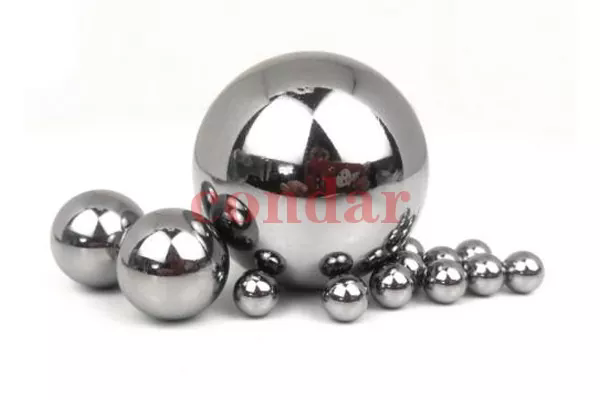
What Material Characteristics Separate 420 from 440C?
The principal difference between AISI 420 and AISI 440C lies in their chemical composition and response to heat treatment. Both are magnetic, hardenable stainless steels, making them useful where a component needs greater hardness than conventional austenitic stainless grades can generally provide in their annealed condition.
AISI 420 typically contains approximately 12 to 14 percent chromium, with carbon content depending on the specific grade and applicable material specification. Its relatively moderate carbon content allows manufacturers to achieve useful hardness while retaining a practical balance of toughness, machinability in the appropriate condition, and corrosion resistance.
AISI 440C generally contains approximately 0.95 to 1.20 percent carbon and 16 to 18 percent chromium. Its higher carbon content supports the formation of hard microstructural constituents after suitable heat treatment. This is one reason the material is widely specified for precision bearings, valve components, and other applications exposed to repeated mechanical contact.
| Material parameter | AISI 420 | AISI 440C |
| Steel family | Martensitic stainless steel | High carbon martensitic stainless steel |
| Typical carbon content | Approximately 0.15 to 0.40 percent for common AISI 420 specifications | Approximately 0.95 to 1.20 percent |
| Typical chromium content | 12 to 14 percent | 16 to 18 percent |
| Heat treatment | Hardening and tempering, subject to grade and process | Hardening and tempering, with close control of temperature and cooling |
| Magnetic behaviour | Magnetic | Magnetic |
| Typical material advantage | Practical hardness and general-purpose wear performance | Higher achievable hardness and strong resistance to abrasive and contact wear |
These composition ranges are general reference values rather than a substitute for the applicable material certificate. Exact chemistry can vary with the specified grade, production standard, and supplier. Our material selection process therefore begins with the customer's drawing, technical specification, and required inspection criteria rather than relying on the grade designation alone.
Another important distinction is that stainless steel does not mean corrosion-proof. Both grades develop a chromium-rich passive film, but their resistance depends on the condition of the surface, heat treatment, cleanliness, and exposure to moisture, chlorides, or aggressive chemicals. Higher chromium content does not automatically guarantee superior corrosion performance in every operating environment.
How Does Hardness Affect Wear Resistance in Industrial Service?
Hardness describes a material's resistance to localized indentation and plastic deformation. Wear resistance is broader: it describes how effectively a component withstands material loss caused by sliding, rolling contact, abrasion, or repeated mechanical interaction. Although hardness often improves resistance to indentation and certain wear mechanisms, it cannot predict service life on its own.
For hardened AISI 420 balls, a representative hardness range is approximately 48 to 55 HRC, although particular specifications and heat treatment conditions can produce different results. Hardened AISI 440C balls commonly fall around 58 to 62 HRC, with some product specifications reporting a wider range depending on the manufacturing process and test method. The actual acceptance range should always be agreed upon before production.
| Performance factor | 420 stainless steel ball | 440C stainless steel ball |
| Typical hardened hardness | Approximately 48 to 55 HRC | Approximately 58 to 62 HRC, depending on specification |
| Resistance to indentation | Suitable for many moderate contact loads | Generally higher under comparable conditions |
| Rolling contact wear | Suitable where the required load and wear limits are compatible with the material | Often preferred for demanding precision rolling contact |
| Abrasive wear | Performance depends on abrasive particles, surface finish, and hardness | Often advantageous where hard particles and repeated contact are significant factors |
| Corrosion considerations | Requires protection in aggressive environments | Also requires protection in aggressive environments despite higher chromium content |
| Selection priority | Balanced performance and cost | Higher hardness and demanding wear requirements |
In bearing applications, higher hardness can help limit permanent deformation at the contact surface and support resistance to rolling contact fatigue. In valve assemblies, it can help a ball retain its geometry when repeatedly contacting a seat. In abrasive environments, it may reduce material removal when hard particles move across the surface. However, the results depend on contact pressure, lubrication, surface roughness, particle size, and the properties of the mating component.
For this reason, we evaluate wear as an operating-system issue rather than a single material number. A harder component can still fail prematurely if it is poorly lubricated, contaminated, incorrectly fitted, or exposed to impact loads beyond its design limits. Excessive contact stress can also damage the mating surface, shifting the wear problem elsewhere in the assembly.
Yuncheng Kangda Steel Ball Co., Ltd. approaches material evaluation by matching the required hardness to the actual duty cycle. For high-cycle rolling contact, the purchaser should consider hardness consistency, dimensional stability, surface finish, and rolling contact fatigue requirements together. Where the load is moderate and the application does not require the higher hardness potential of 440C, 420 may provide an adequate and economical alternative.
Which Grade Performs Better in Corrosive and High-Load Environments?
Corrosion resistance and mechanical wear must be assessed separately. Both materials are martensitic stainless steels, and both can offer useful resistance to atmospheric moisture and relatively mild service conditions. Neither should be assumed suitable for continuous exposure to seawater, concentrated chlorides, or strongly corrosive process fluids without application-specific evaluation.
In many industrial environments, 440C offers a useful combination of high hardness and moderate corrosion resistance. Its chromium content is higher than that of typical AISI 420, but the high carbon content affects how much chromium remains available in the matrix after carbide formation. As a result, the corrosion behaviour of finished components depends on composition, heat treatment, surface condition, and maintenance practices.
AISI 420 may be appropriate for valve mechanisms, pump components, and general industrial hardware where moderate corrosion resistance and useful hardness meet the design requirements. AISI 440C is often selected for precision bearings, high-contact-load mechanisms, and components where wear resistance and dimensional stability are important. These are typical applications, not guarantees that either grade will suit every installation.
Our factory evaluates the service environment alongside mechanical requirements. For example, a precision ball running in a lubricated bearing may experience a different combination of stresses from a ball used in a frequently operated fluid-control valve. The former may be governed by rolling contact fatigue, lubricant cleanliness, and dimensional accuracy, while the latter may face fluid compatibility, seat contact, and intermittent operating loads.
When the environment contains salt spray, chloride-rich water, or aggressive chemicals, engineers should compare alternative materials rather than automatically upgrading from 420 to 440C. AISI 316 may offer better corrosion resistance in many such applications, although its lower achievable hardness means that it may not replace a hardened martensitic grade where severe contact wear is the controlling requirement. The correct choice depends on which failure mechanism presents the greatest risk.
High load also needs a precise definition. Static load, shock loading, repeated rolling contact, and sliding friction place different demands on a component. Higher hardness is beneficial in many contact situations, but toughness, internal material quality, mounting accuracy, and the strength of surrounding parts remain relevant. For a reliable specification, define the load range, rotational speed where applicable, lubricant, operating temperature, and acceptable wear or dimensional change.
What Product Specifications Should Buyers Confirm Before Ordering?
Material grade is only one part of a complete purchasing specification. A precision ball must also meet dimensional, geometric, surface, and inspection requirements appropriate to the assembly. Two balls made from the same steel grade can perform differently if their diameter tolerance, sphericity, surface finish, or heat treatment consistency differs significantly.
At Yuncheng Kangda Steel Ball Co., Ltd., buyers should communicate the following information when requesting a quotation or technical review:
- Material designation: Confirm whether AISI 420 or AISI 440C is required and identify the applicable material standard or customer drawing.
- Nominal diameter: Specify the ball diameter in millimetres or inches, together with the permitted dimensional deviation.
- Hardness requirement: State the required HRC range and whether hardness must be verified for every batch or according to an agreed sampling plan.
- Precision grade: Define the applicable dimensional and geometric tolerance standard, including diameter variation and sphericity where required.
- Surface finish: Specify the required finish according to the application, particularly for bearings, sealing interfaces, and precision mechanisms.
- Operating conditions: Provide information about load, speed, lubrication, moisture, chemical exposure, and expected service life.
- Inspection documentation: Agree on the material certificate, hardness report, dimensional inspection records, and other traceability documents required for acceptance.
Heat treatment deserves particular attention. The final hardness depends on the material chemistry, austenitizing conditions, quenching, tempering, and subsequent processing. A nominal grade does not establish the hardness of a finished ball without confirmation of its actual condition. Buyers should therefore request the agreed hardness range for the finished product instead of relying exclusively on generic material datasheets.
Dimensional accuracy also affects real-world wear. In a bearing, dimensional variation can influence load distribution between rolling elements. In a valve, ball geometry and surface finish may affect contact with the sealing seat. Poorly controlled geometry can create localized stress even when the material itself has excellent hardness. These factors should be reviewed together during supplier qualification.
Finally, confirm how corrosion protection, cleaning, packaging, and storage will be managed. Residual contamination, unsuitable storage conditions, and moisture trapped inside packaging can compromise surface condition before installation. Appropriate handling and inspection help preserve the characteristics established during manufacture.
Frequently Asked Questions About 420 and 440C Material Selection
How Do 420 and 440C Stainless Steel Ball Grades Differ in Hardness and Wear Resistance?
AISI 440C generally achieves higher hardness after suitable heat treatment, commonly around 58 to 62 HRC, compared with approximately 48 to 55 HRC for many hardened AISI 420 specifications. This gives 440C an advantage in many rolling-contact and abrasive-wear applications. Actual wear life still depends on lubrication, contact stress, surface finish, contamination, and heat treatment quality, so the specified hardness and operating conditions should be verified before selection.
Is 440C always more corrosion resistant than 420 in industrial equipment?
No. Although 440C typically contains more chromium, its higher carbon content can lead to chromium carbide formation, affecting the chromium available in the surrounding matrix. The finished component's corrosion performance depends on heat treatment, surface condition, passivation where appropriate, and the service environment. Neither grade should be treated as universally suitable for seawater or concentrated chloride exposure. Where corrosion is the dominant concern, compare other stainless grades against the actual chemical and mechanical requirements.
What information should a buyer provide when specifying precision balls for a new assembly?
Provide the material grade, nominal diameter, dimensional tolerance, required hardness, precision grade, surface finish, operating load, speed, lubrication conditions, and exposure to moisture or chemicals. Also specify the inspection documents and acceptance criteria required for each delivery. These details allow the supplier to assess whether the material and finished-product specifications are suitable for the intended duty instead of quoting solely on diameter and grade.
How Can the Right Material Improve Long-Term Equipment Performance?
The choice between 420 and 440C should follow the application's dominant performance requirement. AISI 420 is a practical option for many general industrial applications requiring useful hardness, wear resistance, and moderate corrosion protection. AISI 440C is often the stronger candidate when higher hardness, precision rolling contact, and resistance to repeated surface loading are central to the design. Neither material eliminates the need for correct lubrication, controlled manufacturing, and appropriate maintenance.
Yuncheng Kangda Steel Ball Co., Ltd. supports material selection by considering the requested grade, finished-product requirements, and intended industrial use. When preparing your next specification, share the drawing, operating conditions, hardness target, and dimensional acceptance criteria with our team. This allows our team to evaluate the technical requirements and help identify a suitable material and manufacturing specification for your application.