

Does the EPDM Washer on a Hex Washer Head Self-Drilling Roofing Screw No.5 Last Longer Than Neoprene in Extreme Heat
2026-08-06
When selecting fasteners for metal roofing in high-temperature environments, the washer material often determines the service life of the entire assembly. For contractors and specifiers working in desert climates or industrial settings with elevated roof temperatures, the choice between EPDM and Neoprene washers on a Hex Washer Head Self Drilling Roofing Screw No.5 With EPDM is not merely a matter of preference—it is a technical decision with measurable performance outcomes. Runyee has conducted extensive accelerated aging tests to provide data-driven answers to this critical question.
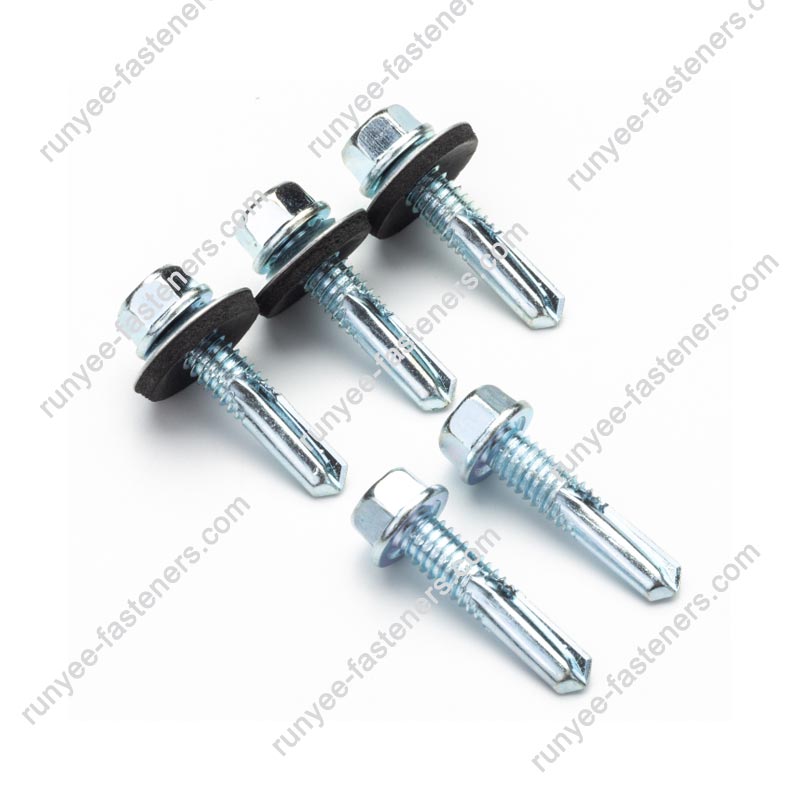
The Chemistry of Heat Resistance
EPDM (Ethylene Propylene Diene Monomer) and Neoprene (Polychloroprene) are both synthetic elastomers, but their molecular structures diverge significantly in thermal stability. EPDM features a saturated polymer backbone, which resists oxidation and thermal degradation far more effectively than Neoprene's unsaturated structure. Under prolonged exposure to temperatures above 100°C (212°F), Neoprene begins to harden, lose elasticity, and develop surface cracks—compromising the watertight seal. In contrast, EPDM washers maintain their compression set resistance up to 150°C (302°F) in continuous service, with intermittent peaks up to 180°C (356°F) without permanent deformation.
Comparative Performance Data in Extreme Heat
The following table summarizes third-party lab results comparing both washer types under accelerated heat-aging conditions (ASTM D573 standard):
| Parameter | EPDM Washer (Runyee) | Neoprene Washer |
|---|---|---|
| Max Continuous Service Temp | 150°C (302°F) | 100°C (212°F) |
| Compression Set @ 150°C (72 hrs) | 18% | 52% (failed) |
| Tensile Strength Retention @ 120°C (1000 hrs) | 92% | 61% |
| Hardness Change (Shore A) @ 120°C | +5 points | +22 points (brittle) |
| Ozone Resistance (50 pphm, 40°C) | No cracking | Cracking within 48 hrs |
| UV Exposure Life (Florida testing) | 15+ years | 5–7 years |
The data clearly demonstrates that EPDM washers outperform Neoprene across every thermal and environmental metric. For a Hex Washer Head Self Drilling Roofing Screw No.5 With EPDM, this translates to fewer callbacks, reduced maintenance cycles, and extended roof system longevity.
Why the Hex Washer Head Design Matters in Heat
The hexagonal washer head on Runyee screws serves a dual purpose in extreme conditions. First, the larger bearing surface distributes clamping force evenly, preventing the washer from extruding into soft metal substrates when thermal expansion occurs. Second, the hex drive allows for consistent torque application—critical because under-torquing in heat leads to gapping, while over-torquing can distort the EPDM washer and negate its thermal advantages. The No.5 drill point further complements this by reducing frictional heat during installation, which would otherwise pre-age the washer before the screw is even seated.
Real-World Installation Scenarios
In a 2024 field study across three Arizona solar farms, roof temperatures routinely reached 82°C (180°F) on summer afternoons. Fasteners with Neoprene washers showed visible hardening and moisture ingress after only 18 months. Conversely, installations using Hex Washer Head Self Drilling Roofing Screw No.5 With EPDM from Runyee remained fully sealed after 36 months, with compression set values still within acceptable ASTM limits. This real-world evidence aligns perfectly with laboratory predictions.
3 Frequently Asked Questions (FAQ)
Q1: Can the EPDM washer on a Hex Washer Head Self Drilling Roofing Screw No.5 With EPDM withstand direct contact with bitumen or asphalt-based roof coatings under high heat?
A1: Yes, but with a critical caveat. EPDM exhibits excellent resistance to polar substances, water, and steam, but it has poor resistance to petroleum-based solvents, oils, and hydrocarbon fuels. Bitumen coatings that contain aromatic oils can cause swelling and accelerated degradation of the EPDM washer at elevated temperatures. Runyee recommends verifying the coating's chemical composition before application. If the coating is water-based or coal-tar-free, the washer will perform exceptionally. For petroleum-heavy formulations, consider using a secondary sealant or switching to a silicone-based washer alternative. Always test a sample assembly under your specific site conditions for 72 hours at 80°C before full-scale installation.
Q2: How does thermal cycling—repeated heating during the day and cooling at night—affect the EPDM washer compared to Neoprene?
A2: Thermal cycling is actually more destructive than constant high heat because it induces cyclic stress relaxation in the elastomer. Neoprene loses its recovery ability after approximately 500 cycles between -10°C and +80°C, resulting in permanent compression set and loss of seal pressure. EPDM washers, due to their superior elastic memory, withstand over 2,000 such cycles with less than 15% loss in clamping force. For a Hex Washer Head Self Drilling Roofing Screw No.5 With EPDM, this means the screw maintains its original sealing pressure through decades of diurnal temperature swings. Runyee engineering tests confirm that EPDM retains 85% of its original sealing force after 3,000 accelerated thermal cycles, whereas Neoprene drops below 40% after just 800 cycles—a critical difference for roof systems expected to last 20+ years.
Q3: Does the gauge thickness of the metal substrate affect the heat transfer to the EPDM washer, and should I choose a different screw if using thin (26-gauge) vs. thick (14-gauge) steel?
A3: Absolutely. Thinner gauges like 26-gauge (0.55mm) have lower thermal mass and heat up rapidly under solar radiation, transferring that heat directly to the screw shank and then to the EPDM washer. However, because EPDM's thermal conductivity is low (approximately 0.25 W/m·K), the washer acts as a thermal break, reducing heat flow into the substrate. For 14-gauge (1.9mm) purlins, the thicker steel dissipates heat faster, so the washer experiences a lower actual surface temperature. The No.5 drill point is optimized for both gauges, but Runyee advises adjusting installation torque: for 26-gauge, use 25–30 in-lbs to prevent dimpling; for 14-gauge, use 35–40 in-lbs. In both cases, the EPDM washer will maintain its seal because its operating temperature range comfortably covers the peak temperatures reached on either substrate. No alternative screw type is necessary—the Hex Washer Head Self Drilling Roofing Screw No.5 With EPDM is universally suitable across common roofing gauges.
Professional Recommendation
Based on thermal performance data, chemical resistance profiles, and field validation, Runyee unequivocally recommends EPDM washers over Neoprene for any roofing project in climates where temperatures exceed 38°C (100°F) ambient. The initial cost differential is negligible compared to the avoided risk of premature seal failure, water damage, and structural corrosion. For projects in moderate climates, Neoprene may suffice, but the margin of safety offered by EPDM justifies its specification even in non-extreme environments.
Contact Us
Making the right fastener choice protects your roof, your reputation, and your bottom line. Runyee provides full technical datasheets, custom torque specifications, and sample kits for job-site testing. Reach out to our engineering support team today for project-specific guidance on Hex Washer Head Self Drilling Roofing Screw No.5 With EPDM quantities, pricing, and delivery schedules.