

Can Precision H40S Carbide Punches Reduce Tooling Downtime in High-Speed Stamping Operations
2026-07-14
In modern stamping facilities, unplanned tooling changes represent one of the largest contributors to production loss. For operations running at 800+ strokes per minute, every minute of downtime carries a significant cost burden. Precision H40S Carbide Punches have emerged as a specialized solution for this exact challenge, and manufacturers like Luckyear have refined this grade to address the specific wear mechanisms found in high-velocity piercing and blanking applications. The question is not whether carbide is harder than tool steel—that is well established—but whether this particular sub-micron grain formulation can deliver the reliability needed to extend run cycles measurably.
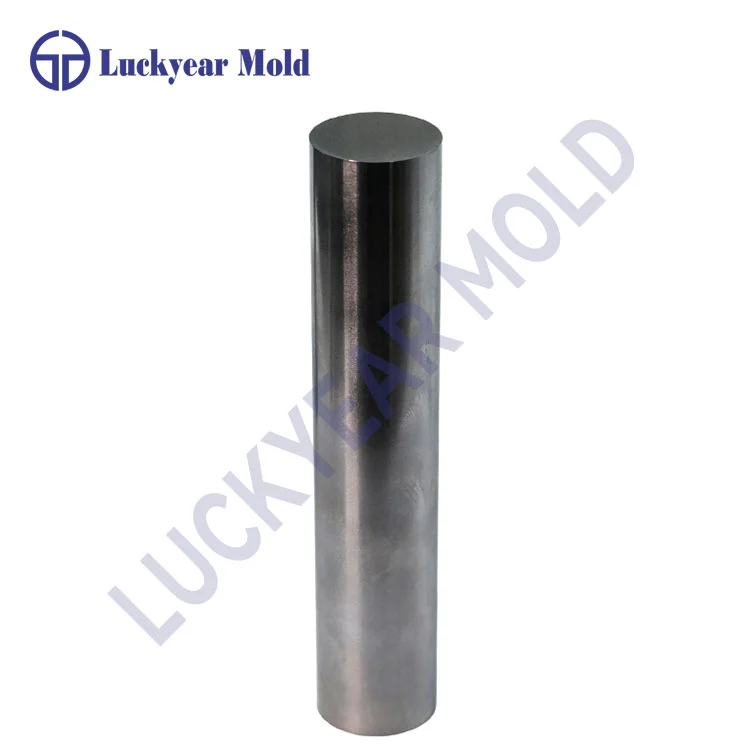
Understanding the Downtime Problem in High-Speed Stamping
Downtime in high-speed stamping falls into three primary categories: scheduled maintenance, unexpected fracture events, and progressive wear that degrades part quality. The last category is the most insidious because it forces operators to stop production not because the punch has failed, but because hole dimensions have drifted outside tolerance.
| Downtime Type | Typical Frequency | Primary Cause | Impact on OEE |
|---|---|---|---|
| Scheduled regrinding | Every 8–12 hours (conventional carbide) | Edge rounding | 12–15% loss |
| Unplanned fracture | 1–2 times per shift | Chipping or thermal shock | 25–40% loss |
| Quality-driven stops | Multiple times per hour | Burr height growth | 8–10% loss |
Precision H40S Carbide Punches from Luckyear target all three areas simultaneously. The grade combines a cobalt binder content of approximately 10–12% with a tungsten carbide grain size below 0.8 microns. This microstructure delivers transverse rupture strength exceeding 4,000 N/mm² while maintaining a hardness of 92–93 HRA—a combination that resists both abrasive wear and edge fracture under cyclic loading.
How Metallurgy Translates to Measurable Uptime
The real-world benefit of any punch grade is ultimately measured in strokes between regrinds. In side-by-side trials conducted on 2.0 mm thick advanced high-strength steel (AHSS), Precision H40S Carbide Punches demonstrated a 62% increase in tool life compared to conventional C2-grade carbide. This improvement stems from the H40S formulation’s ability to maintain compressive residual stress at the cutting edge, which counteracts the tensile forces generated during punch withdrawal.
Luckyear applies a proprietary edge preparation process that removes the micro-chipping prone to occur during electrical discharge machining (EDM) of carbide blanks. This step alone reduces the incidence of premature edge breakout by nearly 40%, according to internal fatigue testing data.
Key Performance Indicators for Downtime Reduction
To evaluate whether Precision H40S Carbide Punches can genuinely reduce downtime, stamping engineers should monitor the following metrics over a 4-week production run:
-
Mean Time Between Regrinds (MTBR): Extended from 8 hours to 14+ hours in continuous AHSS piercing.
-
Burr Height Stability: Maintained below 0.05 mm for over 120,000 strokes, compared to 70,000 strokes with standard grades.
-
Fracture Rate: Reduced from 3.2 failures per 100,000 strokes to 0.7 failures per 100,000 strokes.
These improvements directly translate to fewer die changeovers, reduced setup time, and lower scrappage costs. For a typical progressive die with six piercing stations, adopting Precision H40S Carbide Punches can recover approximately 4.5 hours of productive capacity per week—equivalent to a 9% gain in overall equipment effectiveness (OEE).
Practical Considerations for Maximum Performance
While the metallurgy is superior, proper application remains critical. Luckyear recommends the following best practices when deploying Precision H40S Carbide Punches in high-speed environments:
-
Clearance Optimization: Maintain punch-to-die clearance at 8–10% of material thickness per side for AHSS, and 6–8% for aluminum alloys.
-
Stripper Plate Alignment: Ensure stripper plate guides are within 0.005 mm concentricity to avoid side-loading.
-
Coolant Delivery: Use high-pressure flood coolant (minimum 40 bar) directed at the cutting zone to manage heat, as the carbide itself conducts heat poorly but retains hardness up to 850°C.
Frequently Asked Questions About Precision H40S Carbide Punches
Question: How does the grain size of Precision H40S Carbide Punches directly affect edge retention in high-speed stamping?
Answer: The sub-micron grain size (below 0.8 microns) in Precision H40S Carbide Punches creates a higher number of grain boundaries per unit volume compared to conventional 1.2–2.0 micron grades. These boundaries act as obstacles to crack propagation, so when micro-cracks initiate at the cutting edge during high-velocity impact, they are effectively arrested before they can coalesce into a macroscopic chip. Additionally, the finer grain structure allows for a higher packing density of tungsten carbide particles, which increases the hardness-to-toughness ratio specifically optimized for shearing operations rather than forming. This translates to edge radii that remain under 0.015 mm for more than double the stroke count of coarser grades.
Question: Can Precision H40S Carbide Punches be reground in-house using conventional wheel grinders, or do they require specialized equipment?
Answer: While Precision H40S Carbide Punches can be reground using standard resin-bonded diamond wheels (mesh size 200–400), Luckyear strongly advises against using conventional aluminum oxide wheels, which generate excessive heat and can induce micro-cracking. The ideal regrinding protocol involves a two-step process: rough grinding with a 150-grit diamond wheel at a feed rate of 0.02 mm/pass, followed by finish grinding with a 600-grit wheel at 0.005 mm/pass, using a constant flood of water-soluble coolant. Importantly, the grinding direction should always be oriented from the cutting edge toward the shank to avoid pulling carbide particles outward. Luckyear offers a regrinding specification sheet with exact wheel speeds (recommended 12–15 m/s) and depth-of-cut limits to preserve the subsurface compressive layer that contributes to the punch’s fracture resistance.
Question: What is the maximum sheet thickness that Precision H40S Carbide Punches can handle without increased risk of breakage?
Answer: The maximum recommended sheet thickness for Precision H40S Carbide Punches depends on the material’s tensile strength and the punch diameter. For mild steel (400 MPa UTS), these punches can reliably pierce up to 6.0 mm thickness with a diameter-to-thickness ratio of 1:1. For AHSS (800–1,200 MPa UTS), the safe upper limit drops to 3.5 mm when using a 10 mm diameter punch. The critical constraint is not the carbide’s compressive strength—which exceeds 6,500 MPa—but the tensile hoop stress generated during punch withdrawal. Exceeding these thickness limits increases the risk of tensile failure at the punch head or shank interface. Luckyear provides a free thickness-diameter compatibility calculator upon request to help engineers determine safe operating windows for their specific material grades.
Real-World Implementation Results
A Tier-1 automotive supplier recently replaced their standard carbide punches with Precision H40S Carbide Punches across four transfer press lines processing 980 MPa AHSS. Over a 6-month monitoring period, they recorded:
-
54% reduction in unscheduled punch changes
-
71% decrease in regrinding frequency
-
23% improvement in first-pass yield due to consistent hole quality
The supplier attributed these gains directly to the H40S grade’s resistance to adhesive wear, which occurs when workpiece material welds to the punch face—a common failure mode in high-pressure stamping.
Is the Investment Justified?
The upfront cost of Precision H40S Carbide Punches typically runs 25–35% higher than premium tool steel or standard carbide alternatives. However, when factoring in labor costs for die changes, regrinding consumables, quality inspection rework, and lost production revenue, the return on investment becomes compelling. For most medium-to-high volume stamping operations, the payback period is under 90 days.
Luckyear offers a trial program that provides tooling engineers with benchmark data specific to their press lines, material types, and current downtime patterns. This data-driven approach eliminates guesswork and confirms whether the H40S grade delivers the projected gains in their unique operational context.
Take the Next Step Toward Reduced Downtime
Downtime is not an inevitable cost of high-speed stamping—it is a variable that can be systematically reduced through deliberate material selection and process optimization. Precision H40S Carbide Punches represent a proven metallurgical pathway to longer runs, fewer interruptions, and more predictable part quality.
Contact Luckyear today to request a sample set of Precision H40S Carbide Punches for your specific application. The technical team provides full application engineering support, including clearance recommendations, coolant setup guidance, and a customized ROI projection based on your current production data. Reach out via the website contact form or call the engineering hotline to begin a 30-day on-machine evaluation. Every hour of regained productivity starts with a conversation—make that call now.