

Can an Omnidirectional Buffering and Shock-Absorbing Hard Box Really Withstand High-Impact Drops and Vibration
2026-10-29
When equipment failures happen in the field, the root cause is often packaging that was never engineered for real-world impact. An omnidirectional buffering and shock-absorbing hard box from Weishuo is built to answer that challenge directly, combining multi-axis cushioning with a rigid outer shell to protect sensitive contents from drops, shocks, and sustained vibration. This article examines the engineering principles, test data, and practical limits behind that protection.
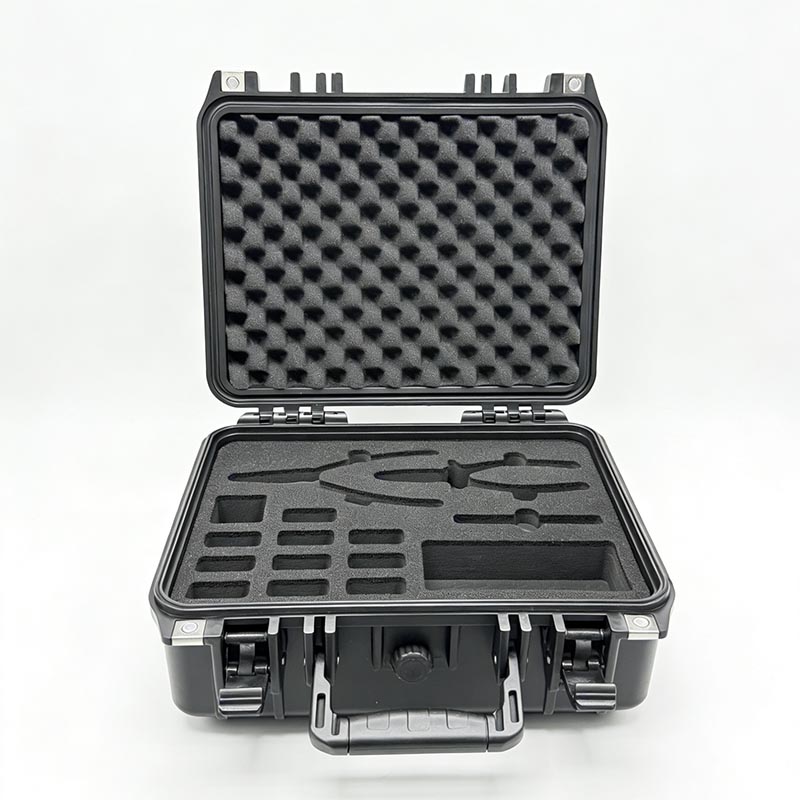
How Omnidirectional Protection Works
Conventional cases absorb force along one or two axes. Weishuo designs its omnidirectional buffering and shock-absorbing hard box to manage energy from every direction through three coordinated layers.
| Layer | Function | Typical Material |
|---|---|---|
| Outer shell | Distributes impact loads, resists penetration | High-impact PP or engineering resin |
| Buffering core | Converts kinetic energy into controlled deformation | EVA foam, TPU, or honeycomb structure |
| Inner lining | Cradles the device, prevents micro-movement | Custom-cut foam or flocked liner |
Key Performance Factors
-
Drop height rating: Determines the maximum free-fall the box survives with contents intact.
-
G-force attenuation: Measures how much peak acceleration reaches the payload.
-
Vibration transmissibility: Indicates how well the box isolates low-frequency and random vibration.
-
Sealing integrity: Prevents dust and moisture ingress after impact.
-
Reusability: Confirms the buffering core recovers rather than permanently deforming.
Test Standards That Matter
| Standard | What It Verifies |
|---|---|
| ISTA 1A / 2A | Package performance under drops and vibration |
| ASTM D4169 | Distribution cycle simulation |
| MIL-STD-810H (516.8, 514.8) | Shock and vibration resilience |
| IEC 60529 | Ingress protection after mechanical stress |
Weishuo validates its omnidirectional buffering and shock-absorbing hard box against these protocols, and independent lab reports are available for project qualification.
Realistic Limits
No case is indestructible. Protection depends on payload mass, drop orientation, temperature, and whether the buffering core has been compromised by prior impacts. Users should match the box rating to the actual risk profile of the transport route rather than assuming a single specification covers all scenarios.
Frequently Asked Questions
Q: Can an omnidirectional buffering and shock-absorbing hard box survive repeated drops without losing protective performance?
A: Yes, provided the buffering core is designed for elastic recovery. Weishuo tests repeated drop cycles and verifies that foam compression set stays within tolerance, so the omnidirectional buffering and shock-absorbing hard box retains its energy-absorption capacity across multiple impacts.
Q: Does an omnidirectional buffering and shock-absorbing hard box protect against vibration during long-distance transport?
A: It does when the buffering layer is tuned to the payload's resonant frequency. Weishuo selects foam density and structure to reduce vibration transmissibility, which is why the omnidirectional buffering and shock-absorbing hard box performs well in truck, rail, and air freight environments.
Q: How do I choose the right omnidirectional buffering and shock-absorbing hard box for my equipment?
A: Start with payload weight, fragility, and transport route. Then match drop height rating, G-force attenuation, and ingress protection to those requirements. Weishuo provides application engineering support to help specify the correct omnidirectional buffering and shock-absorbing hard box configuration.
For specification sheets, test reports, or a custom protection assessment, contact us at Weishuo today and let our engineering team match the right omnidirectional buffering and shock-absorbing hard box to your application.