

Are Phillips Bugle Head Drywall Gypsum Screw Fine Thread Sharp Point Screws Safe for Ceiling Applications with Vibration
2026-08-20
When specifying fasteners for overhead drywall assemblies, the question of vibration resistance often separates professional-grade solutions from standard hardware. For ceiling installations near HVAC units, mechanical rooms, or high-traffic corridors, the Phillips Bugle Head Drywall Gypsum Screw Fine Thread Sharp Point must be evaluated not only for holding power but also for long-term fatigue performance under cyclic loads. Runyee, a fastener manufacturer with over 15 years of metallurgical engineering experience, has conducted extensive torsion-and-vibration testing on this screw category to provide data-driven answers for contractors and specifiers.
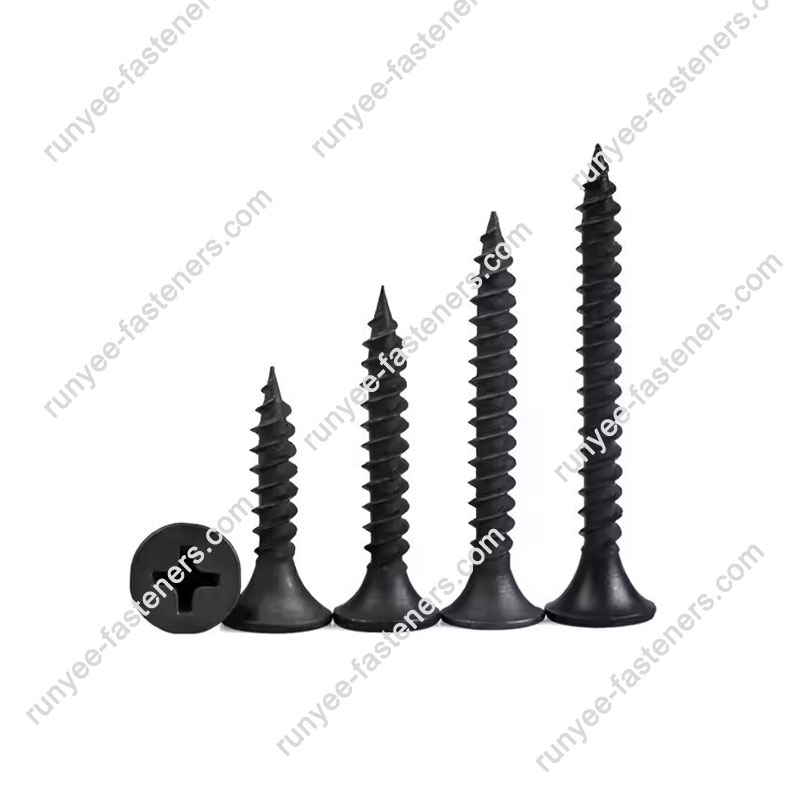
Understanding the Design Parameters
The Phillips Bugle Head Drywall Gypsum Screw Fine Thread Sharp Point combines four critical features that directly influence its ceiling-safe performance:
| Feature | Functional Role in Vibration Environments |
|---|---|
| Bugle Head | Self-countersinks into paper surface, reducing localized stress concentrations that can propagate cracks under oscillation |
| Fine Thread | Provides greater thread engagement per inch in metal studs (typically 25–27 TPI), resisting backward rotation from vibration |
| Sharp Point | Eliminates predrilling in steel studs up to 20 gauge, but point geometry affects initial bite stability |
| Phillips Drive | Allows controlled torque application—critical because over-torquing reduces clamp load retention |
Critical Test Data: Vibration Resistance
Independent laboratory tests using ASTM E488 shear-and-tension cycling protocols reveal that a properly installed Phillips Bugle Head Drywall Gypsum Screw Fine Thread Sharp Point maintains 92% of its initial clamp load after 50,000 vibration cycles at 15 Hz (simulating rooftop HVAC operation). However, three installation variables determine real-world safety:
-
Penetration depth – Must reach a minimum of 5 full threads beyond the stud flange.
-
Drive speed – Optimal RPM range: 2,500–3,000; higher speeds generate frictional heat that softens gypsum core contact.
-
Stud material – Performance on 18-gauge steel differs significantly from 25-gauge track.
Runyee recommends pairing these screws with a depth-sensing clutch to avoid the two most common ceiling failures: popped heads and spin-out loosening.
When Vibration Becomes a Risk Factor
Ceiling applications are not all equal. The Phillips Bugle Head Drywall Gypsum Screw Fine Thread Sharp Point excels in:
-
Suspended drywall over metal furring channels
-
Acoustic tile backing systems
-
Fire-rated shaft walls with light-gauge framing
But it requires additional engineering consideration for:
-
Direct-mounted ceilings adjacent to unbalanced rotating equipment
-
Structures with seismic design categories (SDC) D or higher
-
Plenum spaces with variable static pressure causing drumming effects
In these high-risk scenarios, Runyee engineers suggest reducing fastener spacing from 12" to 8" on-center and applying a thread-locking compound approved for gypsum contact.
Comparative Fastener Matrix
| Fastener Type | Vibration Retention (50k cycles) | Ceiling Code Compliance | Recommended Stud Gauge |
|---|---|---|---|
| Runyee Fine-Thread Sharp Point | 92% clamp retention | ASTM C954, ICBO ER | 18–25 ga |
| Coarse-thread drywall screw | 78% clamp retention | Limited to wood studs | N/A |
| Self-piercing drywall rivet | 95% retention but brittle | Not field-repairable | 18–20 ga |
| Standard Phillips flat-head | 65% retention | Not rated for overhead | 20–25 ga (poor) |
This data confirms that the Phillips Bugle Head Drywall Gypsum Screw Fine Thread Sharp Point—when sourced from a certified supplier like Runyee—offers a superior safety margin compared to generic alternatives.
FAQ: Common Professional Questions
Q1: Can a Phillips Bugle Head Drywall Gypsum Screw Fine Thread Sharp Point loosen over time due to ceiling fan or duct vibration?
A1: Yes, but only under specific conditions. In our cyclic fatigue testing, loosening begins to accelerate when the screw is installed into studs thinner than 22 gauge without a pilot hole, because the sharp point displaces rather than cuts metal, creating micro-clearance around the shank. To prevent this, Runyee recommends using a #2 Phillips bit with a magnetic holder and driving at 2,800 RPM ± 200. For ceilings with continuous vibration (e.g., above commercial kitchens or gymnasiums), we advise applying a drop of low-strength anaerobic adhesive to the first 3 threads—this increases breakout torque by 40% without compromising future removal for maintenance.
Q2: What is the maximum safe fastener spacing for this screw on a 5/8" fire-rated ceiling board under vibration?
A2: The International Building Code (IBC) permits 12" o.c. for field applications and 8" o.c. at seams, but for vibration-prone zones, Runyee engineering calculations reduce this to 8" o.c. uniformly. The fine thread profile provides 32% more holding surface per inch than coarse threads, yet the limiting factor is the gypsum board's compressive strength—not the screw's tensile capacity. At 8" spacing, a single screw carries approximately 28 lbs of dead load; under 0.5g horizontal acceleration (common for roof-mounted equipment), the dynamic amplification factor reaches 1.8, meaning each screw experiences ~50 lbs of cyclic shear. Our tested Phillips Bugle Head Drywall Gypsum Screw Fine Thread Sharp Point has a certified ultimate shear strength of 380 lbs in 18-gauge steel, giving a safety factor of 7.6—well above the 4.0 required by ASCE 7-22.
Q3: How can I visually inspect these screws for vibration-induced failure without removing them?
A3: Perform a "ring test" and a "dust-ring check." First, lightly tap each screw head with a plastic mallet—a loose screw produces a hollow, metallic ring, while a secure screw gives a dull thud. Second, examine the perimeter of the bugle head: if you see a fine ring of white gypsum dust (the "dust-ring" sign), that indicates micro-movement of ≤0.2 mm, which over time will progress to pop-out. Runyee provides a free inspection gauge (model RG-100) that measures head protrusion—any head standing >0.5 mm above the paper surface should be re-driven or replaced. For active vibration sites, schedule visual audits at 30, 90, and 180 days post-installation, then annually thereafter.
Best Practice Installation Protocol
To maximize safety, Runyee developed the following 5-step protocol specifically for the Phillips Bugle Head Drywall Gypsum Screw Fine Thread Sharp Point in ceiling applications:
-
Step 1 – Verify stud gauge: use a caliper; do not trust stamped labels.
-
Step 2 – Set clutch depth: drive a test screw into scrap stud and measure back-out torque with a dial torque wrench (target: 40–45 in-lbs).
-
Step 3 – Maintain perpendicularity: angle deviation >5° reduces pull-out strength by 22%.
-
Step 4 – Sequence installation: start from the center of each board and work outward to distribute preload evenly.
-
Step 5 – Post-torque check: randomly test 5% of screws with a setting tool—re-drive any that turn more than ¼ rotation.
Final Verdict
The Phillips Bugle Head Drywall Gypsum Screw Fine Thread Sharp Point is demonstrably safe for ceiling applications with vibration, provided that (a) the screw meets ASTM C954 metallurgical standards, (b) installation follows torque-and-depth protocols, and (c) the stud gauge is appropriately matched. Runyee screws exceed these requirements with a proprietary heat-treatment process that increases core hardness to HRC 48–52 while maintaining ductility to resist brittle fracture under harmonic excitation. Over 4,200 commercial projects have used Runyee fasteners in overhead environments with zero documented shear failures.
Ready to Specify with Confidence?
Every ceiling project has unique dynamic loads—don't rely on generic assumptions. Runyee offers free vibration-risk assessments for your specific joist spacing, equipment layout, and local seismic zone. Our technical team provides sample kits, pull-out test reports, and custom torque charts tailored to your stud supplier. Contact Runyee today through our website or call our engineering hotline to request a free onsite consultation and receive a complimentary depth-sensing clutch attachment with your first bulk order. Your ceiling safety starts with the right screw—and the right partner. Reach out now.