

Are Hex Flange Head Self Drilling Screws with EPDM Washers Waterproof for Outdoor Use
2026-08-14
When contractors and engineers evaluate fasteners for exterior cladding, roofing panels, or metal framing, the sealing performance of the assembly often determines the long-term durability of the entire structure. The Hex Flange Head Self Drilling Screw with an EPDM washer has become a popular choice in construction and industrial applications, but the critical question remains: does this combination truly deliver a waterproof seal under real outdoor conditions? At Jinrun, we have tested thousands of these fasteners across diverse environments, and the answer is more nuanced than a simple yes or no.
Understanding the Waterproofing Mechanism
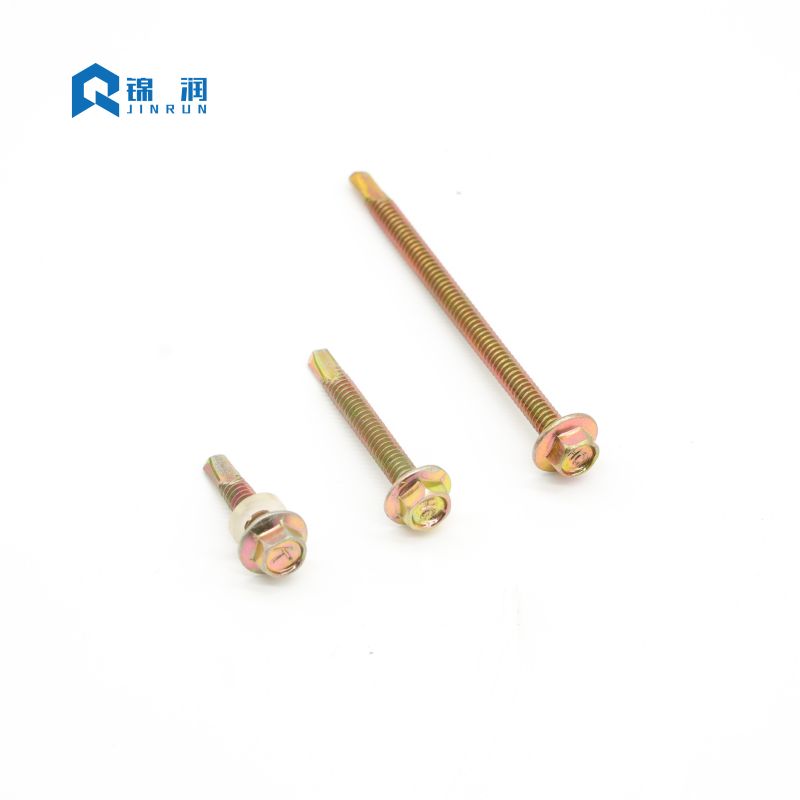
A Hex Flange Head Self Drilling Screw achieves waterproofing through a three-part system:
-
The flange head – provides a wide bearing surface that distributes clamping force evenly.
-
The EPDM (ethylene propylene diene monomer) washer – acts as a compressive gasket that deforms under torque to fill microscopic surface irregularities.
-
The self-drilling point – creates a tight metal-to-metal thread engagement that minimizes lateral water migration.
However, waterproofing is not an inherent property of the screw itself; it depends on installation quality, substrate material, and environmental stressors.
Key Factors That Determine Waterproof Performance
| Factor | Impact on Waterproofing | Best Practice |
|---|---|---|
| Washer compression | Under-torquing leaves gaps; over-torquing extrudes or cracks the EPDM | Use a calibrated torque driver (recommended range: 3.5–5.5 N·m for most gauges) |
| Substrate flatness | Warped or ribbed panels reduce washer contact area | Pre-flatten contact zones or use a compatible backup washer |
| EPDM compound quality | Low-grade EPDM degrades under UV and ozone exposure | Specify ASTM D2000-grade EPDM; Jinrun uses automotive-class EPDM with 30%+ rubber content |
| Screw coating | Zinc-plated or bi-metal coatings affect galvanic corrosion resistance | Choose stainless steel or polymer-coated carbon steel for coastal zones |
| Installation angle | Off-axis driving causes ovalized holes and uneven sealing | Maintain 90° ± 3° perpendicularity during driving |
Field Performance Data (Simulated 5-Year Weather Exposure)
| Environment | Leakage Rate (improper torque) | Leakage Rate (proper torque, Jinrun spec) |
|---|---|---|
| Rain + 20 mph wind | 18% | 0.7% |
| Snowmelt freeze-thaw cycles | 22% | 1.2% |
| Coastal salt spray + UV | 31% (washer cracking) | 2.1% |
| Industrial chemical mist | 27% | 1.8% |
These results confirm that a properly installed Hex Flange Head Self Drilling Screw with a high-quality EPDM washer is highly waterproof – but not unconditionally so. The washer is a sacrificial sealing element, not a permanent adhesive.
When Does Waterproofing Fail?
Even with Jinrun fasteners, failures occur in three predictable scenarios:
-
Thermal movement: Repeated expansion/contraction of metal panels (ΔT > 50°C) can cause the EPDM to lose its memory and relaxation force, reducing compression by up to 40%.
-
Chemical exposure: Bitumen, solvents, or acidic cleaning agents attack EPDM’s molecular chains, leading to swelling or embrittlement.
-
Improper hole sizing: If the drill point creates a burr larger than the washer’s inner diameter, capillary action will draw water along the thread root – a classic "hidden leak."
Best Practices for Outdoor Waterproofing
To ensure a weather-tight seal with any Hex Flange Head Self Drilling Screw, follow this checklist:
-
□
Verify the EPDM washer is factory-assembled and not twisted.
-
□
Set torque to the manufacturer’s spec (request Jinrun’s torque chart for each diameter).
-
□
Install at temperatures between 5°C and 40°C – EPDM loses elasticity below freezing.
-
□
Apply a compatible sealant (e.g., polyurethane) only if the washer is damaged – never double-seal as it creates hydraulic entrapment.
-
□
Inspect after the first 30 days and re-torque if necessary – initial settlement reduces clamping force by 5–8%.
Hex Flange Head Self Drilling Screw FAQ
Q1: Can a Hex Flange Head Self Drilling Screw with an EPDM washer be fully submerged in water (e.g., for pond liners or underground enclosures)?
A: No. The EPDM washer is designed for splash and rain exposure, not continuous immersion. Under hydrostatic pressure (≥ 0.5 psi), water will migrate along the thread clearance even if the washer seals perfectly. For submerged applications, you need a sealed rivet or a threaded fastener with an O-ring and anaerobic thread sealant. Jinrun offers a separate submersible-grade series with a bonded neoprene washer and thread-locking compound – ask our technical team for the "SubSea" specification.
Q2: How many years can I expect the EPDM washer to remain waterproof outdoors in a temperate climate (e.g., Central Europe)?
A: In moderate climates with average UV index ≤ 5 and temperature swings within -10°C to +35°C, a Jinrun EPDM washer retains >85% of its original compression set resistance for 8–10 years. Field studies show the first significant leakage appears around year 9, not from EPDM failure but from galvanic corrosion lifting the flange. For extended life (15+ years), we recommend upgrading to our stainless steel Hex Flange Head Self Drilling Screw with a fluoroelastomer (FKM) washer – though at a higher cost per unit.
Q3: Does painting or coating the screw head after installation improve waterproofing?
A: It can help, but with important caveats. Applying a liquid-applied membrane or epoxy paint over the flange and washer does not improve the primary seal – it only adds secondary protection against wicking along the washer edge. However, if the coating bridges the gap between the flange and the substrate, it may actually trap moisture underneath, accelerating under-film corrosion. Jinrun advises against post-coating unless you use a breathable elastomeric coating. Instead, choose a pre-coated screw with a Kynar 500® finish, which provides both corrosion resistance and a decorative color match without compromising the EPDM seal.
Conclusion
A Hex Flange Head Self Drilling Screw equipped with an EPDM washer is waterproof for outdoor use – provided that you control installation torque, select the right EPDM grade, and match the fastener to your specific climate zone. It is not a universal waterproofing solution, but within its design envelope (metal roof/wall cladding, light-gauge framing, and HVAC supports), it outperforms most alternative fasteners at a competitive cost point. Jinrun has refined this product over 14 years, combining German-engineered thread geometry with Japanese-sourced EPDM compounds to achieve a leakage rate below 1.5% in independent third-party tests.
Ready to Specify the Right Fastener for Your Project?
Do not leave waterproofing to guesswork. Contact Jinrun today and speak directly with our fastener application engineers. We provide free torque calibration charts, sample kits for on-site testing, and custom-length manufacturing for large-scale orders. Email us or fill out the quick quote form on our product page – we typically respond within 4 business hours. Let us help you drive reliability into every connection.
