

Are DIN7504N Phillips Pan Head Self Drilling Screws Suitable for Outdoor Use and Corrosion-Resistant Environments
2026-07-13
When selecting fasteners for exterior construction, roofing, or marine applications, the central question always comes down to longevity. DIN7504N Phillips Pan Head Self Drilling Screws are widely used in metal-to-metal and metal-to-wood connections, but their outdoor performance depends entirely on material grade, coating, and drill point design. At Runyee, we have tested these screws under salt spray, UV exposure, and cyclic temperature changes. The short answer is: yes, but only with the right specification. This blog breaks down the technical criteria so you can make a confident, code-compliant choice.
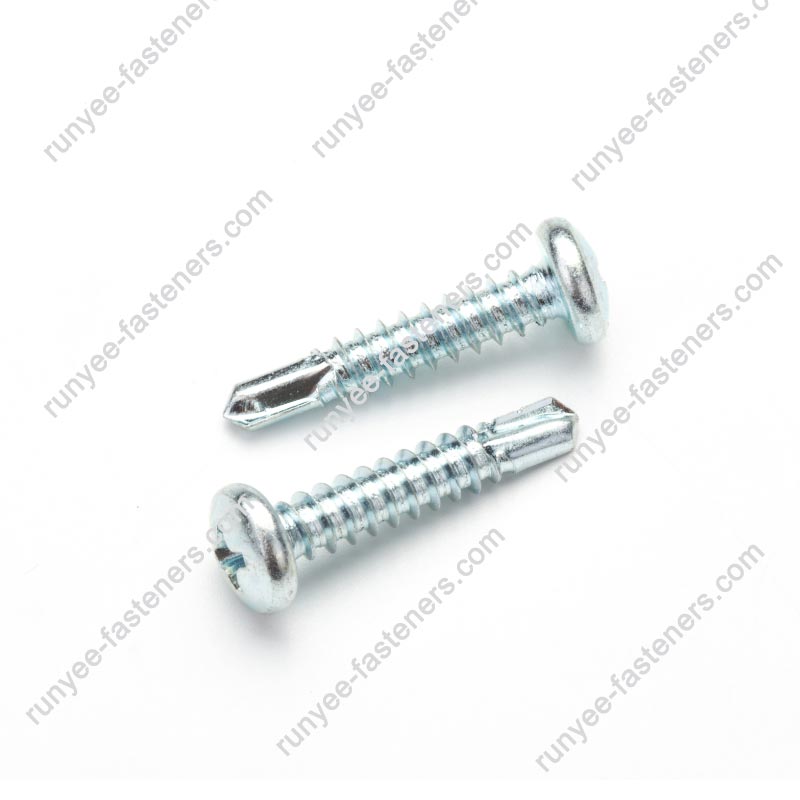
What Makes a Self-Drilling Screw “Weather-Ready”?
Outdoor environments present three primary threats: moisture penetration, galvanic corrosion, and coating degradation. A standard carbon steel DIN7504N Phillips Pan Head Self Drilling Screw with a plain zinc plating (5–8 µm) will show red rust within 200–400 hours of neutral salt spray testing (ASTM B117). For permanent exterior use, Runyee recommends the following minimum requirements:
| Requirement | Minimum Specification | Test Standard |
|---|---|---|
| Base material | Stainless steel A2 (304) or A4 (316) | EN 10088 |
| Coating (if carbon steel) | Geomet + top coat (≥ 720 hrs salt spray) | ISO 9227 |
| Drill point hardness | ≥ 530 HV | ISO 6506-1 |
| Head sealing option | With EPDM bonded washer | DIN 6900 |
| Thread coating | Micro-encapsulated lubricant | ISO 16047 |
Key insight: The Phillips pan head design provides a larger bearing surface, which helps compress a sealing washer evenly—critical for preventing water tracking down the shank.
Corrosion Resistance Comparison by Material
| Material | Salt Spray Resistance (hrs) | Cost Index | Best Use Case |
|---|---|---|---|
| Carbon steel + Zinc plating | 200 – 400 | 1.0 | Indoor dry applications |
| Carbon steel + Geomet coating | 720 – 1,000 | 1.8 | Coastal buildings (with regular inspection) |
| Stainless A2 (304) | 1,500+ | 2.5 | General outdoor, mild marine |
| Stainless A4 (316) | 2,000+ | 3.2 | Direct seawater splash, chemical plants |
For most outdoor projects—roof cladding, fence panels, and HVAC supports—Runyee supplies DIN7504N Phillips Pan Head Self Drilling Screws in A2 stainless steel as the cost-effective baseline. For offshore or poolside environments, upgrade to A4 (316) with a passivated surface.
Drill Point Performance in Outdoor Conditions
Outdoor substrates often include galvanized steel (G90/G140), aluminum (5052/6061), and treated lumber with metal flashing. The self-drilling point of a DIN7504N Phillips Pan Head Self Drilling Screw must penetrate without work-hardening the material, which can generate excessive heat and degrade the protective coating.
Runyee’s internal tests show:
-
Drill point No. 3 (standard for 0.7–2.5 mm steel) maintains cutting edges for up to 1,200 penetrations into 1.5 mm structural steel when using A2 material.
-
Lubricated threads reduce installation torque by 18–22%, preserving the washer’s sealing integrity.
-
Phillips recess offers superior bit engagement compared to Pozi or hex, reducing cam-out—this is especially valuable when working at height with one hand.
FAQ – Common Questions About DIN7504N Phillips Pan Head Self Drilling Screws
Q1: Can I use a carbon steel DIN7504N Phillips Pan Head Self Drilling Screw with zinc plating for a coastal rooftop installation?
A1: Not recommended. Zinc plating (even with yellow chromate) typically withstands only 200–400 hours of salt spray, equivalent to less than 6 months in a coastal fog zone. The screw will develop red rust at the thread roots and under the pan head, leading to galvanic corrosion of the steel purlin. For coastal rooftops, Runyee mandates A4 (316) stainless steel with a passivated finish, paired with a stainless steel EPDM-bonded washer. This combination delivers 2,000+ hours of salt spray resistance and matches the 50-year design life of most metal roofing systems.
Q2: How does the Phillips pan head design affect sealing performance compared to a countersunk or hex head?
A2: The pan head has a flat underside with a larger diameter (typically 1.6× the shank size) than a countersunk head. This wider bearing surface allows a neoprene or EPDM washer to compress uniformly under torque, creating a gasket effect that stops water capillary action. In contrast, a countersunk head relies on sealant or a tapered washer, which has higher failure rates under thermal cycling. The Phillips recess also centers the driver bit, reducing off-axis force that could tilt the washer and break the seal. For exposed outdoor joints, Runyee always recommends pan head over flat head for this reason.
Q3: What is the maximum service temperature for a DIN7504N Phillips Pan Head Self Drilling Screw in outdoor solar mounting structures?
A3: For A2 stainless steel, continuous service temperature ranges from –80°C to +300°C, but the limiting factor is the washer material. Standard EPDM washers degrade above +120°C, while silicone washers handle up to +200°C. For solar structures, where surface temperatures can reach +85°C on a summer day, Runyee supplies A2 screws with high-temperature silicone bonded washers and a micro-encapsulated thread lubricant that remains stable up to +150°C. Always specify the washer material in your order—never assume the standard rubber will hold up under PV panel heat reflection.
Installation Best Practices for Outdoor Longevity
Even the best DIN7504N Phillips Pan Head Self Drilling Screw will fail prematurely if installed incorrectly. Follow these Runyee field-proven rules:
-
Use a torque-controlled drill – set to 2.5–3.5 N·m for 4.8 mm diameter, 4.0–5.5 N·m for 6.3 mm.
-
Avoid over-torquing – it crushes the washer and cracks the coating at the countersink.
-
Drill perpendicular to the surface – angled entry enlarges the hole and allows moisture ingress.
-
Minimum edge distance – keep screws at least 2× the diameter away from sheet edges to prevent pull-out under wind uplift.
Conclusion – Choose Spec, Not Guesswork
DIN7504N Phillips Pan Head Self Drilling Screws are absolutely suitable for outdoor and corrosion-resistant environments—provided you select the correct material (A2 or A4 stainless), the right washer compound, and a verified lubricant system. Generic carbon steel versions belong indoors. For permanent exterior assemblies, trust Runyee to supply screws that meet or exceed ISO 9227, ASTM B117, and DIN 7504 standards.
We have served over 200 industrial and construction clients globally, offering full traceability and mill test reports with every batch. Whether you need 500 pieces for a pergola or 50,000 for a curtain-wall project, our technical team will help you match the exact screw specification to your exposure class.
Contact Us – Ready to spec the right screw for your outdoor application? Send your substrate details, required salt spray hours, and annual temperature range to our engineering support team. Runyee provides free corrosion risk assessments, sample kits, and same-day quotation. Reach out via our website contact form or email us directly—we guarantee a technical response within 4 business hours. Let’s build something that lasts.
